 Add to Chrome
 Add to Firefox
 Add to Edge
Quantum Reservoir Computing with Neutral Atoms on a Small, Complex, Medical Dataset
Feb 16, 2026
Biomarker-based prediction of clinical outcomes is challenging due to nonlinear relationships, correlated features, and the limited size of many medical datasets. Classical machine-learning methods can struggle under these conditions, motivating the search for alternatives. In this work, we investigate quantum reservoir computing (QRC), using both noiseless emulation and hardware execution on the neutral-atom Rydberg processor \textit{Aquila}. We evaluate performance with six classical machine-learning models and use SHAP to generate feature subsets. We find that models trained on emulated quantum features achieve mean test accuracies comparable to those trained on classical features, but have higher training accuracies and greater variability over data splits, consistent with overfitting. When comparing hardware execution of QRC to noiseless emulation, the models are more robust over different data splits and often exhibit statistically significant improvements in mean test accuracy. This combination of improved accuracy and increased stability is suggestive of a regularising effect induced by hardware execution. To investigate the origin of this behaviour, we examine the statistical differences between hardware and emulated quantum feature distributions. We find that hardware execution applies a structured, time-dependent transformation characterised by compression toward the mean and a progressive reduction in mutual information relative to emulation.

Non-native Quantum Generative Optimization with Adversarial Autoencoders
Jul 18, 2024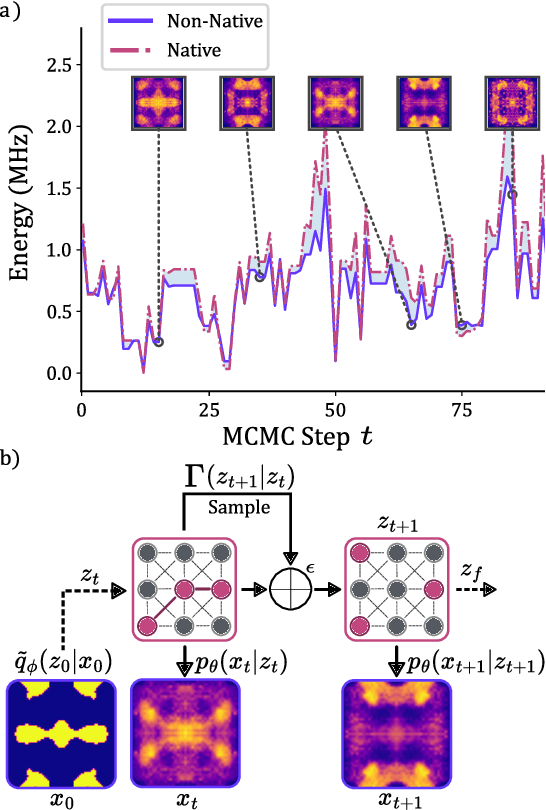
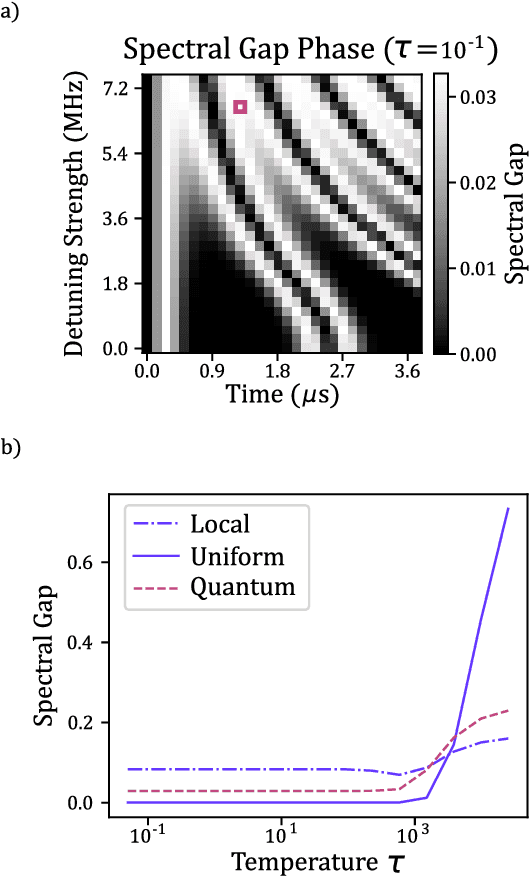
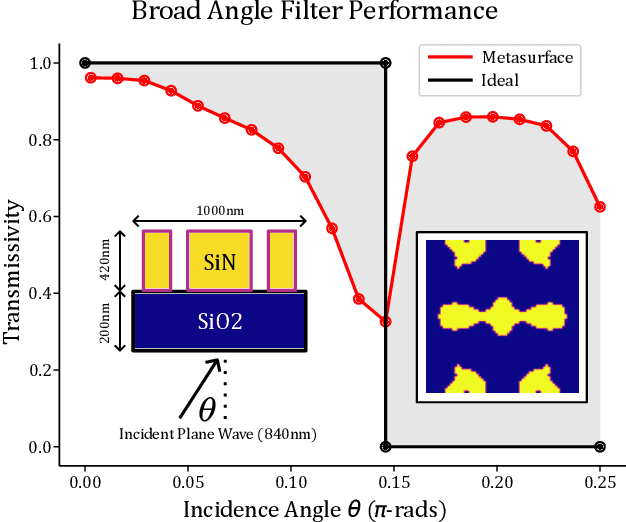
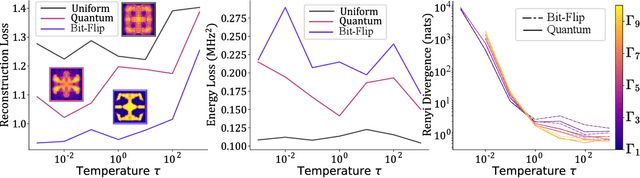
Large-scale optimization problems are prevalent in several fields, including engineering, finance, and logistics. However, most optimization problems cannot be efficiently encoded onto a physical system because the existing quantum samplers have too few qubits. Another typical limiting factor is that the optimization constraints are not compatible with the native cost Hamiltonian. This work presents a new approach to address these challenges. We introduce the adversarial quantum autoencoder model (AQAM) that can be used to map large-scale optimization problems onto existing quantum samplers while simultaneously optimizing the problem through latent quantum-enhanced Boltzmann sampling. We demonstrate the AQAM on a neutral atom sampler, and showcase the model by optimizing 64px by 64px unit cells that represent a broad-angle filter metasurface applicable to improving the coherence of neutral atom devices. Using 12-atom simulations, we demonstrate that the AQAM achieves a lower Renyi divergence and a larger spectral gap when compared to classical Markov Chain Monte Carlo samplers. Our work paves the way to more efficient mapping of conventional optimization problems into existing quantum samplers.