 Add to Chrome
 Add to Firefox
 Add to Edge
Real-Time Drone Detection in Event Cameras via Per-Pixel Frequency Analysis
Mar 09, 2026
Detecting fast-moving objects, such as unmanned aerial vehicle (UAV), from event camera data is challenging due to the sparse, asynchronous nature of the input. Traditional Discrete Fourier Transforms (DFT) are effective at identifying periodic signals, such as spinning rotors, but they assume uniformly sampled data, which event cameras do not provide. We propose a novel per-pixel temporal analysis framework using the Non-uniform Discrete Fourier Transform (NDFT), which we call Drone Detection via Harmonic Fingerprinting (DDHF). Our method uses purely analytical techniques that identify the frequency signature of drone rotors, as characterized by frequency combs in their power spectra, enabling a tunable and generalizable algorithm that achieves accurate real-time localization of UAV. We compare against a YOLO detector under equivalent conditions, demonstrating improvement in accuracy and latency across a difficult array of drone speeds, distances, and scenarios. DDHF achieves an average localization F1 score of 90.89% and average latency of 2.39ms per frame, while YOLO achieves an F1 score of 66.74% and requires 12.40ms per frame. Through utilization of purely analytic techniques, DDHF is quickly tuned on small data, easily interpretable, and achieves competitive accuracies and latencies to deep learning alternatives.

PearSAN: A Machine Learning Method for Inverse Design using Pearson Correlated Surrogate Annealing
Dec 26, 2024PearSAN is a machine learning-assisted optimization algorithm applicable to inverse design problems with large design spaces, where traditional optimizers struggle. The algorithm leverages the latent space of a generative model for rapid sampling and employs a Pearson correlated surrogate model to predict the figure of merit of the true design metric. As a showcase example, PearSAN is applied to thermophotovoltaic (TPV) metasurface design by matching the working bands between a thermal radiator and a photovoltaic cell. PearSAN can work with any pretrained generative model with a discretized latent space, making it easy to integrate with VQ-VAEs and binary autoencoders. Its novel Pearson correlational loss can be used as both a latent regularization method, similar to batch and layer normalization, and as a surrogate training loss. We compare both to previous energy matching losses, which are shown to enforce poor regularization and performance, even with upgraded affine parameters. PearSAN achieves a state-of-the-art maximum design efficiency of 97%, and is at least an order of magnitude faster than previous methods, with an improved maximum figure-of-merit gain.
Non-native Quantum Generative Optimization with Adversarial Autoencoders
Jul 18, 2024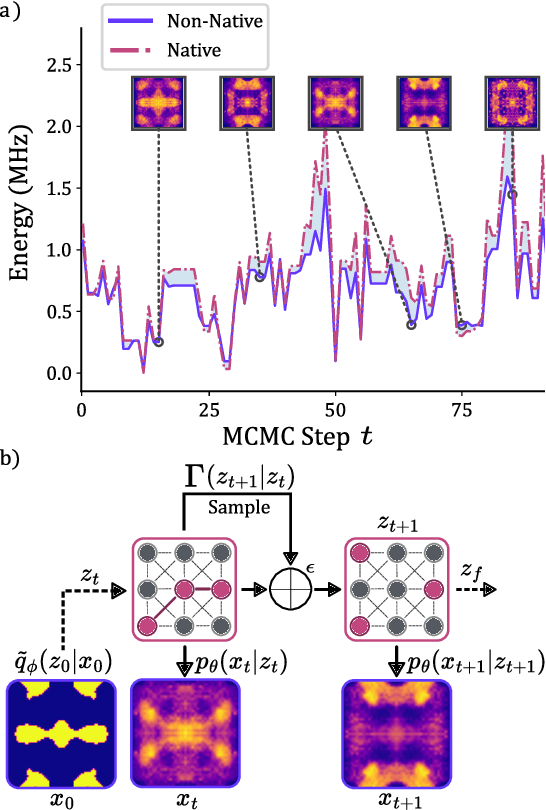
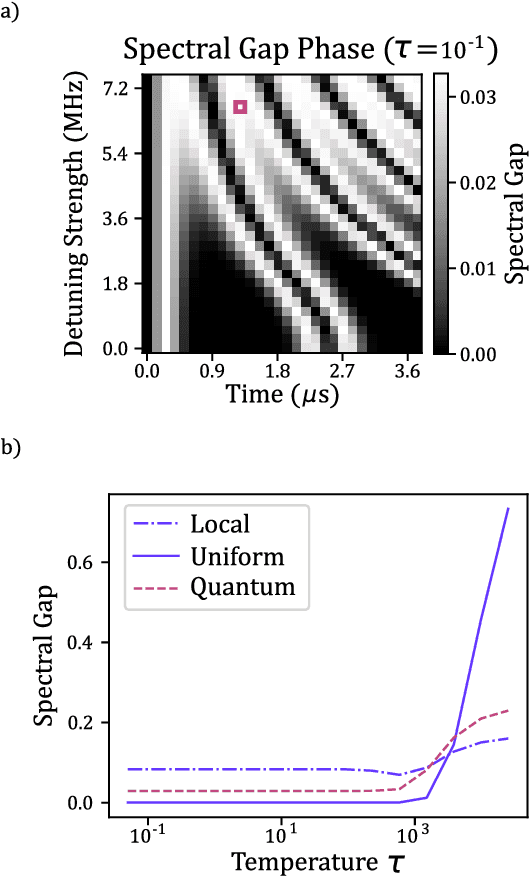
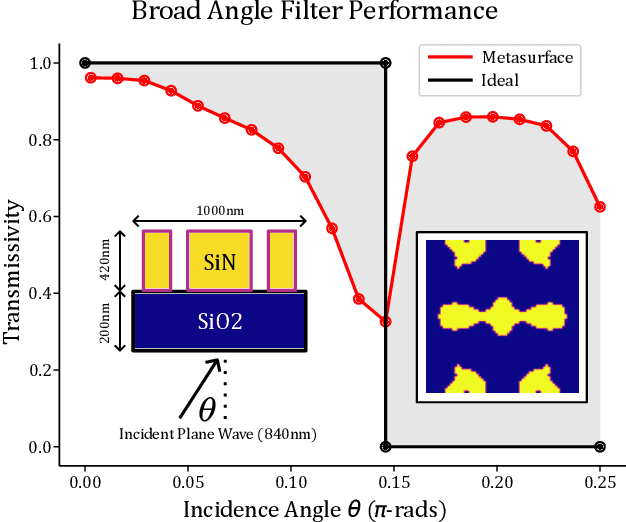
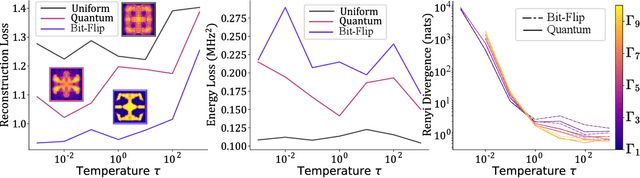
Large-scale optimization problems are prevalent in several fields, including engineering, finance, and logistics. However, most optimization problems cannot be efficiently encoded onto a physical system because the existing quantum samplers have too few qubits. Another typical limiting factor is that the optimization constraints are not compatible with the native cost Hamiltonian. This work presents a new approach to address these challenges. We introduce the adversarial quantum autoencoder model (AQAM) that can be used to map large-scale optimization problems onto existing quantum samplers while simultaneously optimizing the problem through latent quantum-enhanced Boltzmann sampling. We demonstrate the AQAM on a neutral atom sampler, and showcase the model by optimizing 64px by 64px unit cells that represent a broad-angle filter metasurface applicable to improving the coherence of neutral atom devices. Using 12-atom simulations, we demonstrate that the AQAM achieves a lower Renyi divergence and a larger spectral gap when compared to classical Markov Chain Monte Carlo samplers. Our work paves the way to more efficient mapping of conventional optimization problems into existing quantum samplers.