 Add to Chrome
 Add to Firefox
 Add to Edge
Quantum Spectral Model: Data Reuploading with Input-Conditioned Frequency Support
Jul 24, 2026
A central design principle in modern machine learning and artificial intelligence is to align a model's inductive bias with the structure of its input data. For matrix-valued inputs, relevant matrix-level relationships can be characterised through spectral values and spectral subspaces; however, common coordinate-wise rotation-gate data-encoding unitaries used in most quantum machine learning models do not explicitly construct such a matrix-level representation. We introduce Quantum Spectral Models (QSMs), in which we construct the generator of the data-encoding unitary directly from each input matrix. We study three QSM variants based on symmetric, global block, and non-overlapping patch-local block Hamiltonians. Their outputs admit truncated Fourier representations in which input-dependent spectral gaps supply candidate phase carriers, while spectral subspaces help determine their coefficients. We evaluate the QSMs and comparison quantum models on two matrix representations of Pendigits and two controlled synthetic tasks defined by spectral statistics. At the largest evaluated circuit depth, QSM variants lead the tested quantum models in mean test accuracy across all four benchmarks. The patch-local QSM leads on Pendigits, whereas the global block-Hamiltonian QSM leads on the controlled spectral tasks. Ablations show a task-dependent reversal: subspace-preserving controls perform better on Pendigits, whereas spectral-value-only controls lead among the tested ablations on the synthetic tasks. Together, these results shed new light on quantum machine-learning model design by showing how input-conditioned spectral representations can provide an analysable inductive bias, while offering a broader perspective on structure-aware model design in machine learning and artificial intelligence.

Fine-Tuning Large Language Models for Quantum Reasoning
Jun 20, 2026Large language models (LLMs) exhibit abilities beyond natural language modelling and text generation. Recent advances in their reasoning capabilities have spurred interest in applying LLMs to complex scientific tasks requiring deep domain expertise and sophisticated reasoning. Quantum computing, as a highly specialised field with significant knowledge barriers and hardware constraints, could greatly benefit from such advancements. However, a key open question that first must be answered is: How can we develop fine-tuning pipelines that instil genuine quantum reasoning in LLMs, rather than task-specific pattern matching? We study this question through quantum circuit simulation as a training objective, where the model must predict the measurement probability distribution resulting from a sequence of quantum gate operations. We propose and compare two fine-tuning pipelines: (1) Supervised Fine-Tuning (SFT) on explicit gate-by-gate state-vector simulation traces, and (2) a two-stage SFT+Group Relative Policy Optimisation (GRPO) approach that sequentially applies SFT followed by GRPO with verifiable rewards. Our findings show that SFT achieves near-perfect in-distribution and gate-count extrapolation accuracy, significantly outperforming both the base model and the GPT-OSS-120B baseline. SFT+GRPO trades some in-distribution precision for better generalisation to larger qubit systems that SFT alone cannot handle. Both pipelines significantly outperform the baselines, demonstrating that targeted fine-tuning on explicit reasoning traces is an effective strategy for advancing quantum reasoning in LLMs.
Quantum Reservoir Computing with Neutral Atoms on a Small, Complex, Medical Dataset
Feb 16, 2026Biomarker-based prediction of clinical outcomes is challenging due to nonlinear relationships, correlated features, and the limited size of many medical datasets. Classical machine-learning methods can struggle under these conditions, motivating the search for alternatives. In this work, we investigate quantum reservoir computing (QRC), using both noiseless emulation and hardware execution on the neutral-atom Rydberg processor \textit{Aquila}. We evaluate performance with six classical machine-learning models and use SHAP to generate feature subsets. We find that models trained on emulated quantum features achieve mean test accuracies comparable to those trained on classical features, but have higher training accuracies and greater variability over data splits, consistent with overfitting. When comparing hardware execution of QRC to noiseless emulation, the models are more robust over different data splits and often exhibit statistically significant improvements in mean test accuracy. This combination of improved accuracy and increased stability is suggestive of a regularising effect induced by hardware execution. To investigate the origin of this behaviour, we examine the statistical differences between hardware and emulated quantum feature distributions. We find that hardware execution applies a structured, time-dependent transformation characterised by compression toward the mean and a progressive reduction in mutual information relative to emulation.
Maritime object classification with SAR imagery using quantum kernel methods
Dec 12, 2025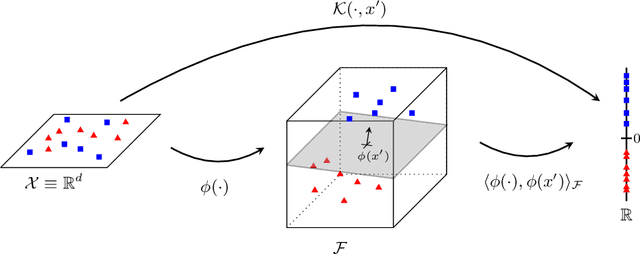
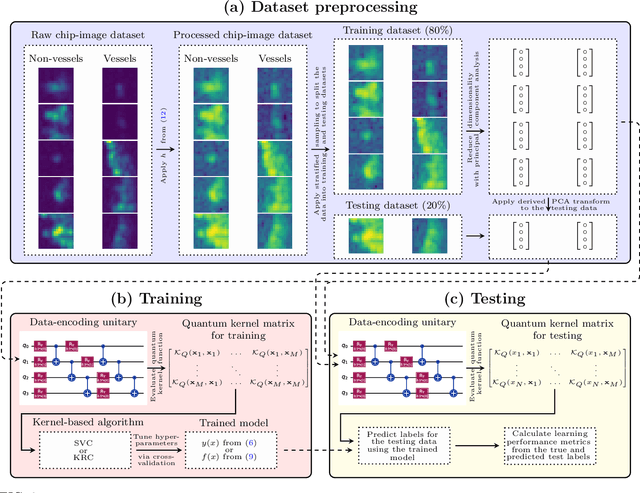
Illegal, unreported, and unregulated (IUU) fishing causes global economic losses of \$10-25 billion annually and undermines marine sustainability and governance. Synthetic Aperture Radar (SAR) provides reliable maritime surveillance under all weather and lighting conditions, but classifying small maritime objects in SAR imagery remains challenging. We investigate quantum machine learning for this task, focusing on Quantum Kernel Methods (QKMs) applied to real and complex SAR chips extracted from the SARFish dataset. We tackle two binary classification problems, the first for distinguishing vessels from non-vessels, and the second for distinguishing fishing vessels from other types of vessels. We compare QKMs applied to real and complex SAR chips against classical Laplacian, RBF, and linear kernels applied to real SAR chips. Using noiseless numerical simulations of the quantum kernels, we find that QKMs are capable of obtaining equal or better performance than the classical kernel on these tasks in the best case, but do not demonstrate a clear advantage for the complex SAR data. This work presents the first application of QKMs to maritime classification in SAR imagery and offers insight into the potential and current limitations of quantum-enhanced learning for maritime surveillance.
Quantum Hamiltonian Embedding of Images for Data Reuploading Classifiers
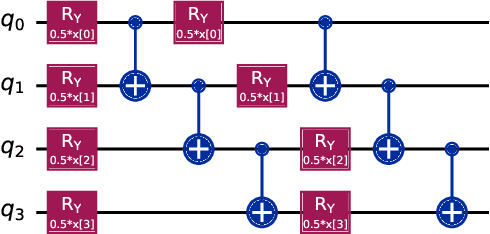
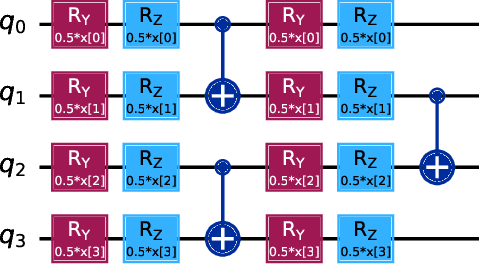
Jul 19, 2024When applying quantum computing to machine learning tasks, one of the first considerations is the design of the quantum machine learning model itself. Conventionally, the design of quantum machine learning algorithms relies on the ``quantisation" of classical learning algorithms, such as using quantum linear algebra to implement important subroutines of classical algorithms, if not the entire algorithm, seeking to achieve quantum advantage through possible run-time accelerations brought by quantum computing. However, recent research has started questioning whether quantum advantage via speedup is the right goal for quantum machine learning [1]. Research also has been undertaken to exploit properties that are unique to quantum systems, such as quantum contextuality, to better design quantum machine learning models [2]. In this paper, we take an alternative approach by incorporating the heuristics and empirical evidences from the design of classical deep learning algorithms to the design of quantum neural networks. We first construct a model based on the data reuploading circuit [3] with the quantum Hamiltonian data embedding unitary [4]. Through numerical experiments on images datasets, including the famous MNIST and FashionMNIST datasets, we demonstrate that our model outperforms the quantum convolutional neural network (QCNN)[5] by a large margin (up to over 40% on MNIST test set). Based on the model design process and numerical results, we then laid out six principles for designing quantum machine learning models, especially quantum neural networks.
Automated Quantum Circuit Design with Nested Monte Carlo Tree Search
Jul 01, 2022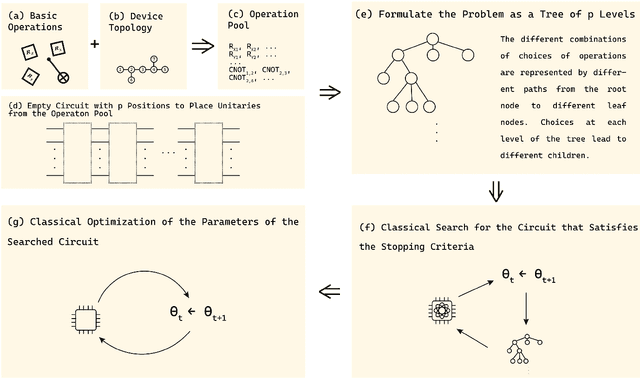
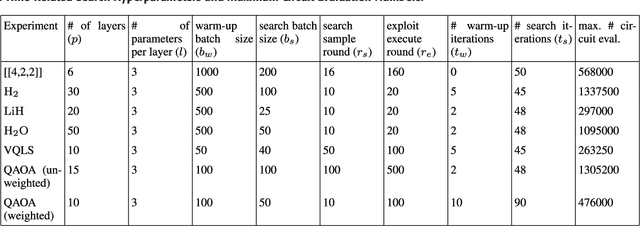
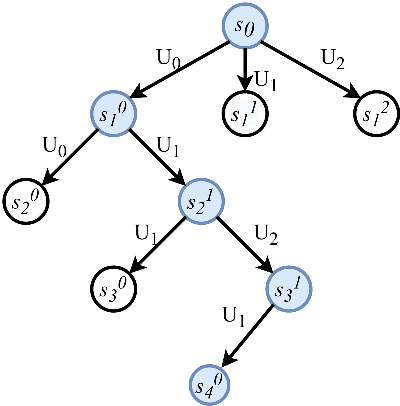
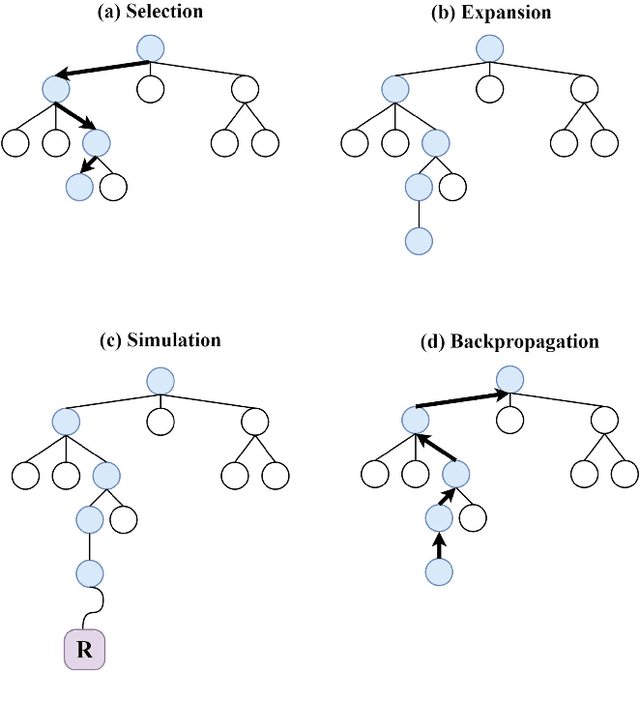
Quantum algorithms based on variational approaches are one of the most promising methods to construct quantum solutions and have found a myriad of applications in the last few years. Despite the adaptability and simplicity, their scalability and the selection of suitable ans\"atzs remain key challenges. In this work, we report an algorithmic framework based on nested Monte-Carlo Tree Search (MCTS) coupled with the combinatorial multi-armed bandit (CMAB) model for the automated design of quantum circuits. Through numerical experiments, we demonstrated our algorithm applied to various kinds of problems, including the ground energy problem in quantum chemistry, quantum optimisation on a graph, solving systems of linear equations, and finding encoding circuit for quantum error detection codes. Compared to the existing approaches, the results indicate that our circuit design algorithm can explore larger search spaces and optimise quantum circuits for larger systems, showing both versatility and scalability.