 Add to Chrome
 Add to Firefox
 Add to Edge
Black-box, Adaptive, Efficient, Transferable, Harmful, Applicable... Attacks Are All You Need to Break LLMs
Jun 02, 2026
Accurately evaluating adversarial robustness is a longstanding challenge. A flawed attack design can inflate robustness estimates, making deployment risk assessment and defense comparison unreliable. Historically, standardized attacks such as AutoAttack have largely resolved this for image classifiers, providing a reliable evaluation baseline for systematic comparison across defenses. However, no equivalent exists for LLM jailbreak evaluation yet, where designing such an attack is considerably more difficult. A reliable attack must, among other things, be black-box compatible, applicable to arbitrary defense pipelines, and efficient, which no existing method jointly satisfies. We introduce Indirect Harm Optimization (IHO), a masked diffusion language model attacker trained via iterative preference optimization against a harmfulness judge, requiring only black-box access to the target. The same method can be used without modification as a strong adaptive attack on individual behaviors, or as an efficient amortized policy that transfers to held-out behaviors and unseen target models without fine-tuning. Even against layered defenses, such as a Circuit Breaker-trained model combined with an auxiliary detector, IHO improves attack success considerably over state-of-the-art approaches, without any defense-specific adaptation. Our results position IHO as a practical step toward the kind of standardized jailbreak evaluation that has improved reliability in the past. Code and models are available on GitHub and Hugging Face.

Closing the Distribution Gap in Adversarial Training for LLMs
Feb 16, 2026Adversarial training for LLMs is one of the most promising methods to reliably improve robustness against adversaries. However, despite significant progress, models remain vulnerable to simple in-distribution exploits, such as rewriting prompts in the past tense or translating them into other languages. We argue that this persistent fragility stems from a fundamental limitation in current adversarial training algorithms: they minimize adversarial loss on their training set but inadequately cover the data distribution, resulting in vulnerability to seemingly simple attacks. To bridge this gap, we propose Distributional Adversarial Training, DAT. We leverage Diffusion LLMs to approximate the true joint distribution of prompts and responses, enabling generation of diverse, high-likelihood samples that address generalization failures. By combining optimization over the data distribution provided by the diffusion model with continuous adversarial training, DAT achieves substantially higher adversarial robustness than previous methods.
AdversariaLLM: A Unified and Modular Toolbox for LLM Robustness Research
Nov 06, 2025The rapid expansion of research on Large Language Model (LLM) safety and robustness has produced a fragmented and oftentimes buggy ecosystem of implementations, datasets, and evaluation methods. This fragmentation makes reproducibility and comparability across studies challenging, hindering meaningful progress. To address these issues, we introduce AdversariaLLM, a toolbox for conducting LLM jailbreak robustness research. Its design centers on reproducibility, correctness, and extensibility. The framework implements twelve adversarial attack algorithms, integrates seven benchmark datasets spanning harmfulness, over-refusal, and utility evaluation, and provides access to a wide range of open-weight LLMs via Hugging Face. The implementation includes advanced features for comparability and reproducibility such as compute-resource tracking, deterministic results, and distributional evaluation techniques. \name also integrates judging through the companion package JudgeZoo, which can also be used independently. Together, these components aim to establish a robust foundation for transparent, comparable, and reproducible research in LLM safety.
A Simple Combination of Diffusion Models for Better Quality Trade-Offs in Image Denoising
Mar 18, 2025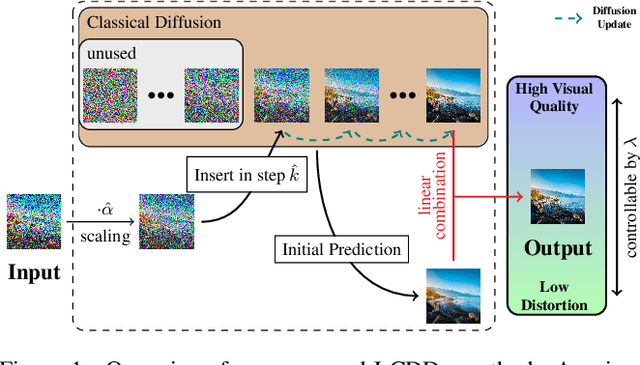
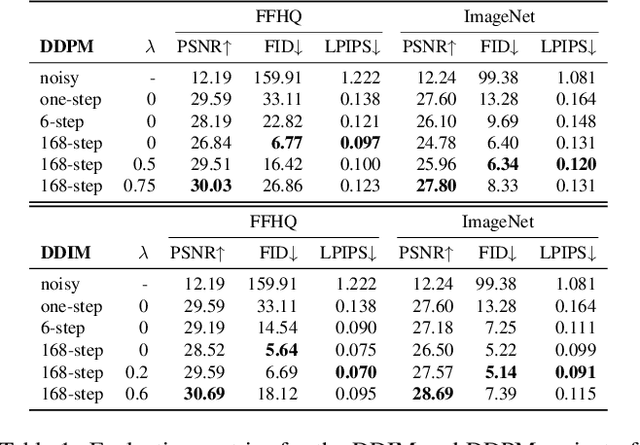
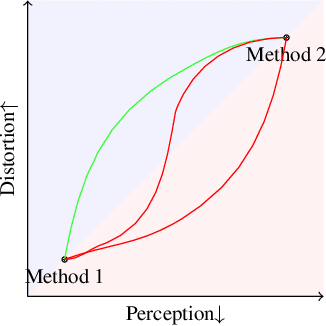
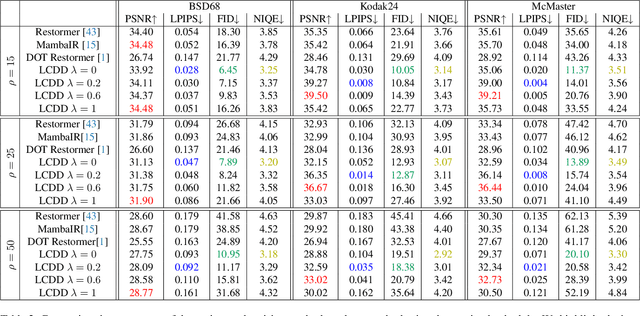
Diffusion models have garnered considerable interest in computer vision, owing both to their capacity to synthesize photorealistic images and to their proven effectiveness in image reconstruction tasks. However, existing approaches fail to efficiently balance the high visual quality of diffusion models with the low distortion achieved by previous image reconstruction methods. Specifically, for the fundamental task of additive Gaussian noise removal, we first illustrate an intuitive method for leveraging pretrained diffusion models. Further, we introduce our proposed Linear Combination Diffusion Denoiser (LCDD), which unifies two complementary inference procedures - one that leverages the model's generative potential and another that ensures faithful signal recovery. By exploiting the inherent structure of the denoising samples, LCDD achieves state-of-the-art performance and offers controlled, well-behaved trade-offs through a simple scalar hyperparameter adjustment.