 Add to Chrome
 Add to Firefox
 Add to Edge
Out-of-Length Scene Text Recognition: A Two-Axis Diagnosis and a Training-Free Fix
Jul 25, 2026
Scene Text Recognition (STR) models are trained almost exclusively on word crops of at most 25 characters, yet real deployments (signage, product labels, dense captions) require reading much longer text. This paper diagnoses that failure and then closes it. The diagnosis separates out-of-length failure into two simultaneously extrapolating axes (the encoder's width axis and the decoder's time axis) and shows that encoder width, not decoder length, is the dominant failure mode. Representation-side fixes bring only partial relief: training-free rotary rescalings recover at most 2-4 points of character error rate (CER), and a weighted fine-tuning recipe recovers 6-8 points while improving standard-benchmark accuracy, yet word accuracy on the Long Text Benchmark (LTB) stays near zero, because the residual gap lies in the decoding mechanism rather than the representation. We then close that gap at inference time, on an unmodified word-level checkpoint: the long image is sliced into overlapping crops at the model's training width, each decoded independently and in-distribution, and the reads stitched by geometry-anchored edit-distance alignment. This procedure reaches 42.79-43.05% bucket-average word accuracy on LTB across two base checkpoints, matching the published state of the art (41.57%) and beating it by 11-12 points on the hardest bucket, at wall-clock parity with plain decoding; applied unchanged to the public PARSeq checkpoint it reaches 47.11%. Once chunking is applied fine-tuning no longer helps: the decoding-side fix alone matches purpose-built architectures. We release the diagnosis harness and implementation.

iVISION-2DCD: A Long-Term Change Detection Dataset for Large-Scale Outdoor Construction Monitoring
Jul 03, 2026Automation in construction is essential for reducing costs and human errors in large-scale projects. We approach the construction progress monitoring from the aspect of detecting changes in construction sites. As construction buildings continue to evolve in geometry and appearance over time, change detection need to be performed from arbitrary camera viewpoints. This necessitates developing 2D Change Detection (2DCD) algorithms that operate robustly across diverse camera perspectives at construction sites. While developing and evaluating such systems is data-intensive, no open-source benchmark dataset exists at the intersection of 2D change detection and construction automation research. Data collection using Unmanned Aerial Vehicles (UAVs) is gaining its popularity in outdoor large-scale surveying. However, in active construction sites conducting drone missions equipped with high-end sensors imposes safety concerns. Flight trajectory and collected camera viewpoints can be significantly limited. To address this critical gap, we introduce iVISION-2DCD, a large-scale synthetically generated dataset from dense LiDAR point clouds with photorealistic input images and accurate ground truth annotations. Our dataset formally defines the problem of viewpoint-robust 2DCD at construction sites and captures the inherent complexities of real-world deployment. In this paper, we present our systematic methodology for synthetic data generation, developing novel view synthesis techniques to overcome bi-temporal alignment and viewpoint diversity challenges, and implementing semi-automated semantic segmentation with change label generation while preserving challenging real-world cases. Benchmark evaluations using state-of-the-art 2DCD algorithms demonstrate that iVISION-2DCD poses novel research challenges for the computer vision and robotics communities.
CoGS: Compositional Dynamic Human-Object Scenes Gaussian Splatting from Monocular Video
Jun 27, 2026Reconstructing dynamic human--object interaction scenes from monocular video is difficult because the human, manipulated object, and background obey different motion models while sharing the same pixels. Existing dynamic radiance-field and Gaussian-splatting methods often entangle these components, causing object motion to leak into the human or static scene, and monocular human reconstruction remains underconstrained in regions that are rarely observed. We present CoGS, a compositional Gaussian-splatting framework for monocular human--object scene reconstruction. CoGS decomposes the video into three coordinated branches: an articulated human initialized from a complete canonical prior, a rigid object field driven by an estimated object trajectory, and a static scene field regularized by weak scene-only planar primitives when available. A six-stage optimization schedule first stabilizes the human and object independently, then fuses them with the scene under full-image supervision, visibility-aware human anchoring, object silhouette and motion constraints, and delayed scene regularization. This design keeps each component responsible for its own geometry and motion while allowing photometric evidence to correct the final composite. Experiments on HOSNeRF and NeuMan show that CoGS improves both human--object interaction reconstruction and in-the-wild human--scene rendering, achieving stronger fidelity and perceptual quality across full-frame and human-focused evaluations. Code will be released upon publication.
Scalable Injury-Risk Screening in Baseball Pitching From Broadcast Video
Mar 05, 2026Injury prediction in pitching depends on precise biomechanical signals, yet gold-standard measurements come from expensive, stadium-installed multi-camera systems that are unavailable outside professional venues. We present a monocular video pipeline that recovers 18 clinically relevant biomechanics metrics from broadcast footage, positioning pose-derived kinematics as a scalable source for injury-risk modeling. Built on DreamPose3D, our approach introduces a drift-controlled global lifting module that recovers pelvis trajectory via velocity-based parameterization and sliding-window inference, lifting pelvis-rooted poses into global space. To address motion blur, compression artifacts, and extreme pitching poses, we incorporate a kinematics refinement pipeline with bone-length constraints, joint-limited inverse kinematics, smoothing, and symmetry constraints to ensure temporally stable and physically plausible kinematics. On 13 professional pitchers (156 paired pitches), 16/18 metrics achieve sub-degree agreement (MAE $< 1^{\circ}$). Using these metrics for injury prediction, an automated screening model achieves AUC 0.811 for Tommy John surgery and 0.825 for significant arm injuries on 7,348 pitchers. The resulting pose-derived metrics support scalable injury-risk screening, establishing monocular broadcast video as a viable alternative to stadium-scale motion capture for biomechanics.
Interpretable Pre-Release Baseball Pitch Type Anticipation from Broadcast 3D Kinematics
Mar 05, 2026How much can a pitcher's body reveal about the upcoming pitch? We study this question at scale by classifying eight pitch types from monocular 3D pose sequences, without access to ball-flight data. Our pipeline chains a diffusion-based 3D pose backbone with automatic pitching-event detection, groundtruth-validated biomechanical feature extraction, and gradient-boosted classification over 229 kinematic features. Evaluated on 119,561 professional pitches, the largest such benchmark to date, we achieve 80.4\% accuracy using body kinematics alone. A systematic importance analysis reveals that upper-body mechanics contribute 64.9\% of the predictive signal versus 35.1\% for the lower body, with wrist position (14.8\%) and trunk lateral tilt emerging as the most informative joint group and biomechanical feature, respectively. We further show that grip-defined variants (four-seam vs.\ two-seam fastball) are not separable from pose, establishing an empirical ceiling near 80\% and delineating where kinematic information ends and ball-flight information begins.
Avatar4D: Synthesizing Domain-Specific 4D Humans for Real-World Pose Estimation
Dec 18, 2025We present Avatar4D, a real-world transferable pipeline for generating customizable synthetic human motion datasets tailored to domain-specific applications. Unlike prior works, which focus on general, everyday motions and offer limited flexibility, our approach provides fine-grained control over body pose, appearance, camera viewpoint, and environmental context, without requiring any manual annotations. To validate the impact of Avatar4D, we focus on sports, where domain-specific human actions and movement patterns pose unique challenges for motion understanding. In this setting, we introduce Syn2Sport, a large-scale synthetic dataset spanning sports, including baseball and ice hockey. Avatar4D features high-fidelity 4D (3D geometry over time) human motion sequences with varying player appearances rendered in diverse environments. We benchmark several state-of-the-art pose estimation models on Syn2Sport and demonstrate their effectiveness for supervised learning, zero-shot transfer to real-world data, and generalization across sports. Furthermore, we evaluate how closely the generated synthetic data aligns with real-world datasets in feature space. Our results highlight the potential of such systems to generate scalable, controllable, and transferable human datasets for diverse domain-specific tasks without relying on domain-specific real data.
Ice Hockey Puck Localization Using Contextual Cues
Jun 04, 2025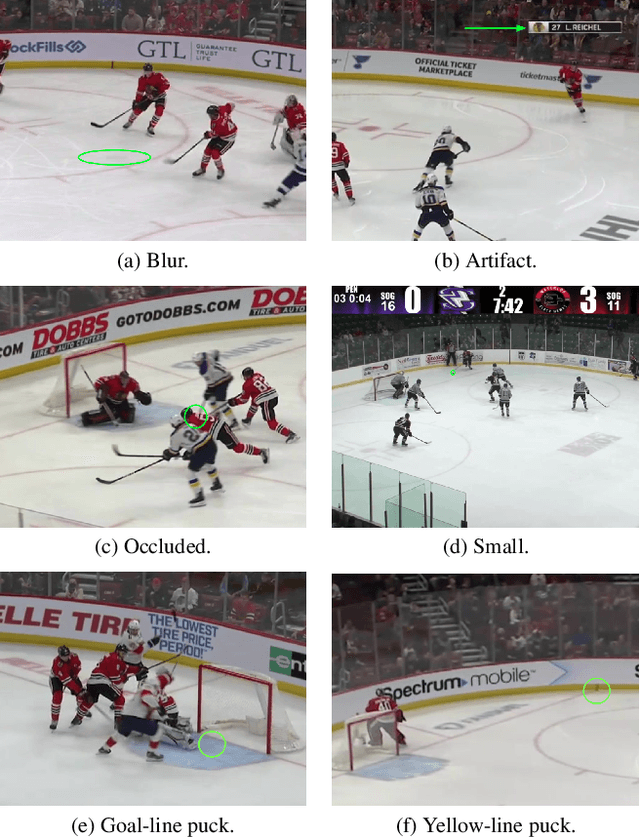
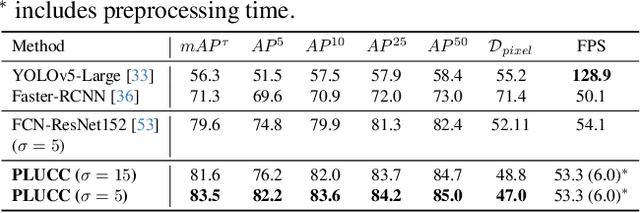
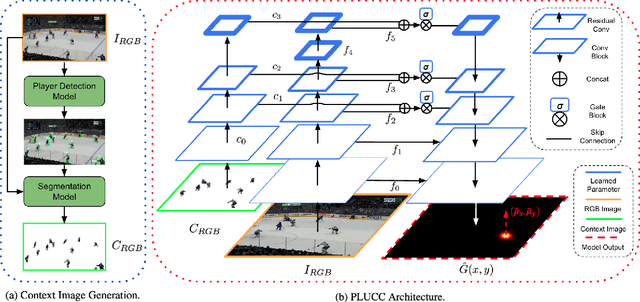
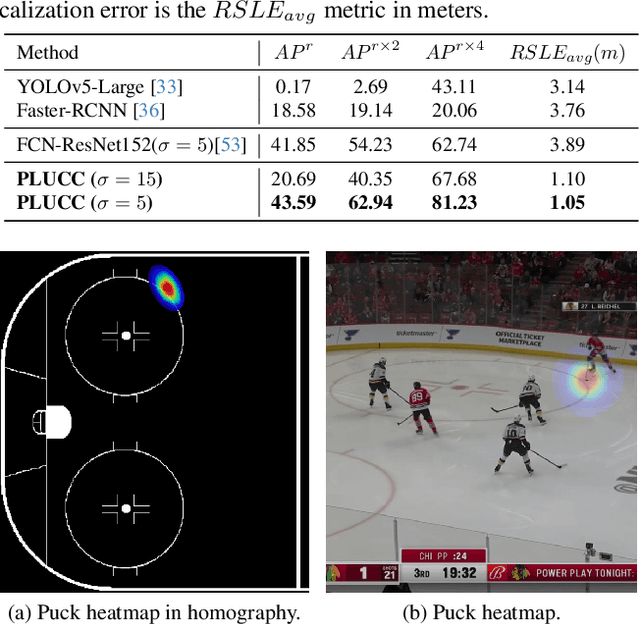
Puck detection in ice hockey broadcast videos poses significant challenges due to the puck's small size, frequent occlusions, motion blur, broadcast artifacts, and scale inconsistencies due to varying camera zoom and broadcast camera viewpoints. Prior works focus on appearance-based or motion-based cues of the puck without explicitly modelling the cues derived from player behaviour. Players consistently turn their bodies and direct their gaze toward the puck. Motivated by this strong contextual cue, we propose Puck Localization Using Contextual Cues (PLUCC), a novel approach for scale-aware and context-driven single-frame puck detections. PLUCC consists of three components: (a) a contextual encoder, which utilizes player orientations and positioning as helpful priors; (b) a feature pyramid encoder, which extracts multiscale features from the dual encoders; and (c) a gating decoder that combines latent features with a channel gating mechanism. For evaluation, in addition to standard average precision, we propose Rink Space Localization Error (RSLE), a scale-invariant homography-based metric for removing perspective bias from rink space evaluation. The experimental results of PLUCC on the PuckDataset dataset demonstrated state-of-the-art detection performance, surpassing previous baseline methods by an average precision improvement of 12.2% and RSLE average precision of 25%. Our research demonstrates the critical role of contextual understanding in improving puck detection performance, with broad implications for automated sports analysis.
SplatPose+: Real-time Image-Based Pose-Agnostic 3D Anomaly Detection
Oct 15, 2024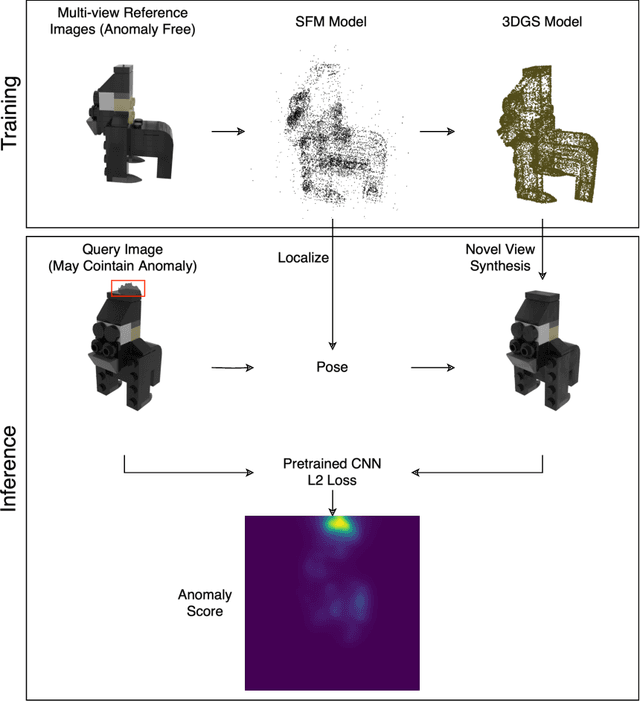


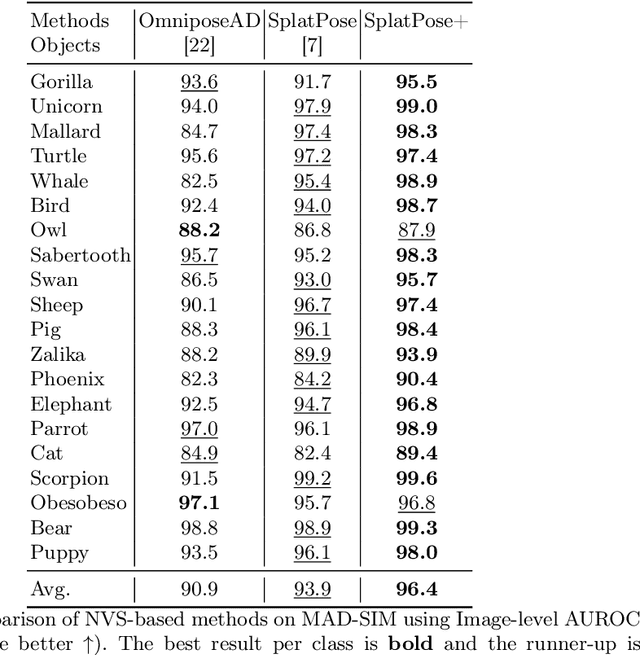
Image-based Pose-Agnostic 3D Anomaly Detection is an important task that has emerged in industrial quality control. This task seeks to find anomalies from query images of a tested object given a set of reference images of an anomaly-free object. The challenge is that the query views (a.k.a poses) are unknown and can be different from the reference views. Currently, new methods such as OmniposeAD and SplatPose have emerged to bridge the gap by synthesizing pseudo reference images at the query views for pixel-to-pixel comparison. However, none of these methods can infer in real-time, which is critical in industrial quality control for massive production. For this reason, we propose SplatPose+, which employs a hybrid representation consisting of a Structure from Motion (SfM) model for localization and a 3D Gaussian Splatting (3DGS) model for Novel View Synthesis. Although our proposed pipeline requires the computation of an additional SfM model, it offers real-time inference speeds and faster training compared to SplatPose. Quality-wise, we achieved a new SOTA on the Pose-agnostic Anomaly Detection benchmark with the Multi-Pose Anomaly Detection (MAD-SIM) dataset.
Inline Photometrically Calibrated Hybrid Visual SLAM
Sep 25, 2024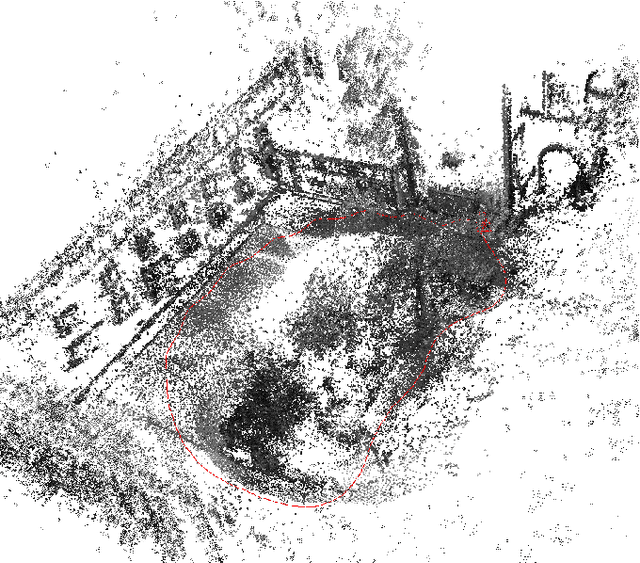
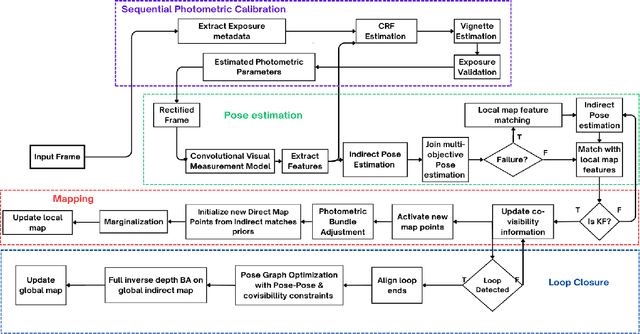

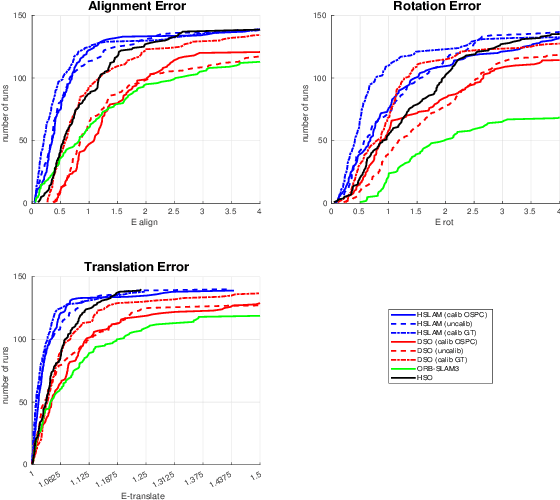
This paper presents an integrated approach to Visual SLAM, merging online sequential photometric calibration within a Hybrid direct-indirect visual SLAM (H-SLAM). Photometric calibration helps normalize pixel intensity values under different lighting conditions, and thereby improves the direct component of our H-SLAM. A tangential benefit also results to the indirect component of H-SLAM given that the detected features are more stable across variable lighting conditions. Our proposed photometrically calibrated H-SLAM is tested on several datasets, including the TUM monoVO as well as on a dataset we created. Calibrated H-SLAM outperforms other state of the art direct, indirect, and hybrid Visual SLAM systems in all the experiments. Furthermore, in online SLAM tested at our site, it also significantly outperformed the other SLAM Systems.
Towards Real-Time Gaussian Splatting: Accelerating 3DGS through Photometric SLAM
Aug 07, 2024Initial applications of 3D Gaussian Splatting (3DGS) in Visual Simultaneous Localization and Mapping (VSLAM) demonstrate the generation of high-quality volumetric reconstructions from monocular video streams. However, despite these promising advancements, current 3DGS integrations have reduced tracking performance and lower operating speeds compared to traditional VSLAM. To address these issues, we propose integrating 3DGS with Direct Sparse Odometry, a monocular photometric SLAM system. We have done preliminary experiments showing that using Direct Sparse Odometry point cloud outputs, as opposed to standard structure-from-motion methods, significantly shortens the training time needed to achieve high-quality renders. Reducing 3DGS training time enables the development of 3DGS-integrated SLAM systems that operate in real-time on mobile hardware. These promising initial findings suggest further exploration is warranted in combining traditional VSLAM systems with 3DGS.