 Add to Chrome
 Add to Firefox
 Add to Edge
Emergent Autonomous Drifting for Collision Avoidance in Real-World Winter Driving Scenarios
Jul 21, 2026
Real-world collision avoidance is a core motivation for studying the dynamics and control of high sideslip drifting in vehicles, yet the practical benefit of such maneuvers has so far primarily been tested in scenarios explicitly engineered to require drifting. In this work, we explore the question of if and when drifting may be optimal for safety in real-world winter driving conditions. We present a drift-capable nonlinear model predictive control (MPC) system designed to handle scenarios grounded in crash fatality data and deploy the controller in a high fidelity simulator across road departure and oncoming vehicle collision avoidance scenarios. The controller naturally initiates and sustains drifting maneuvers to stay on the road when hitting a patch of ice on the rear axle and to avoid an oncoming vehicle that has slid into its lane. Comparisons with a benchmark electronic stability control (ESC) system demonstrate how a drift-capable controller can trade off stability for controllability to precisely maneuver through dangerous winter driving scenarios. A Monte Carlo study over random ice patches further shows that the drift-capable controller achieves lower median lane error than ESC across several speeds, while revealing that drifting emerges predominantly at higher speeds.

3D Lane Detection with Odometry for High-Speed Vehicle Racing
Jul 15, 2026Lane boundary detection is a critical component in autonomous driving systems and has been rigorously studied in regular driving scenarios. However, it is less explored in vehicle racing, where the car moves at higher speeds across more extreme road geometries. To study this problem, we introduce a new dataset for 3D lane detection in racing, featuring >$250$k images from multiple camera feeds and inertial measurements taken with a Lexus LC 500 driving on a closed circuit. With this dataset, we compare various approaches to 3D lane detection and propose modifications that permit frames to be processed at rates of almost 300Hz while retaining high predictive performance in the racing application. This facilitates a multi-camera ensemble approach that is validated on hardware. We show that sensing modalities such as inertial measurements can be leveraged for pre-integration to regress road geometries over both cameras and time, yielding improvements in key metrics. Compared to methods such as BevLaneDet, adding odometry and ensemble predictions improves the F1 score by 3 points and reduces near-vehicle mean absolute errors (MAEs) by $>30 \%$. We show F1 scores $>$0.9 and lateral MAEs of $<$0.18m in vehicle deployments.
Generalized-CVO: Fast and Correspondence-Free Local Point Cloud Registration with Second Order Riemannian Optimization
Jun 08, 2026We propose a fast and correspondence-free local point cloud registration method that leverages geometric surface structure and reproducing kernel Hilbert space (RKHS) embeddings. The method represents point clouds as continuous functions with point-wise anisotropic kernels that encode local geometry. This formulation improves alignment along surface normals while relaxing alignment along tangential directions. To solve the resulting registration problem, we propose a second-order on-manifold optimization scheme with approximate Riemannian Hessians, achieving a speedup of up to 10x over the first-order solvers used in prior correspondence-free RKHS-based methods. We demonstrate improved frame-to-frame LiDAR and RGB-D tracking accuracy across diverse indoor and outdoor datasets. On a LiDAR tracking registration task in the driving domain, we achieve a reduction of $>55\%$ in both translational and rotational drift in challenging feature-sparse environments. On object registration benchmarks, we show improved robustness over ICP-based methods and further gains when refining global initialization, particularly under moderate misalignment.
Boundary Sampling to Learn Predictive Safety Filters via Pontryagin's Maximum Principle
Apr 14, 2026Safety filters provide a practical approach for enforcing safety constraints in autonomous systems. While learning-based tools scale to high-dimensional systems, their performance depends on informative data that includes states likely to lead to constraint violation, which can be difficult to efficiently sample in complex, high-dimensional systems. In this work, we characterize trajectories that barely avoid safety violations using the Pontryagin Maximum Principle. These boundary trajectories are used to guide data collection for learned Hamilton-Jacobi Reachability, concentrating learning efforts near safety-critical states to improve efficiency. The learned Control Barrier Value Function is then used directly for safety filtering. Simulations and experimental validation on a shared-control automotive racing application demonstrate PMP sampling improves learning efficiency, yielding faster convergence, reduced failure rates, and improved safe set reconstruction, with wall times around 3ms.
Vision-Conditioned Variational Bayesian Last Layer Dynamics Models
Jan 16, 2026Agile control of robotic systems often requires anticipating how the environment affects system behavior. For example, a driver must perceive the road ahead to anticipate available friction and plan actions accordingly. Achieving such proactive adaptation within autonomous frameworks remains a challenge, particularly under rapidly changing conditions. Traditional modeling approaches often struggle to capture abrupt variations in system behavior, while adaptive methods are inherently reactive and may adapt too late to ensure safety. We propose a vision-conditioned variational Bayesian last-layer dynamics model that leverages visual context to anticipate changes in the environment. The model first learns nominal vehicle dynamics and is then fine-tuned with feature-wise affine transformations of latent features, enabling context-aware dynamics prediction. The resulting model is integrated into an optimal controller for vehicle racing. We validate our method on a Lexus LC500 racing through water puddles. With vision-conditioning, the system completed all 12 attempted laps under varying conditions. In contrast, all baselines without visual context consistently lost control, demonstrating the importance of proactive dynamics adaptation in high-performance applications.
Semantic Property Maps for Driving Applications
Nov 13, 2025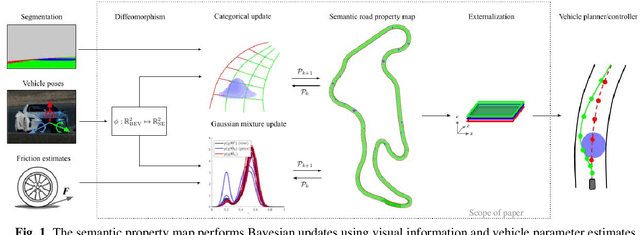
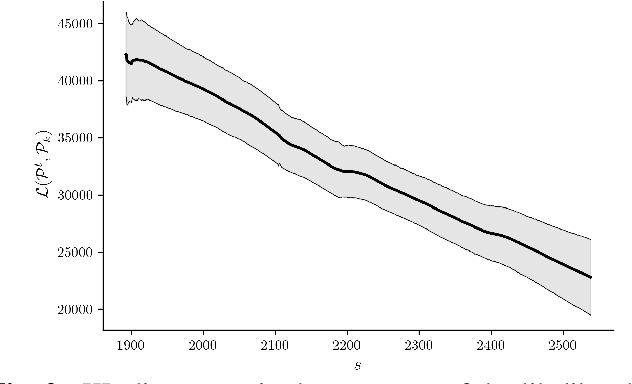
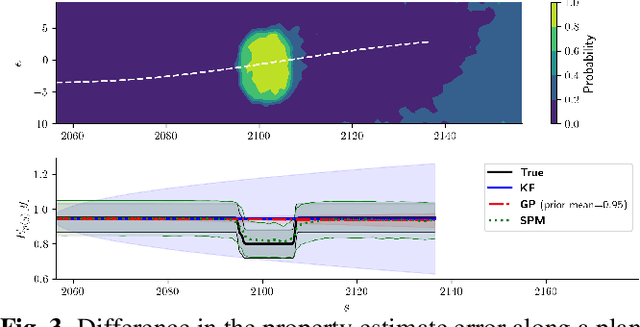
We consider the problem of estimating the parameters of a vehicle dynamics model for predictive control in driving applications. Instead of solely using the instantaneous parameters estimated from the vehicle signals, we combine this with cameras and update a probabilistic map with parameter estimates and semantic information using Bayesian moment matching. Key to this approach is the map representation, which is constructed with conjugate priors to the measurement likelihoods and defined in the same path coordinates as the vehicle controller, such that the map can be externalized to provide a local representation of the parameter likelihoods that vary in space. The result is a spatial map of vehicle parameters adapted online to enhance the driving control system. We provide theoretical guarantees on the smoothness of relevant parameter likelihood statistics as a function of space, which is critical for their use in predictive control.
Towards an Autonomous Test Driver: High-Performance Driver Modeling via Reinforcement Learning
Dec 05, 2024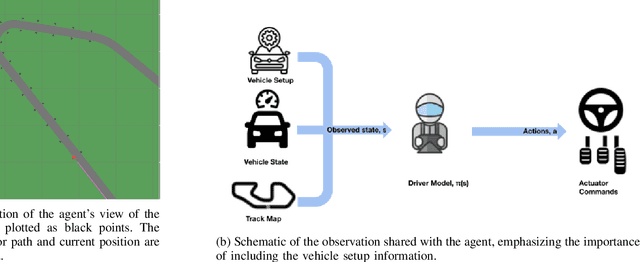

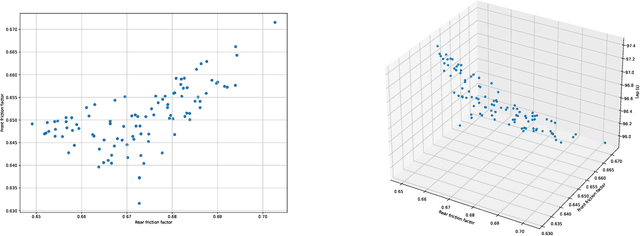
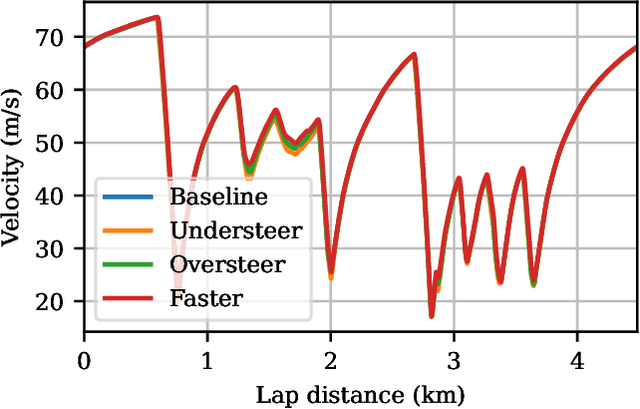
Success in racing requires a unique combination of vehicle setup, understanding of the racetrack, and human expertise. Since building and testing many different vehicle configurations in the real world is prohibitively expensive, high-fidelity simulation is a critical part of racecar development. However, testing different vehicle configurations still requires expert human input in order to evaluate their performance on different racetracks. In this work, we present the first steps towards an autonomous test driver, trained using deep reinforcement learning, capable of evaluating changes in vehicle setup on racing performance while driving at the level of the best human drivers. In addition, the autonomous driver model can be tuned to exhibit more human-like behavioral patterns by incorporating imitation learning into the RL training process. This extension permits the possibility of driver-specific vehicle setup optimization.
First, Learn What You Don't Know: Active Information Gathering for Driving at the Limits of Handling
Oct 31, 2024Combining data-driven models that adapt online and model predictive control (MPC) has enabled effective control of nonlinear systems. However, when deployed on unstable systems, online adaptation may not be fast enough to ensure reliable simultaneous learning and control. For example, controllers on a vehicle executing highly dynamic maneuvers may push the tires to their friction limits, destabilizing the vehicle and allowing modeling errors to quickly compound and cause a loss of control. In this work, we present a Bayesian meta-learning MPC framework. We propose an expressive vehicle dynamics model that leverages Bayesian last-layer meta-learning to enable rapid online adaptation. The model's uncertainty estimates are used to guide informative data collection and quickly improve the model prior to deployment. Experiments on a Toyota Supra show that (i) the framework enables reliable control in dynamic drifting maneuvers, (ii) online adaptation alone may not suffice for zero-shot control of a vehicle at the edge of stability, and (iii) active data collection helps achieve reliable performance.
Reference-Free Formula Drift with Reinforcement Learning: From Driving Data to Tire Energy-Inspired, Real-World Policies
Oct 28, 2024
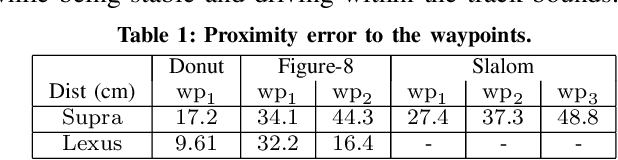
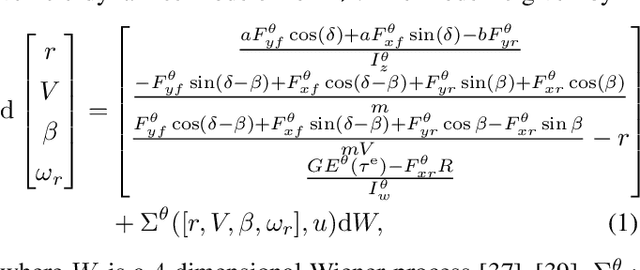
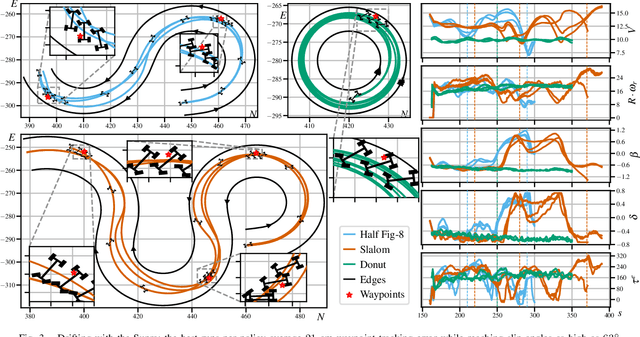
The skill to drift a car--i.e., operate in a state of controlled oversteer like professional drivers--could give future autonomous cars maximum flexibility when they need to retain control in adverse conditions or avoid collisions. We investigate real-time drifting strategies that put the car where needed while bypassing expensive trajectory optimization. To this end, we design a reinforcement learning agent that builds on the concept of tire energy absorption to autonomously drift through changing and complex waypoint configurations while safely staying within track bounds. We achieve zero-shot deployment on the car by training the agent in a simulation environment built on top of a neural stochastic differential equation vehicle model learned from pre-collected driving data. Experiments on a Toyota GR Supra and Lexus LC 500 show that the agent is capable of drifting smoothly through varying waypoint configurations with tracking error as low as 10 cm while stably pushing the vehicles to sideslip angles of up to 63{\deg}.
Risk-Averse Model Predictive Control for Racing in Adverse Conditions
Oct 22, 2024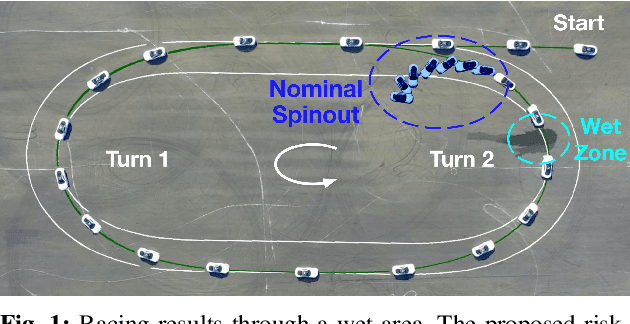
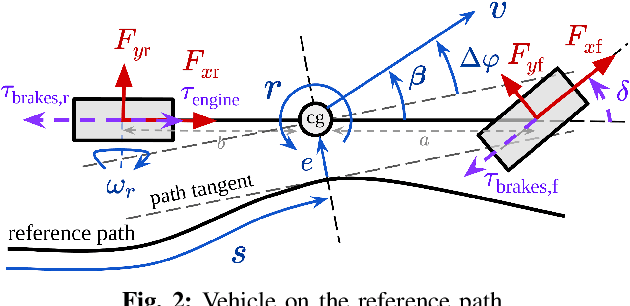
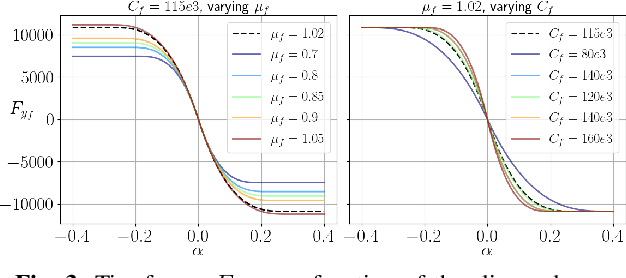
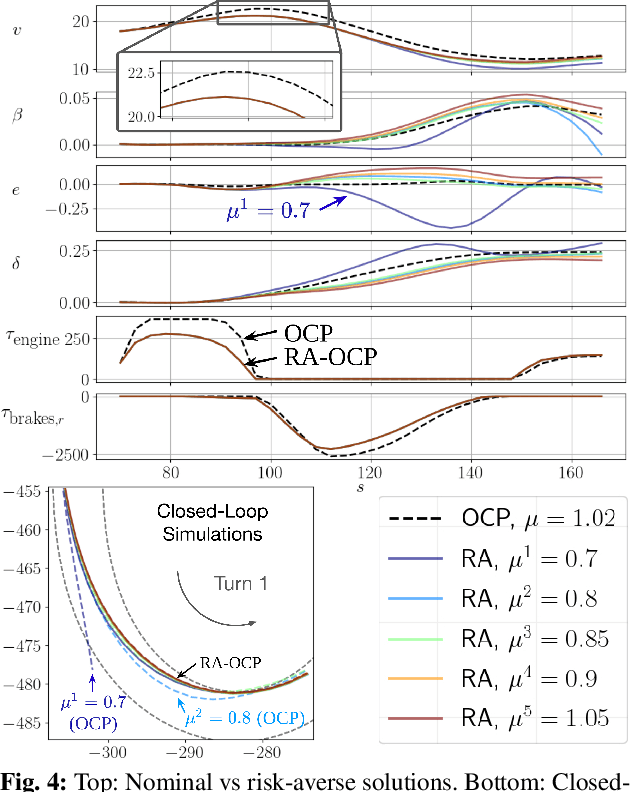
Model predictive control (MPC) algorithms can be sensitive to model mismatch when used in challenging nonlinear control tasks. In particular, the performance of MPC for vehicle control at the limits of handling suffers when the underlying model overestimates the vehicle's capabilities. In this work, we propose a risk-averse MPC framework that explicitly accounts for uncertainty over friction limits and tire parameters. Our approach leverages a sample-based approximation of an optimal control problem with a conditional value at risk (CVaR) constraint. This sample-based formulation enables planning with a set of expressive vehicle dynamics models using different tire parameters. Moreover, this formulation enables efficient numerical resolution via sequential quadratic programming and GPU parallelization. Experiments on a Lexus LC 500 show that risk-averse MPC unlocks reliable performance, while a deterministic baseline that plans using a single dynamics model may lose control of the vehicle in adverse road conditions.