 Add to Chrome
 Add to Firefox
 Add to Edge
Emergent Autonomous Drifting for Collision Avoidance in Real-World Winter Driving Scenarios
Jul 21, 2026
Real-world collision avoidance is a core motivation for studying the dynamics and control of high sideslip drifting in vehicles, yet the practical benefit of such maneuvers has so far primarily been tested in scenarios explicitly engineered to require drifting. In this work, we explore the question of if and when drifting may be optimal for safety in real-world winter driving conditions. We present a drift-capable nonlinear model predictive control (MPC) system designed to handle scenarios grounded in crash fatality data and deploy the controller in a high fidelity simulator across road departure and oncoming vehicle collision avoidance scenarios. The controller naturally initiates and sustains drifting maneuvers to stay on the road when hitting a patch of ice on the rear axle and to avoid an oncoming vehicle that has slid into its lane. Comparisons with a benchmark electronic stability control (ESC) system demonstrate how a drift-capable controller can trade off stability for controllability to precisely maneuver through dangerous winter driving scenarios. A Monte Carlo study over random ice patches further shows that the drift-capable controller achieves lower median lane error than ESC across several speeds, while revealing that drifting emerges predominantly at higher speeds.

High Speed Emulation in a Vehicle-in-the-Loop Driving Simulator
Mar 21, 2022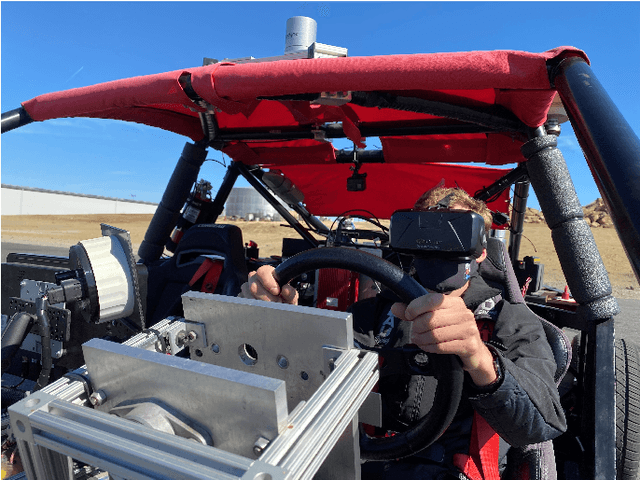
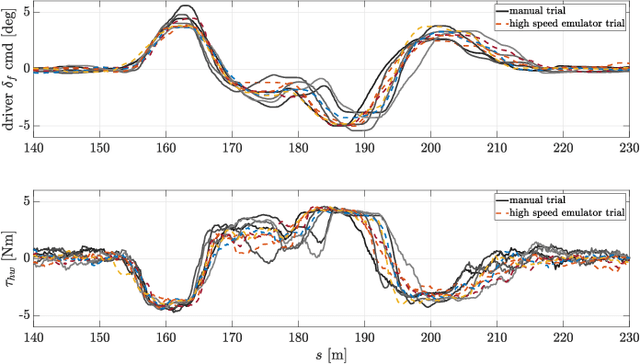
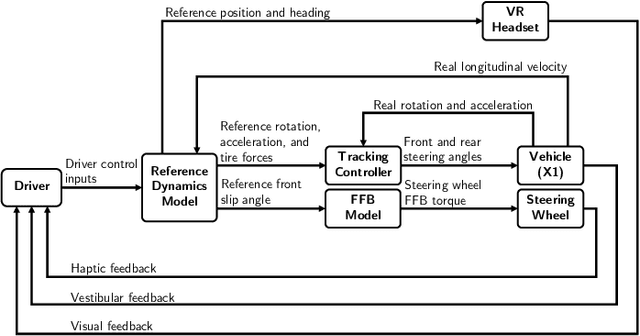
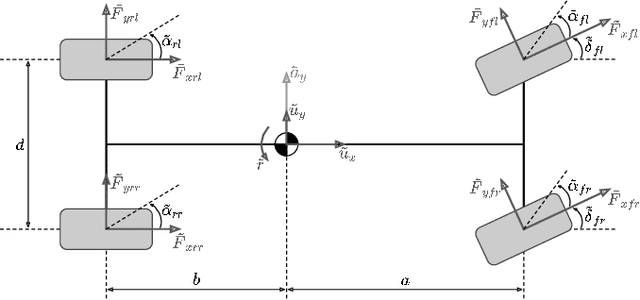
Rendering accurate multisensory feedback is critical to ensure natural user behavior in driving simulators. In this work, we present a virtual reality (VR)-based Vehicle-in-the-Loop (ViL) simulator that provides visual, vestibular, and haptic feedback to drivers in high speed driving conditions. Designing our simulator around a four-wheel steer-by-wire vehicle enables us to emulate the dynamics of a vehicle traveling significantly faster than the test vehicle and to transmit corresponding haptic steering feedback to the driver. By scaling the speed of the test vehicle through a combination of VR visuals, vehicle dynamics emulation, and steering wheel force feedback, we can safely and immersively run experiments up to highway speeds within a limited driving space. In double lane change and highway weaving experiments, our high speed emulation method tracks yaw motion within human perception limits and provides sensory feedback comparable to the same maneuvers driven manually.