 Add to Chrome
 Add to Firefox
 Add to Edge
Panda: Unsupervised Pelvic Anomaly Detection for Real-Time MR Imaging
Jul 27, 2026
Female pelvic diseases remain an under researched area characterized by often delayed diagnosis. While pelvic MRI offers superior soft-tissue contrast for diagnosis and image-guided procedures, real-time anomaly detection remains challenging due to physiological motion, tissue deformation, and instrument artifacts. Existing supervised approaches are impractical, as adverse events are rare, heterogeneous, and difficult to annotate. We present a Dinomaly-based unsupervised anomaly detection framework adapted for pelvic MRI that learns normative representations from healthy cases and flags deviations without requiring labels. Our approach leverages a frozen DINOv3 Vision Transformer encoder combined with a noisy MLP bottleneck and Linear Attention decoder to prevent identity mapping while maintaining computational efficiency. Anomalies are localized via per-token cosine distance between encoder and decoder representations, yielding spatial anomaly maps that provide immediate feedback at the scanner to support radiologist decision-making and adaptive protocol adjustment. Evaluated on a curated subset of the Uterine Myoma Dataset, the framework achieves a pixel-level AUROC of 88.06% and high specificity (95.45%) at frame level at 40.5 slices/s, meeting real-time clinical deployment requirements. The spatial anomaly maps and frame-level scores provide immediate, localized feedback at the scanner to support radiologist decision-making and adaptive protocol adjustment during active procedures.

Geometry-Aware Uncertainty Coresets for Robust Visual In-Context Learning in Histopathology
May 18, 2026Vision-language models (VLMs) can couple visual perception with open-ended clinical reasoning, making them attractive for computational histopathology. However, fine-tuning billions of parameters on scarce, expert-annotated pathology data is prohibitive, while in-context learning (ICL), which conditions the VLM on demonstrative image-text pairs without parameter updates, suffers from high sensitivity to which examples are selected and how the query is phrased, producing unreliable diagnostics. Existing selection strategies rely on query-dependent nearest-neighbour retrieval that ignores global data structure, require costly parameter updates, or disregard the joint vision-text embedding geometry of VLMs. We propose GAUC, a training-free coreset selection method operating directly in the pre-trained multimodal embedding space. GAUC jointly optimises three objectives: (1) a Maximum Mean Discrepancy term enforcing distributional fidelity between coreset and full dataset, (2) an Effective Mutual Information Difference regulariser bounding performance degradation under prompt paraphrases by exploiting the VLM's joint vision-text alignment, and (3) a predictive-variance penalty suppressing overconfident, unstable outputs. On CRC-100K and MHIST across multiple open-source VLM architectures, GAUC consistently improves accuracy, calibration, and prompt robustness over recent ICL selection methods and dataset-distillation baselines, all without a single gradient update.
Stochastic Vision Transformers with Wasserstein Distance-Aware Attention
Nov 30, 2023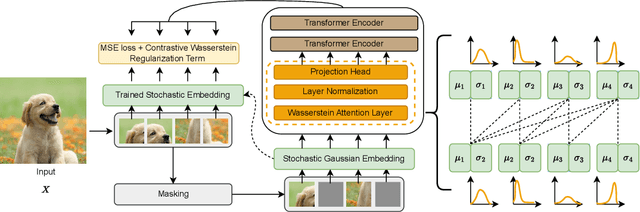
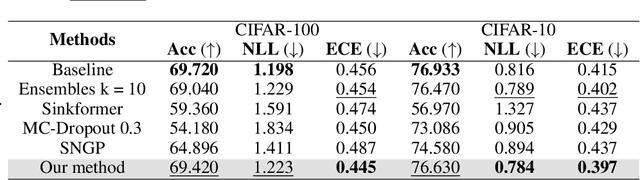
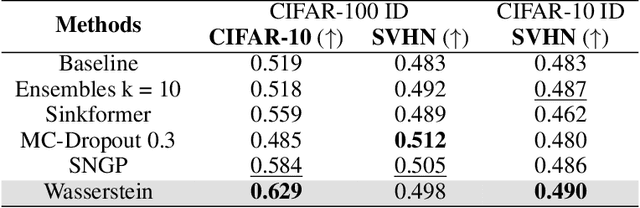
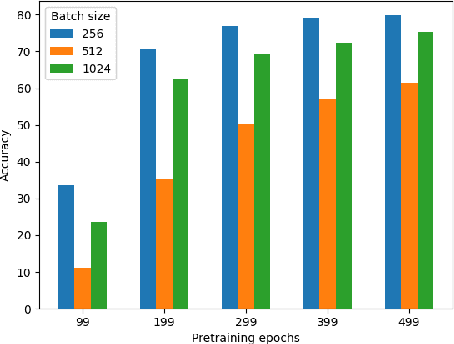
Self-supervised learning is one of the most promising approaches to acquiring knowledge from limited labeled data. Despite the substantial advancements made in recent years, self-supervised models have posed a challenge to practitioners, as they do not readily provide insight into the model's confidence and uncertainty. Tackling this issue is no simple feat, primarily due to the complexity involved in implementing techniques that can make use of the latent representations learned during pre-training without relying on explicit labels. Motivated by this, we introduce a new stochastic vision transformer that integrates uncertainty and distance awareness into self-supervised learning (SSL) pipelines. Instead of the conventional deterministic vector embedding, our novel stochastic vision transformer encodes image patches into elliptical Gaussian distributional embeddings. Notably, the attention matrices of these stochastic representational embeddings are computed using Wasserstein distance-based attention, effectively capitalizing on the distributional nature of these embeddings. Additionally, we propose a regularization term based on Wasserstein distance for both pre-training and fine-tuning processes, thereby incorporating distance awareness into latent representations. We perform extensive experiments across different tasks such as in-distribution generalization, out-of-distribution detection, dataset corruption, semi-supervised settings, and transfer learning to other datasets and tasks. Our proposed method achieves superior accuracy and calibration, surpassing the self-supervised baseline in a wide range of experiments on a variety of datasets.