 Add to Chrome
 Add to Firefox
 Add to Edge
Resolving space-sharing conflicts in road user interactions through uncertainty reduction: An active inference-based computational model
Apr 21, 2026
Understanding how road users resolve space-sharing conflicts is important both for traffic safety and the safe deployment of autonomous vehicles. While existing models have captured specific aspects of such interactions (e.g., explicit communication), a theoretically-grounded computational framework has been lacking. In this paper, we extend a previously developed active inference-based driver behavior model to simulate interactive behavior of two agents. Our model captures three complementary mechanisms for uncertainty reduction in interaction: (i) implicit communication via direct behavioral coupling, (ii) reliance on normative expectations (stop signs, priority rules, etc.), and (iii) explicit communication. In a simplified intersection scenario, we show that normative and explicit communication cues can increase the likelihood of a successful conflict resolution. However, this relies on agents acting as expected. In situations where another agent (intentionally or unintentionally) violates normative expectations or communicates misleading information, reliance on these cues may induce collisions. These findings illustrate how active inference can provide a novel framework for modeling road user interactions which is also applicable in other fields.

Automated Brake Onset Detection in Naturalistic Driving Data
Jul 23, 2025Response timing measures play a crucial role in the assessment of automated driving systems (ADS) in collision avoidance scenarios, including but not limited to establishing human benchmarks and comparing ADS to human driver response performance. For example, measuring the response time (of a human driver or ADS) to a conflict requires the determination of a stimulus onset and a response onset. In existing studies, response onset relies on manual annotation or vehicle control signals such as accelerator and brake pedal movements. These methods are not applicable when analyzing large scale data where vehicle control signals are not available. This holds in particular for the rapidly expanding sets of ADS log data where the behavior of surrounding road users is observed via onboard sensors. To advance evaluation techniques for ADS and enable measuring response timing when vehicle control signals are not available, we developed a simple and efficient algorithm, based on a piecewise linear acceleration model, to automatically estimate brake onset that can be applied to any type of driving data that includes vehicle longitudinal time series data. We also proposed a manual annotation method to identify brake onset and used it as ground truth for validation. R2 was used as a confidence metric to measure the accuracy of the algorithm, and its classification performance was analyzed using naturalistic collision avoidance data of both ADS and humans, where our method was validated against human manual annotation. Although our algorithm is subject to certain limitations, it is efficient, generalizable, applicable to any road user and scenario types, and is highly configurable.
Resolving uncertainty on the fly: Modeling adaptive driving behavior as active inference
Nov 10, 2023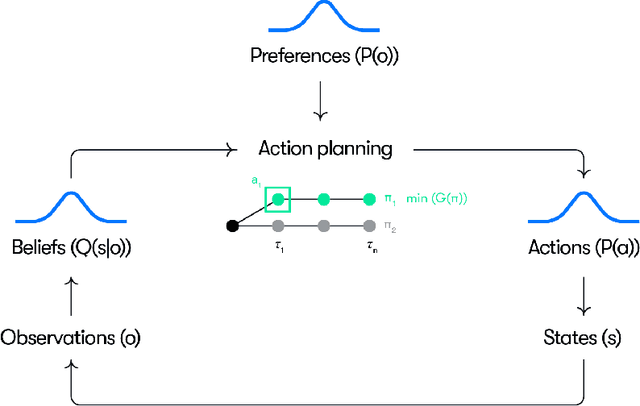
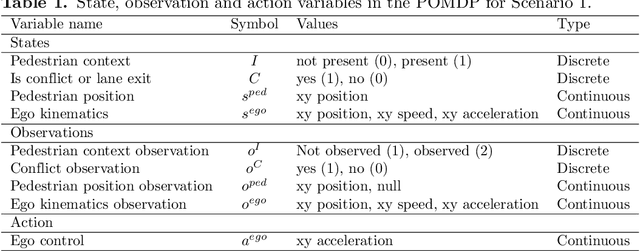
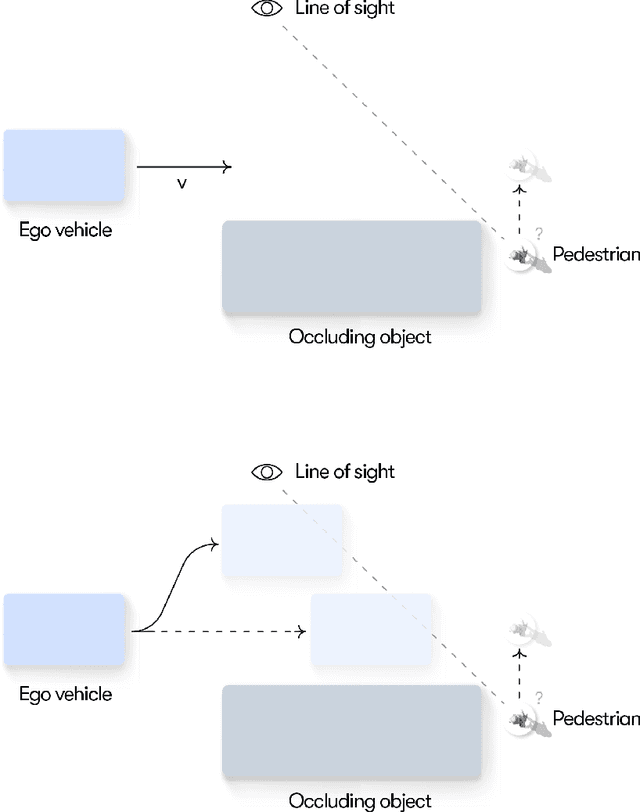
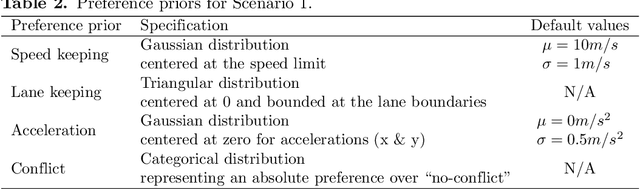
Understanding adaptive human driving behavior, in particular how drivers manage uncertainty, is of key importance for developing simulated human driver models that can be used in the evaluation and development of autonomous vehicles. However, existing traffic psychology models of adaptive driving behavior either lack computational rigor or only address specific scenarios and/or behavioral phenomena. While models developed in the fields of machine learning and robotics can effectively learn adaptive driving behavior from data, due to their black box nature, they offer little or no explanation of the mechanisms underlying the adaptive behavior. Thus, a generalizable, interpretable, computational model of adaptive human driving behavior is still lacking. This paper proposes such a model based on active inference, a behavioral modeling framework originating in computational neuroscience. The model offers a principled solution to how humans trade progress against caution through policy selection based on the single mandate to minimize expected free energy. This casts goal-seeking and information-seeking (uncertainty-resolving) behavior under a single objective function, allowing the model to seamlessly resolve uncertainty as a means to obtain its goals. We apply the model in two apparently disparate driving scenarios that require managing uncertainty, (1) driving past an occluding object and (2) visual time sharing between driving and a secondary task, and show how human-like adaptive driving behavior emerges from the single principle of expected free energy minimization.