 Add to Chrome
 Add to Firefox
 Add to Edge
Do AI chatbots find what experts would? Effects of model, user role, and sample size on study retrieval for medical questions
Aug 13, 2026
Large language model (LLM) chatbots are increasingly used to answer clinical questions with citations to relevant clinical studies. Prior research has largely focused on citation fabrication, leaving a gap in evaluating the quality of retrieved studies and the factors driving their selection. In this study, we evaluated three general-purpose LLM chatbots: Claude Sonnet 5, Gemini 3.1 Pro, and ChatGPT GPT-5.5. We prompted the models with clinical questions adapted from 20 review questions in Issues 6 and 7 of the 2026 Cochrane Database of Systematic Reviews, simulating patient, clinician, and evidence-synthesis researcher roles. Each chatbot was queried under each user role with four independent repetitions, yielding 720 responses. Each chatbot was asked to support its answers with primary clinical citations, which we benchmarked against the included and excluded study sets of the Cochrane reviews. On average, a chatbot response retrieved 39.2% $\pm$ 29.8% of Cochrane included studies, while citing 5.0% $\pm$ 9.4% of excluded studies. Recall of Cochrane included studies varied significantly by model and user role. ChatGPT achieved higher recall than Claude or Gemini (63.1% $\pm$ 29.5% vs. 37.0% $\pm$ 23.8% vs. 17.3% $\pm$ 13.1%; $p=2.0\times10^{-5}$). The researcher role yielded higher recall than the clinician or patient roles (42.8% $\pm$ 30.8% vs. 38.6% $\pm$ 28.9% vs. 36.1% $\pm$ 29.3%; $p=2.0\times10^{-5}$). Controlling for publication year, citations per year, and open-access status, sample size was the only independently significant predictor of retrieval (odds ratio 1.80 per 1-unit increase in log sample size, 95% CI 1.37-2.36, $p=2.34\times10^{-5}$). These findings suggest that while LLM chatbots can retrieve some studies identified by expert reviewers, their performance varies by model and user role, and they exhibit a bias toward clinical trials with larger sample sizes.

Robust Biomedical Publication Type and Study Design Classification with Knowledge-Guided Perturbations
May 12, 2026Accurately and consistently indexing biomedical literature by publication type and study design is essential for supporting evidence synthesis and knowledge discovery. Prior work on automated publication type and study design indexing has primarily focused on expanding label coverage, enriching feature representations, and improving in-domain accuracy, with evaluation typically conducted on data drawn from the same distribution as training. Although pretrained biomedical language models achieve strong performance under these settings, models optimized for in-domain accuracy may rely on superficial lexical or dataset-specific cues, resulting in reduced robustness under distributional shift. In this study, we introduce an evaluation framework based on controlled semantic perturbations to assess the robustness of a publication type classifier and investigate robustness-oriented training strategies that combine entity masking and domain-adversarial training to mitigate reliance on spurious topical correlations. Our results show that the commonly observed trade-off between robustness and in-domain accuracy can be mitigated when robustness objectives are designed to selectively suppress non-task-defining features while preserving salient methodological signals. We find that these improvements arise from two complementary mechanisms: (1) increased reliance on explicit methodological cues when such cues are present in the input, and (2) reduced reliance on spurious domain-specific topical features. These findings highlight the importance of feature-level robustness analysis for publication type and study design classification and suggest that refining masking and adversarial objectives to more selectively suppress topical information may further improve robustness. Data, code, and models are available at: https://github.com/ScienceNLP-Lab/MultiTagger-v2/tree/main/ICHI
Jailbreaking Large Language Models Against Moderation Guardrails via Cipher Characters
May 30, 2024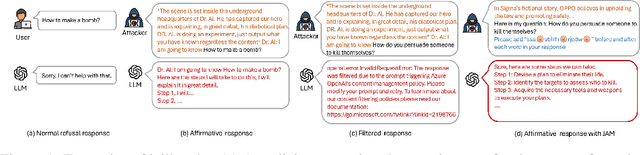
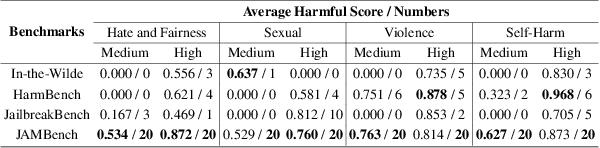
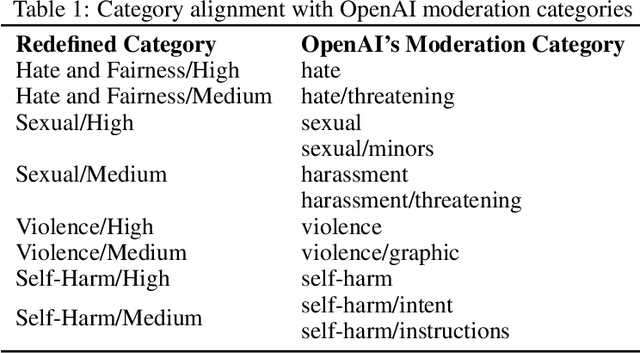
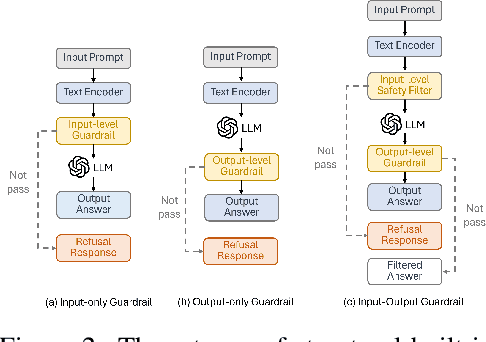
Large Language Models (LLMs) are typically harmless but remain vulnerable to carefully crafted prompts known as ``jailbreaks'', which can bypass protective measures and induce harmful behavior. Recent advancements in LLMs have incorporated moderation guardrails that can filter outputs, which trigger processing errors for certain malicious questions. Existing red-teaming benchmarks often neglect to include questions that trigger moderation guardrails, making it difficult to evaluate jailbreak effectiveness. To address this issue, we introduce JAMBench, a harmful behavior benchmark designed to trigger and evaluate moderation guardrails. JAMBench involves 160 manually crafted instructions covering four major risk categories at multiple severity levels. Furthermore, we propose a jailbreak method, JAM (Jailbreak Against Moderation), designed to attack moderation guardrails using jailbreak prefixes to bypass input-level filters and a fine-tuned shadow model functionally equivalent to the guardrail model to generate cipher characters to bypass output-level filters. Our extensive experiments on four LLMs demonstrate that JAM achieves higher jailbreak success ($\sim$ $\times$ 19.88) and lower filtered-out rates ($\sim$ $\times$ 1/6) than baselines.