 Add to Chrome
 Add to Firefox
 Add to Edge
Inverting Data Transformations via Diffusion Sampling
Feb 09, 2026
We study the problem of transformation inversion on general Lie groups: a datum is transformed by an unknown group element, and the goal is to recover an inverse transformation that maps it back to the original data distribution. Such unknown transformations arise widely in machine learning and scientific modeling, where they can significantly distort observations. We take a probabilistic view and model the posterior over transformations as a Boltzmann distribution defined by an energy function on data space. To sample from this posterior, we introduce a diffusion process on Lie groups that keeps all updates on-manifold and only requires computations in the associated Lie algebra. Our method, Transformation-Inverting Energy Diffusion (TIED), relies on a new trivialized target-score identity that enables efficient score-based sampling of the transformation posterior. As a key application, we focus on test-time equivariance, where the objective is to improve the robustness of pretrained neural networks to input transformations. Experiments on image homographies and PDE symmetries demonstrate that TIED can restore transformed inputs to the training distribution at test time, showing improved performance over strong canonicalization and sampling baselines. Code is available at https://github.com/jw9730/tied.

A Real-Time Lyrics Alignment System Using Chroma And Phonetic Features For Classical Vocal Performance
Jan 17, 2024The goal of real-time lyrics alignment is to take live singing audio as input and to pinpoint the exact position within given lyrics on the fly. The task can benefit real-world applications such as the automatic subtitling of live concerts or operas. However, designing a real-time model poses a great challenge due to the constraints of only using past input and operating within a minimal latency. Furthermore, due to the lack of datasets for real-time models for lyrics alignment, previous studies have mostly evaluated with private in-house datasets, resulting in a lack of standard evaluation methods. This paper presents a real-time lyrics alignment system for classical vocal performances with two contributions. First, we improve the lyrics alignment algorithm by finding an optimal combination of chromagram and phonetic posteriorgram (PPG) that capture melodic and phonetics features of the singing voice, respectively. Second, we recast the Schubert Winterreise Dataset (SWD) which contains multiple performance renditions of the same pieces as an evaluation set for the real-time lyrics alignment.
A study of audio mixing methods for piano transcription in violin-piano ensembles
May 23, 2023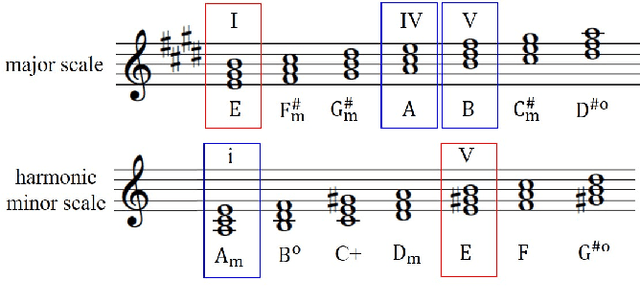
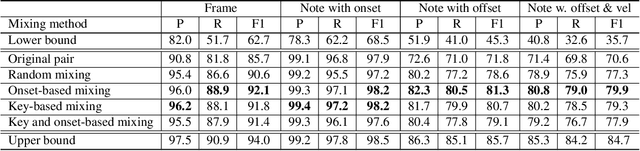
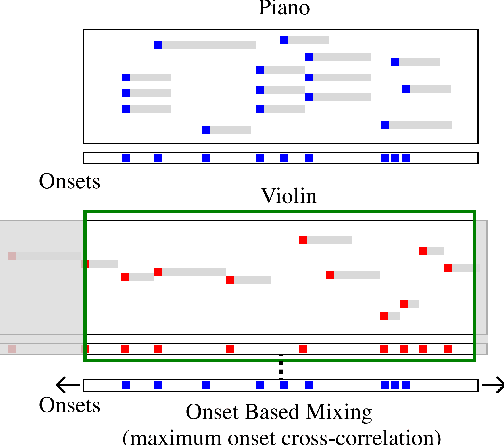
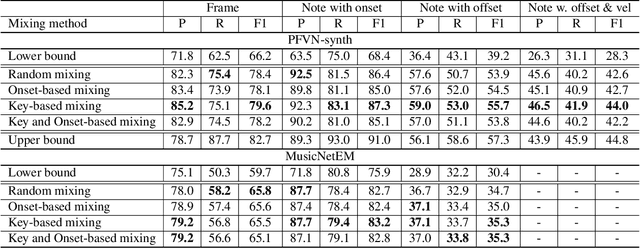
While piano music transcription models have shown high performance for solo piano recordings, their performance degrades when applied to ensemble recordings. This study aims to analyze the impact of different data augmentation methods on piano transcription performance, specifically focusing on mixing techniques applied to violin-piano ensembles. We apply mixing methods that consider both harmonic and temporal characteristics of the audio. To create datasets for this study, we generated the PFVN-synth dataset, which contains 7 hours of violin-piano ensemble audio by rendering MIDI files and corresponding labels, and also collected unaccompanied violin recordings and mixed them with the MAESTRO dataset. We evaluated the transcription results on both synthesized and real audio recordings datasets.