 Add to Chrome
 Add to Firefox
 Add to Edge
IndustryBench: Probing the Industrial Knowledge Boundaries of LLMs
May 11, 2026
In industrial procurement, an LLM answer is useful only if it survives a standards check: recommended material must match operating condition, every parameter must respect a regulated threshold, and no procedure may contradict a safety clause. Partial correctness can mask safety-critical contradictions that aggregate LLM benchmarks rarely capture. We introduce IndustryBench, a 2,049-item benchmark for industrial procurement QA in Chinese, grounded in Chinese national standards (GB/T) and structured industrial product records, organized by seven capability dimensions, ten industry categories, and panel-derived difficulty tiers, with item-aligned English, Russian, and Vietnamese renderings. Our construction pipeline rejects 70.3% of LLM-generated candidates at a search-based external-verification stage, calibrating how unreliable industrial QA remains after LLM-only filtering.Our evaluation decouples raw correctness, scored by a Qwen3-Max judge validated at $κ_w = 0.798$ against a domain expert, from a separate safety-violation (SV) check against source texts. Across 17 models in Chinese and an 8-model intersection over four languages, we find: (i) the best system reaches only 2.083 on the 0--3 rubric, leaving substantial headroom; (ii) Standards & Terminology is the most persistent capability weakness and survives item-aligned translation; (iii) extended reasoning lowers safety-adjusted scores for 12 of 13 models, primarily by introducing unsupported safety-critical details into longer final answers; and (iv) safety-violation rates reshuffle the leaderboard -- GPT-5.4 climbs from rank 6 to rank 3 after SV adjustment, while Kimi-k2.5-1T-A32B drops seven positions.Industrial LLM evaluation therefore requires source-grounded, safety-aware diagnosis rather than aggregate accuracy. We release IndustryBench with all prompts, scoring scripts, and dataset documentation.

Taiyi: A Bilingual Fine-Tuned Large Language Model for Diverse Biomedical Tasks
Nov 20, 2023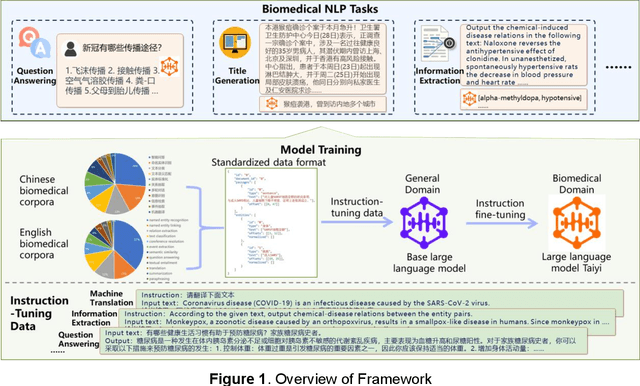
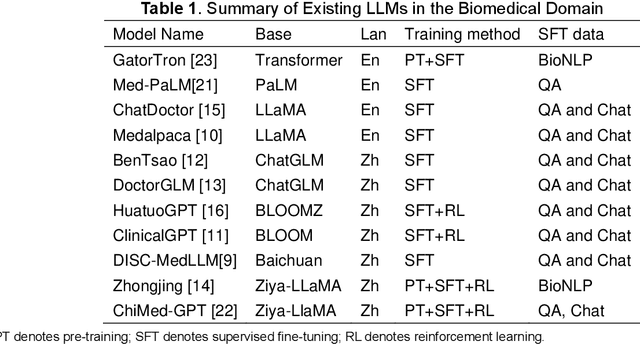
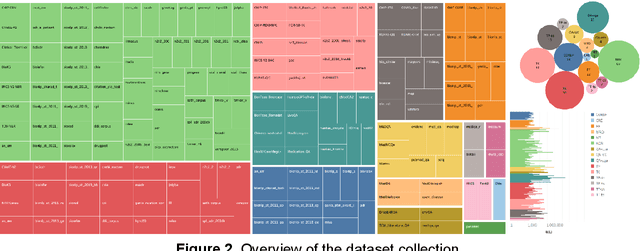
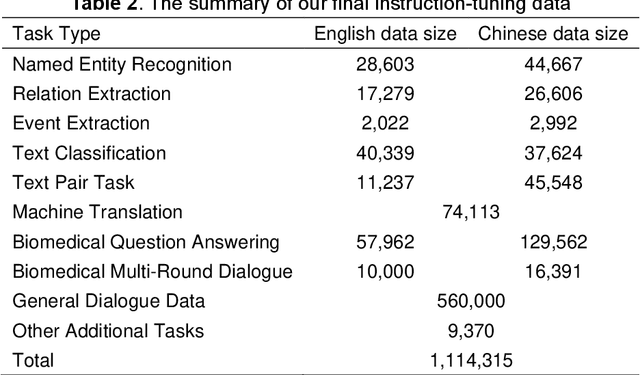
Recent advancements in large language models (LLMs) have shown promising results across a variety of natural language processing (NLP) tasks. The application of LLMs to specific domains, such as biomedicine, has achieved increased attention. However, most biomedical LLMs focus on enhancing performance in monolingual biomedical question answering and conversation tasks. To further investigate the effectiveness of the LLMs on diverse biomedical NLP tasks in different languages, we present Taiyi, a bilingual (English and Chinese) fine-tuned LLM for diverse biomedical tasks. In this work, we first curated a comprehensive collection of 140 existing biomedical text mining datasets across over 10 task types. Subsequently, a two-stage strategy is proposed for supervised fine-tuning to optimize the model performance across varied tasks. Experimental results on 13 test sets covering named entity recognition, relation extraction, text classification, question answering tasks demonstrate Taiyi achieves superior performance compared to general LLMs. The case study involving additional biomedical NLP tasks further shows Taiyi's considerable potential for bilingual biomedical multi-tasking. The source code, datasets, and model for Taiyi are freely available at https://github.com/DUTIR-BioNLP/Taiyi-LLM.