 Add to Chrome
 Add to Firefox
 Add to Edge
Continuum Robot Modeling with Action Conditioned Flow Matching
May 09, 2026
Predicting the shape of tendon driven continuum robots (TDCRs) at steady state from actuation remains challenging due to continuous deformation, complex tendon routing, compliance, friction, and fabrication variability. In this paper, we address this problem as kinematic self modeling conditioned on action. We present a lightweight 3D printed TDCR hardware platform and an RGB-D data collection pipeline with multiple cameras, and we learn a point cloud flow matching model that maps motor actuation states to the robot's settled 3D geometry. The model is trained from randomly sampled quasi static configurations and evaluated on test motor commands within the same TDCR design family and actuation range. We compare against prior 3D deformable object and robot self modeling approaches in both MuJoCo simulation and real hardware experiments. Experiments on simulated 2-, 3-, and 5-module TDCRs and real 2- and 3-module robots show improved shape prediction accuracy under CD and EMD metrics. We further show in simulation that the same conditional formulation generalizes to tip payload as a conditioning input, enabling payload conditioned steady-state shape prediction. These results demonstrate a data driven self modeling framework for quasi static TDCR geometry prediction.

From Experience to Skill: Multi-Agent Generative Engine Optimization via Reusable Strategy Learning
Apr 21, 2026Generative engines (GEs) are reshaping information access by replacing ranked links with citation-grounded answers, yet current Generative Engine Optimization (GEO) methods optimize each instance in isolation, unable to accumulate or transfer effective strategies across tasks and engines. We reframe GEO as a strategy learning problem and propose MAGEO, a multi-agent framework in which coordinated planning, editing, and fidelity-aware evaluation serve as the execution layer, while validated editing patterns are progressively distilled into reusable, engine-specific optimization skills. To enable controlled assessment, we introduce a Twin Branch Evaluation Protocol for causal attribution of content edits and DSV-CF, a dual-axis metric that unifies semantic visibility with attribution accuracy. We further release MSME-GEO-Bench, a multi-scenario, multi-engine benchmark grounded in real-world queries. Experiments on three mainstream engines show that MAGEO substantially outperforms heuristic baselines in both visibility and citation fidelity, with ablations confirming that engine-specific preference modeling and strategy reuse are central to these gains, suggesting a scalable learning-driven paradigm for trustworthy GEO. Code is available at https://github.com/Wu-beining/MAGEO
Beyond Cropping and Rotation: Automated Evolution of Powerful Task-Specific Augmentations with Generative Models
Feb 03, 2026Data augmentation has long been a cornerstone for reducing overfitting in vision models, with methods like AutoAugment automating the design of task-specific augmentations. Recent advances in generative models, such as conditional diffusion and few-shot NeRFs, offer a new paradigm for data augmentation by synthesizing data with significantly greater diversity and realism. However, unlike traditional augmentations like cropping or rotation, these methods introduce substantial changes that enhance robustness but also risk degrading performance if the augmentations are poorly matched to the task. In this work, we present EvoAug, an automated augmentation learning pipeline, which leverages these generative models alongside an efficient evolutionary algorithm to learn optimal task-specific augmentations. Our pipeline introduces a novel approach to image augmentation that learns stochastic augmentation trees that hierarchically compose augmentations, enabling more structured and adaptive transformations. We demonstrate strong performance across fine-grained classification and few-shot learning tasks. Notably, our pipeline discovers augmentations that align with domain knowledge, even in low-data settings. These results highlight the potential of learned generative augmentations, unlocking new possibilities for robust model training.
AutoURDF: Unsupervised Robot Modeling from Point Cloud Frames Using Cluster Registration
Dec 07, 2024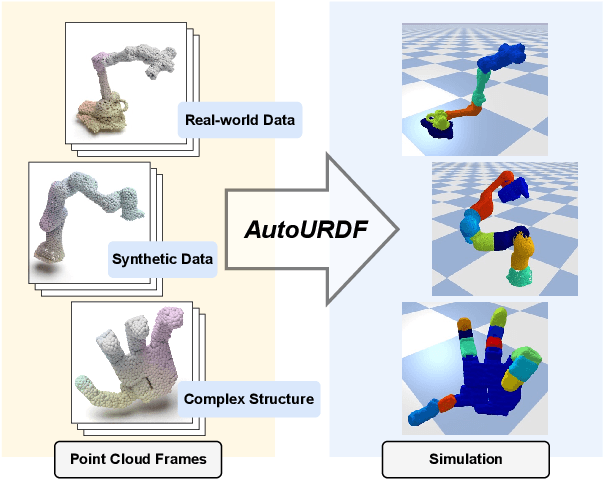
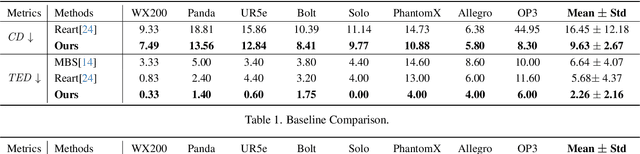
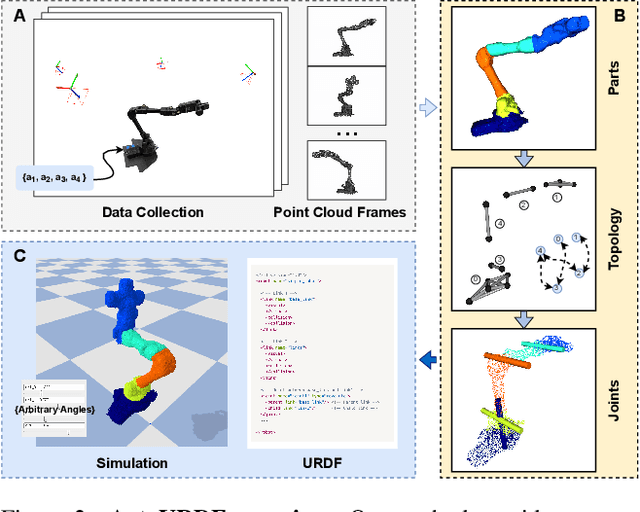
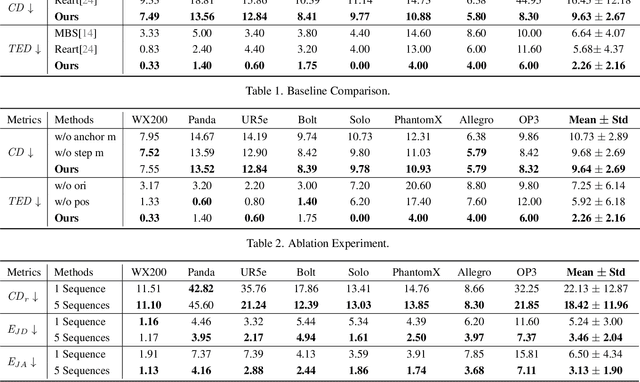
Robot description models are essential for simulation and control, yet their creation often requires significant manual effort. To streamline this modeling process, we introduce AutoURDF, an unsupervised approach for constructing description files for unseen robots from point cloud frames. Our method leverages a cluster-based point cloud registration model that tracks the 6-DoF transformations of point clusters. Through analyzing cluster movements, we hierarchically address the following challenges: (1) moving part segmentation, (2) body topology inference, and (3) joint parameter estimation. The complete pipeline produces robot description files that are fully compatible with existing simulators. We validate our method across a variety of robots, using both synthetic and real-world scan data. Results indicate that our approach outperforms previous methods in registration and body topology estimation accuracy, offering a scalable solution for automated robot modeling.
Teaching Robots to Build Simulations of Themselves
Nov 20, 2023Simulation enables robots to plan and estimate the outcomes of prospective actions without the need to physically execute them. We introduce a self-supervised learning framework to enable robots model and predict their morphology, kinematics and motor control using only brief raw video data, eliminating the need for extensive real-world data collection and kinematic priors. By observing their own movements, akin to humans watching their reflection in a mirror, robots learn an ability to simulate themselves and predict their spatial motion for various tasks. Our results demonstrate that this self-learned simulation not only enables accurate motion planning but also allows the robot to detect abnormalities and recover from damage.