 Add to Chrome
 Add to Firefox
 Add to Edge
LABO: LLM-Accelerated Bayesian Optimization through Broad Exploration and Selective Experimentation
May 21, 2026
The high cost and data scarcity in scientific exploration have motivated the use of large language models (LLMs) as knowledge-driven components in Bayesian optimization (BO). However, existing approaches typically embed LLMs directly into the sampling or surrogate modeling pipeline, without fully leveraging their significantly lower evaluation cost compared to real-world experiments. To address this limitation, we propose LLM-Accelerated Bayesian Optimization (LABO), a framework that combines LLM predictions with experimental observations within a single BO loop. LABO employs a gating criterion to dynamically balance the reliance on LLM predictions versus actual experiments. By leveraging inexpensive LLM evaluations to broadly explore the search space and reserving costly real experiments only for regions with high uncertainty, LABO achieves more sample-efficient optimization. We provide a theoretical analysis with a cumulative regret bound that formalizes this efficiency gain. Empirical results across diverse scientific tasks demonstrate that LABO consistently outperforms existing methods under identical experimental budgets. Our results suggest that LABO offers a practical and theoretically grounded approach for integrating LLMs into scientific discovery workflows.

Expectation Consistency Loss: Rethink Confidence Calibration under Covariate Shift
May 20, 2026Confidence calibration for classification models is vital in safety-critical decision-making scenarios and has received extensive attention. General confidence calibration methods assume training and test data are independent and identically distributed, limiting their effectiveness under covariate shifts. Previous calibration methods under covariate shift struggle with class-wise or canonical calibrations and often rely on unstable importance weighting when density ratios are large or unbounded. Given the above limitations, this paper rethinks confidence calibration under covariate shifts. First, we derive a necessary and sufficient condition for confidence calibration under covariate shifts, named Expectation consistency condition, which reveals covariate shifts do not necessarily lead to uncalibrated confidence and provides a weaker condition for confidence calibration than global covariate distribution alignment. Then, utilizing Expectation consistency condition, this paper proposes an unsupervised domain adaptation loss to calibrate confidence of the target domain, named Expectation consistency loss (ECL), which is compatible with canonical calibration, class-wise calibration, and top-label calibration. Third, we prove that computing ECL loss has the same sample complexity as Expected Calibration Error (ECE) and provide a theoretically grounded mini-batch trainable scheme for ECL loss. Finally, we validate the effectiveness of our method on both simulated and real-world covariate shift datasets.
Proximal Action Replacement for Behavior Cloning Actor-Critic in Offline Reinforcement Learning
Feb 07, 2026Offline reinforcement learning (RL) optimizes policies from a previously collected static dataset and is an important branch of RL. A popular and promising approach is to regularize actor-critic methods with behavior cloning (BC), which yields realistic policies and mitigates bias from out-of-distribution actions, but can impose an often-overlooked performance ceiling: when dataset actions are suboptimal, indiscriminate imitation structurally prevents the actor from fully exploiting high-value regions suggested by the critic, especially in later training when imitation is already dominant. We formally analyzed this limitation by investigating convergence properties of BC-regularized actor-critic optimization and verified it on a controlled continuous bandit task. To break this ceiling, we propose proximal action replacement (PAR), a plug-and-play training sample replacer that progressively replaces low-value actions with high-value actions generated by a stable actor, broadening the action exploration space while reducing the impact of low-value data. PAR is compatible with multiple BC regularization paradigms. Extensive experiments across offline RL benchmarks show that PAR consistently improves performance and approaches state-of-the-art when combined with the basic TD3+BC.
Combining Priors with Experience: Confidence Calibration Based on Binomial Process Modeling
Dec 18, 2024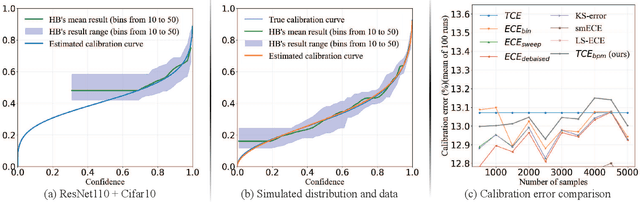
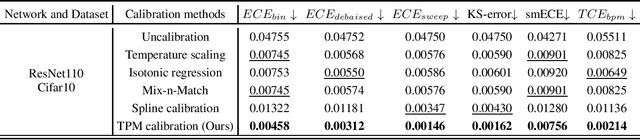
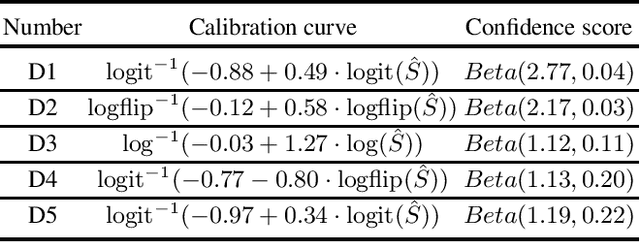
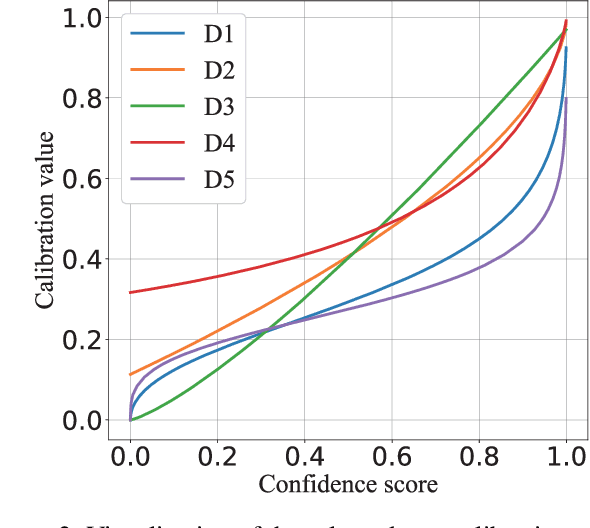
Confidence calibration of classification models is a technique to estimate the true posterior probability of the predicted class, which is critical for ensuring reliable decision-making in practical applications. Existing confidence calibration methods mostly use statistical techniques to estimate the calibration curve from data or fit a user-defined calibration function, but often overlook fully mining and utilizing the prior distribution behind the calibration curve. However, a well-informed prior distribution can provide valuable insights beyond the empirical data under the limited data or low-density regions of confidence scores. To fill this gap, this paper proposes a new method that integrates the prior distribution behind the calibration curve with empirical data to estimate a continuous calibration curve, which is realized by modeling the sampling process of calibration data as a binomial process and maximizing the likelihood function of the binomial process. We prove that the calibration curve estimating method is Lipschitz continuous with respect to data distribution and requires a sample size of $3/B$ of that required for histogram binning, where $B$ represents the number of bins. Also, a new calibration metric ($TCE_{bpm}$), which leverages the estimated calibration curve to estimate the true calibration error (TCE), is designed. $TCE_{bpm}$ is proven to be a consistent calibration measure. Furthermore, realistic calibration datasets can be generated by the binomial process modeling from a preset true calibration curve and confidence score distribution, which can serve as a benchmark to measure and compare the discrepancy between existing calibration metrics and the true calibration error. The effectiveness of our calibration method and metric are verified in real-world and simulated data.