 Add to Chrome
 Add to Firefox
 Add to Edge
The Rise of Sparse Mixture-of-Experts: A Survey from Algorithmic Foundations to Decentralized Architectures and Vertical Domain Applications
Feb 08, 2026
The sparse Mixture of Experts(MoE) architecture has evolved as a powerful approach for scaling deep learning models to more parameters with comparable computation cost. As an important branch of large language model(LLM), MoE model only activate a subset of experts based on a routing network. This sparse conditional computation mechanism significantly improves computational efficiency, paving a promising path for greater scalability and cost-efficiency. It not only enhance downstream applications such as natural language processing, computer vision, and multimodal in various horizontal domains, but also exhibit broad applicability across vertical domains. Despite the growing popularity and application of MoE models across various domains, there lacks a systematic exploration of recent advancements of MoE in many important fields. Existing surveys on MoE suffer from limitations such as lack coverage or none extensively exploration of key areas. This survey seeks to fill these gaps. In this paper, Firstly, we examine the foundational principles of MoE, with an in-depth exploration of its core components-the routing network and expert network. Subsequently, we extend beyond the centralized paradigm to the decentralized paradigm, which unlocks the immense untapped potential of decentralized infrastructure, enables democratization of MoE development for broader communities, and delivers greater scalability and cost-efficiency. Furthermore we focus on exploring its vertical domain applications. Finally, we also identify key challenges and promising future research directions. To the best of our knowledge, this survey is currently the most comprehensive review in the field of MoE. We aim for this article to serve as a valuable resource for both researchers and practitioners, enabling them to navigate and stay up-to-date with the latest advancements.

Interference Factors and Compensation Methods when Using Infrared Thermography for Temperature Measurement: A Review
Feb 24, 2025Infrared thermography (IRT) is a widely used temperature measurement technology, but it faces the problem of measurement errors under interference factors. This paper attempts to summarize the common interference factors and temperature compensation methods when applying IRT. According to the source of factors affecting the infrared temperature measurement accuracy, the interference factors are divided into three categories: factors from the external environment, factors from the measured object, and factors from the infrared thermal imager itself. At the same time, the existing compensation methods are classified into three categories: Mechanism Modeling based Compensation method (MMC), Data-Driven Compensation method (DDC), and Mechanism and Data jointly driven Compensation method (MDC). Furthermore, we discuss the problems existing in the temperature compensation methods and future research directions, aiming to provide some references for researchers in academia and industry when using IRT technology for temperature measurement.
Combining Priors with Experience: Confidence Calibration Based on Binomial Process Modeling
Dec 18, 2024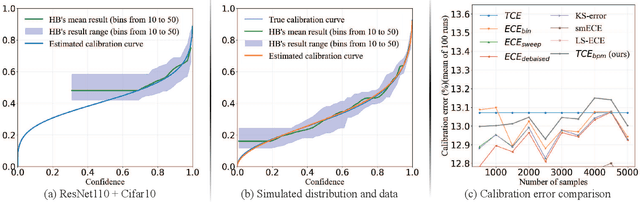
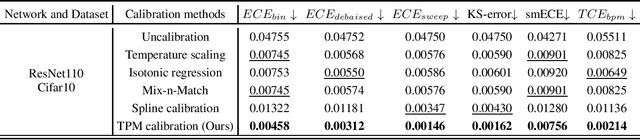
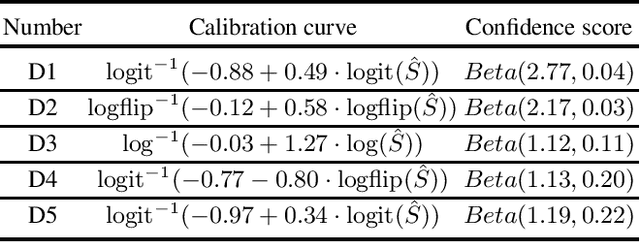
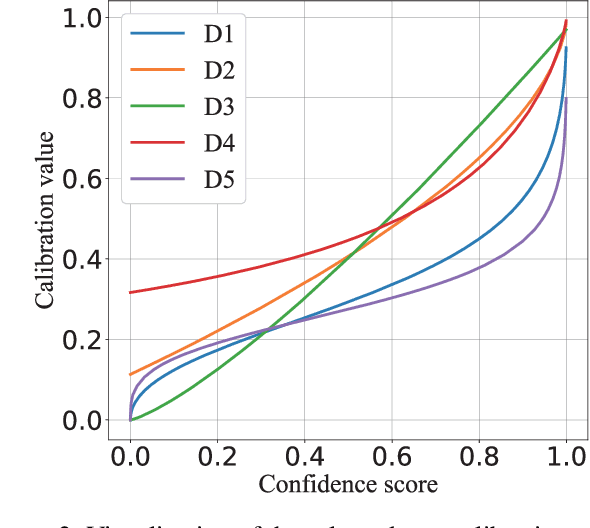
Confidence calibration of classification models is a technique to estimate the true posterior probability of the predicted class, which is critical for ensuring reliable decision-making in practical applications. Existing confidence calibration methods mostly use statistical techniques to estimate the calibration curve from data or fit a user-defined calibration function, but often overlook fully mining and utilizing the prior distribution behind the calibration curve. However, a well-informed prior distribution can provide valuable insights beyond the empirical data under the limited data or low-density regions of confidence scores. To fill this gap, this paper proposes a new method that integrates the prior distribution behind the calibration curve with empirical data to estimate a continuous calibration curve, which is realized by modeling the sampling process of calibration data as a binomial process and maximizing the likelihood function of the binomial process. We prove that the calibration curve estimating method is Lipschitz continuous with respect to data distribution and requires a sample size of $3/B$ of that required for histogram binning, where $B$ represents the number of bins. Also, a new calibration metric ($TCE_{bpm}$), which leverages the estimated calibration curve to estimate the true calibration error (TCE), is designed. $TCE_{bpm}$ is proven to be a consistent calibration measure. Furthermore, realistic calibration datasets can be generated by the binomial process modeling from a preset true calibration curve and confidence score distribution, which can serve as a benchmark to measure and compare the discrepancy between existing calibration metrics and the true calibration error. The effectiveness of our calibration method and metric are verified in real-world and simulated data.
High speed free-space optical communication using standard fiber communication component without optical amplification
Feb 27, 2023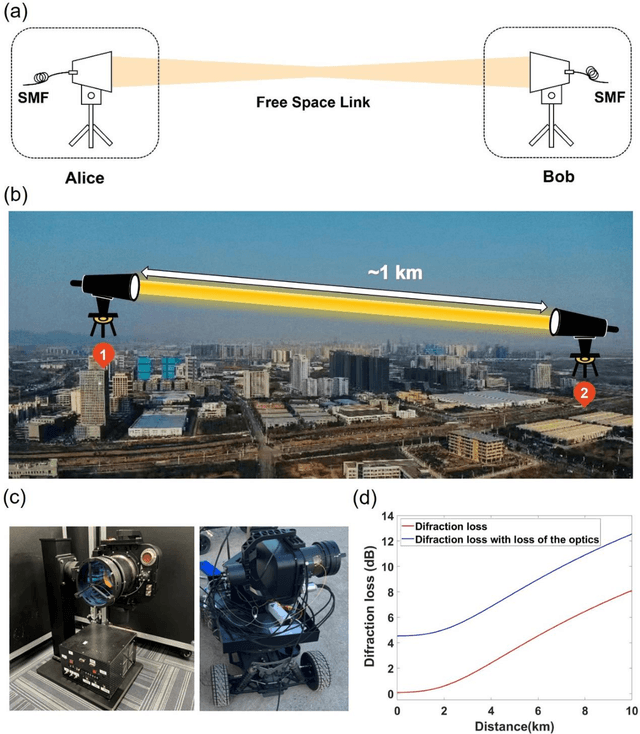
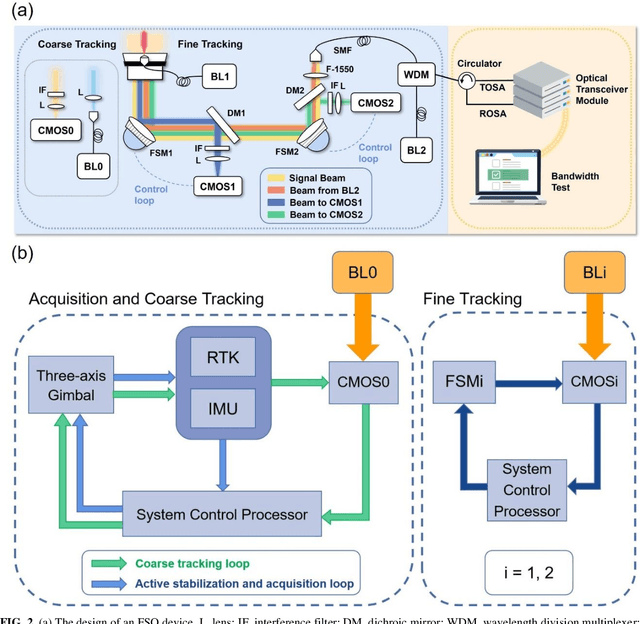
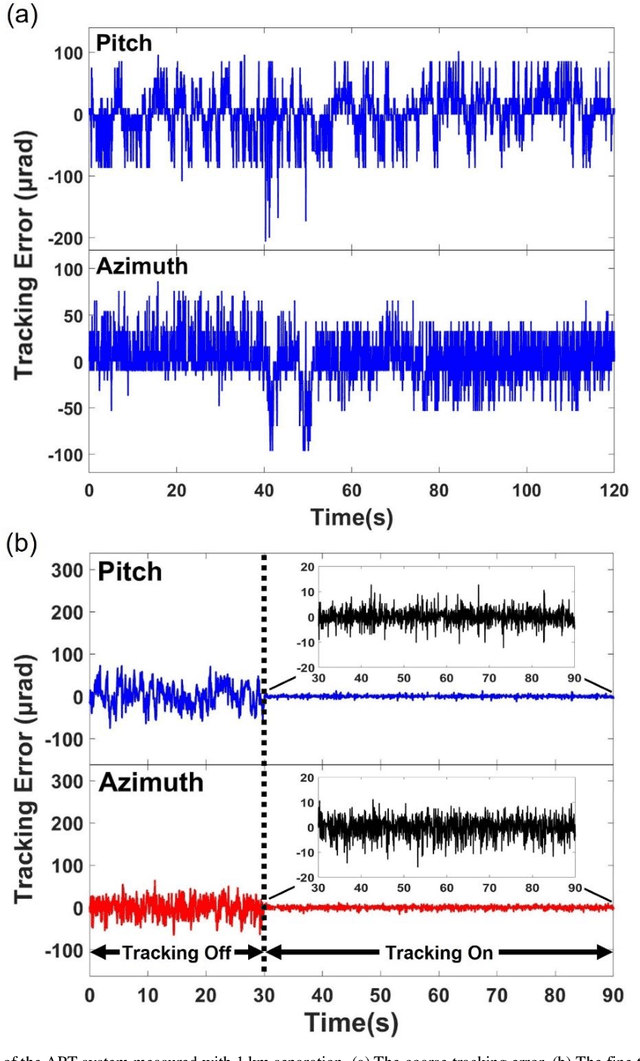
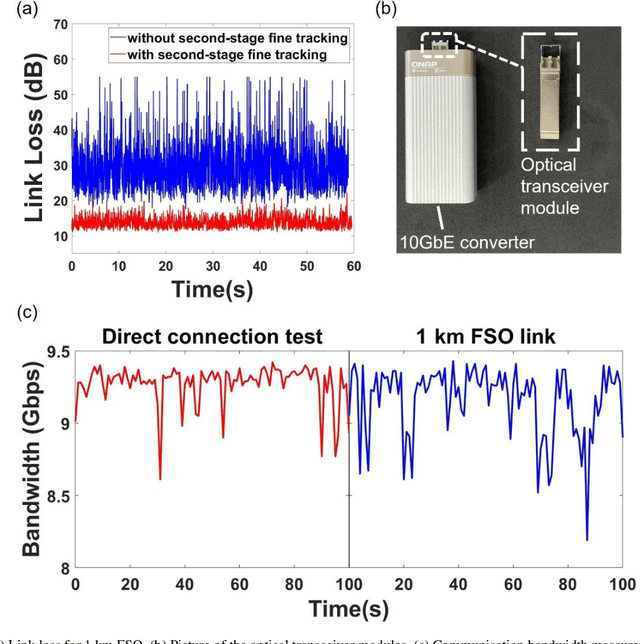
Free-space optical communication (FSO) can achieve fast, secure and license-free communication without need for physical cables, making it a cost-effective, energy-efficient and flexible solution when the fiber connection is absent. To establish FSO connection on-demand, it is essential to build portable FSO devices with compact structure and light weight. Here, we develop a miniaturized FSO system and realize 9.16 Gbps FSO between two nodes that is 1 km apart, using a commercial fiber-coupled optical transceiver module with no optical amplification. Basing on the home-made compact 90 mm-diameter acquisition, pointing and tracking (APT) system with four-stage close-loop feedback, the link tracking error is controlled at 3 {\mu}rad and results an average coupling loss of 13.7 dB. Such loss is within the tolerance of the commercial optical communication modules, and without the need of optical amplifiers, which contributes to the low system weight and power consumption. As a result, a single FSO device weighs only about 12 kg, making it compact and portable for potential application in high-speed wireless communication. Our FSO link has been tested up to 4 km, with link loss of 18 dB in the foggy weather in Nanjing, that shows longer distances can be covered with optical amplification.