 Add to Chrome
 Add to Firefox
 Add to Edge
X-Stage: An Overlooked Pipeline Stage for Communication-Computation Overlap in DiT Inference
Jul 25, 2026
Fine-grained, device-initiated communication lets persistent GPU kernels in distributed diffusion transformer (DiT) inference issue remote stores and overlap data movement with Tensor Core computation. Existing systems schedule when communication is issued and when received data becomes consumable, but omit post-issue progress before remote-visible completion, making sender backpressure hard to predict. We identify X-Stage, a software-visible post-issue pipeline stage. Measurements on an eight-GPU node with a recent NVIDIA architecture show that short remote-store bursts drain as the issuer resumes work, whereas sustained injection exhausts finite outstanding capacity and delays later issues. A lightweight Burst-Gap model parameterized by backpressure-free issue time, effective drain rate, and outstanding capacity predicts issue overhead, recovery between bursts, and the onset of backpressure. Guided by the model, we redesign two communication-computation fused kernels. For DeepGEMM MegaMoE, interleaving Linear-1 and Linear-2 work across expert waves places computation between concentrated remote-store bursts, yielding a 1.18x geometric-mean and 1.62x maximum kernel speedup over the Expert-Wave baseline across 84 configurations. For Ulysses sequence-parallel attention, tile-granular fusion of the post-attention All-to-All with FlashAttention lets an output-tile owner issue remote stores and resume computation without a dedicated communication warp or streaming multiprocessor. FlashAttention-3 and FlashAttention-4 reach maximum sender-visible speedups of 1.43x and 1.42x over serial execution, and at long sequences their steady-state times approach those of FlashAttention alone. These results establish post-issue progress as a measurable scheduling lever for shaping bursts, avoiding backpressure, and hiding sender-side overhead.

Combining the Silhouette and Skeleton Data for Gait Recognition
Mar 29, 2022
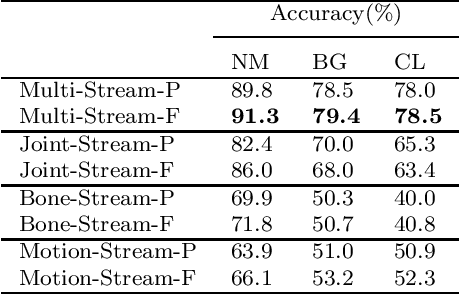
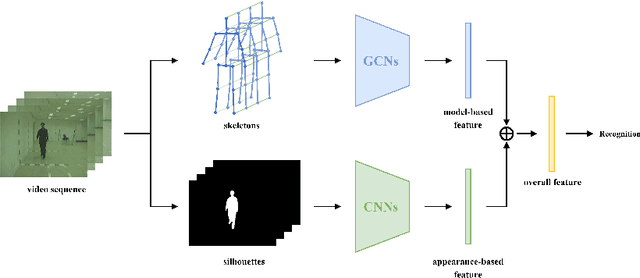
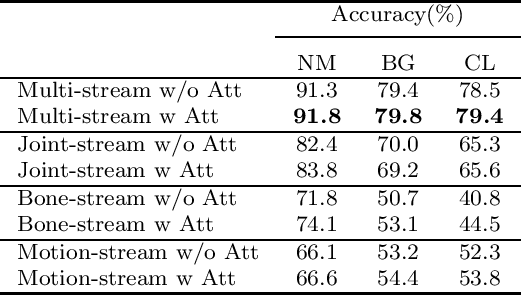
Gait recognition, a promising long-distance biometric technology, has aroused intense interest in computer vision. Existing works on gait recognition can be divided into appearance-based methods and model-based methods, which extract features from silhouettes and skeleton data, respectively. However, since appearance-based methods are greatly affected by clothing changing and carrying condition, and model-based methods are limited by the accuracy of pose estimation approaches, gait recognition remains challenging in practical applications. In order to integrate the advantages of such two approaches, a two-branch neural network (NN) is proposed in this paper. Our method contains two branches, namely a CNN-based branch taking silhouettes as input and a GCN-based branch taking skeletons as input. In addition, two new modules are proposed in the GCN-based branch for better gait representation. First, we present a simple yet effective fully connected graph convolution operator to integrate the multi-scale graph convolutions and alleviate the dependence on natural human joint connections. Second, we deploy a multi-dimension attention module named STC-Att to learn spatial, temporal and channel-wise attention simultaneously. We evaluated the proposed two-branch neural network on the CASIA-B dataset. The experimental results show that our method achieves state-of-the-art performance in various conditions.