 Add to Chrome
 Add to Firefox
 Add to Edge
MAJEPPA: Morphing and Assessing in a Unified Piano Performance Space
Aug 11, 2026
We present MAJEPPA, a self-supervised framework to learn piano performance representations that span the full skill spectrum, from beginner practice sessions to virtuoso concert recordings. We curate the MAJEPPA dataset, comprising ~4,000 annotated recordings across six expertise levels and six recording contexts. We adapt a single pre-trained MIDI autoregressive model with a joint objective: next-token prediction learns score-conditioned performance generation at various skill levels, while InfoNCE and supervised contrastive losses align abstract score and performance representations in a joint embedding space. The proposed model both generates and understands performances in a unified framework. By introducing the EVPMR benchmark, a suite of downstream tasks spanning quality assessment, competition ranking, mistake and technique classification, we evaluate the learnt representations, demonstrating progress towards a real-world model for the piano performance space.

Mobile Image Restoration via Prior Quantization
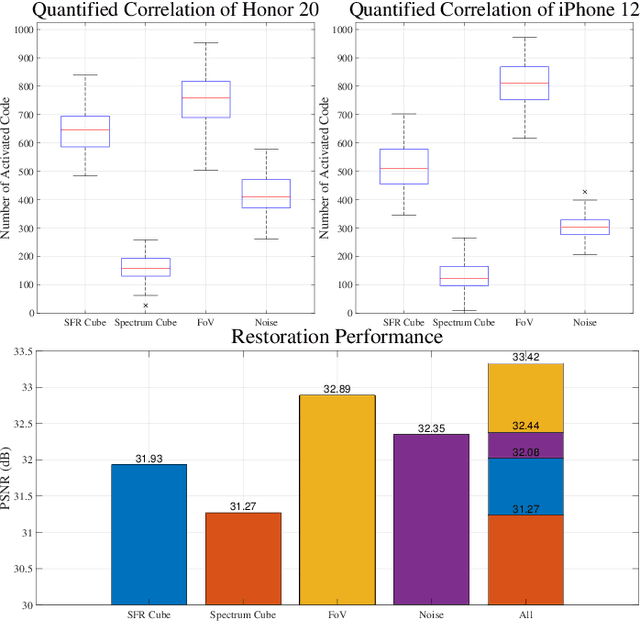
May 10, 2023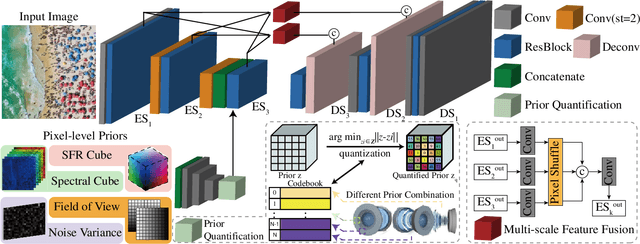


In digital images, the performance of optical aberration is a multivariate degradation, where the spectral of the scene, the lens imperfections, and the field of view together contribute to the results. Besides eliminating it at the hardware level, the post-processing system, which utilizes various prior information, is significant for correction. However, due to the content differences among priors, the pipeline that aligns these factors shows limited efficiency and unoptimized restoration. Here, we propose a prior quantization model to correct the optical aberrations in image processing systems. To integrate these messages, we encode various priors into a latent space and quantify them by the learnable codebooks. After quantization, the prior codes are fused with the image restoration branch to realize targeted optical aberration correction. Comprehensive experiments demonstrate the flexibility of the proposed method and validate its potential to accomplish targeted restoration for a specific camera. Furthermore, our model promises to analyze the correlation between the various priors and the optical aberration of devices, which is helpful for joint soft-hardware design.