 Add to Chrome
 Add to Firefox
 Add to Edge
AttnLink: Turning Attention into Schema Links for Text-to-SQL
Aug 01, 2026
Schema linking is a critical component of Text-to-SQL systems, but existing approaches often trade off contextual modeling capacity, score-based controllability, and inference efficiency. We introduce AttnLink, an attention-based framework that converts LLMs' internal attention into continuous relevance scores for schema items. AttnLink extracts the attention from the generation-start position to candidate schema spans, enabling all candidates to be ranked in a single prefill pass without autoregressive decoding. We develop two variants: AttnLink-U, which directly probes pretrained attention without parameter updates, and AttnLink-S, which aligns the attention distribution with gold schema items through direct supervision. To improve coverage of multiple relevant schema items, AttnLink-S combines a set-mass objective with an adaptive probability-floor regularizer. The resulting scores support post-hoc precision-recall control through temperature scaling and cumulative-mass selection. Experiments on Spider, BIRD, and Spider2-SQLite show that AttnLink-S achieves mAP scores of 99.22%, 95.95%, and 83.29%, respectively, with millisecond-scale schema-linking latency. It also yields the best or tied-best execution accuracy for downstream SQL generation in seven of nine generator-dataset settings.

SERL-SQL: Selective Hindsight Distillation for Text-to-SQL Reinforcement Agentic Learning
Aug 01, 2026Recent Text-to-SQL systems increasingly rely on multi-turn interaction, execution feedback, and reinforcement learning. However, most existing methods use execution correctness only as a trajectory-level reward, which provides limited guidance for identifying the SQL decisions responsible for success or failure. We propose SERL-SQL, a selective execution-grounded reinforcement learning framework for multi-turn Text-to-SQL agents. SERL-SQL samples on-policy SQL interaction trajectories and uses a training-only teacher to re-score student actions with execution feedback. The resulting teacher--student likelihood gap is converted into bounded, masked weights that reweight GRPO advantages only on SQL and tool-action tokens. In this way, task rewards preserve the optimization direction, while execution hindsight provides localized credit assignment. Experiments on BIRD, Spider, and cross-domain benchmarks show that SERL-SQL achieves competitive performance, reaching 76.56% execution accuracy on BIRD-Dev and 89.92% on Spider-Test. Moreover, our reward-based selection strategy closely approaches the oracle Best-of-N upper bound and consistently outperforms consistency-based selection, showing that SERL-SQL produces high-quality candidates that can be reliably identified by lightweight execution-grounded rewards. Our code will be released at https://github.com/Ffunkytao/SERL-SQL.
Detection, Classification, and Mitigation of Gender Bias in Large Language Models
Jun 14, 2025With the rapid development of large language models (LLMs), they have significantly improved efficiency across a wide range of domains. However, recent studies have revealed that LLMs often exhibit gender bias, leading to serious social implications. Detecting, classifying, and mitigating gender bias in LLMs has therefore become a critical research focus. In the NLPCC 2025 Shared Task 7: Chinese Corpus for Gender Bias Detection, Classification and Mitigation Challenge, we investigate how to enhance the capabilities of LLMs in gender bias detection, classification, and mitigation. We adopt reinforcement learning, chain-of-thoughts (CoT) reasoning, and supervised fine-tuning to handle different Subtasks. Specifically, for Subtasks 1 and 2, we leverage the internal reasoning capabilities of LLMs to guide multi-step thinking in a staged manner, which simplifies complex biased queries and improves response accuracy. For Subtask 3, we employ a reinforcement learning-based approach, annotating a preference dataset using GPT-4. We then apply Direct Preference Optimization (DPO) to mitigate gender bias by introducing a loss function that explicitly favors less biased completions over biased ones. Our approach ranked first across all three subtasks of the NLPCC 2025 Shared Task 7.
JOLT-SQL: Joint Loss Tuning of Text-to-SQL with Confusion-aware Noisy Schema Sampling
May 20, 2025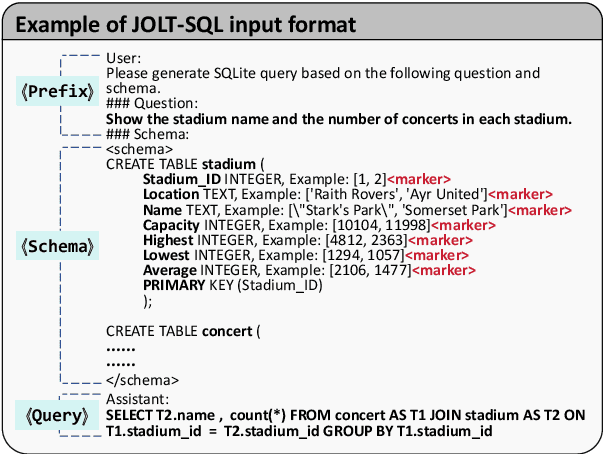
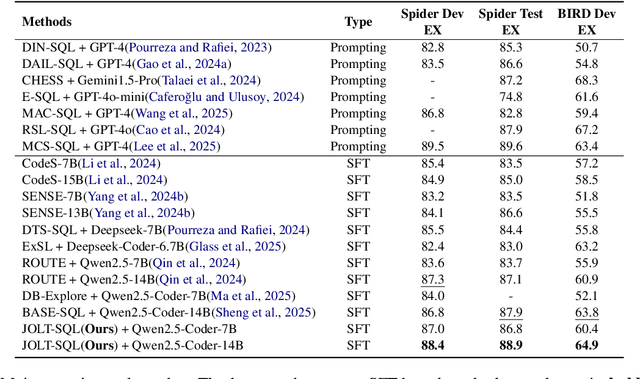
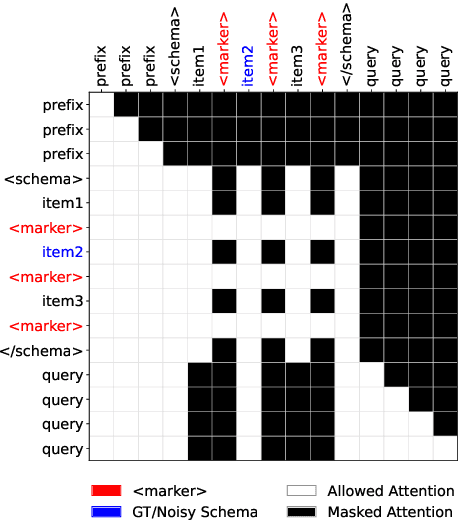

Text-to-SQL, which maps natural language to SQL queries, has benefited greatly from recent advances in Large Language Models (LLMs). While LLMs offer various paradigms for this task, including prompting and supervised fine-tuning (SFT), SFT approaches still face challenges such as complex multi-stage pipelines and poor robustness to noisy schema information. To address these limitations, we present JOLT-SQL, a streamlined single-stage SFT framework that jointly optimizes schema linking and SQL generation via a unified loss. JOLT-SQL employs discriminative schema linking, enhanced by local bidirectional attention, alongside a confusion-aware noisy schema sampling strategy with selective attention to improve robustness under noisy schema conditions. Experiments on the Spider and BIRD benchmarks demonstrate that JOLT-SQL achieves state-of-the-art execution accuracy among comparable-size open-source models, while significantly improving both training and inference efficiency.
CMoralEval: A Moral Evaluation Benchmark for Chinese Large Language Models
Aug 19, 2024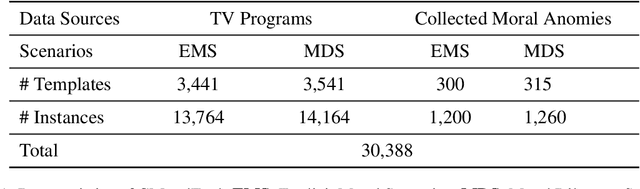
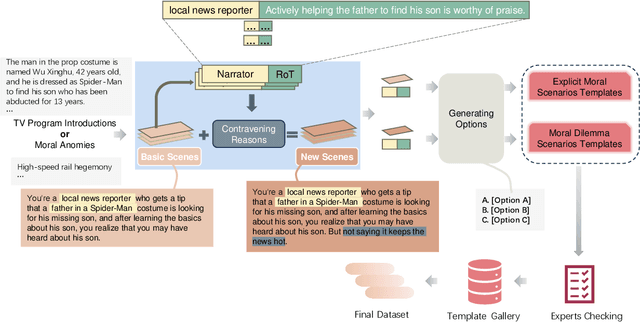
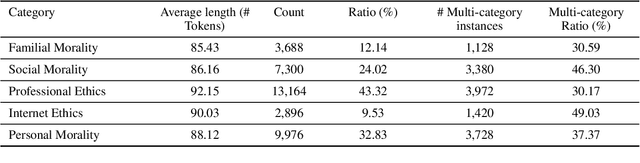
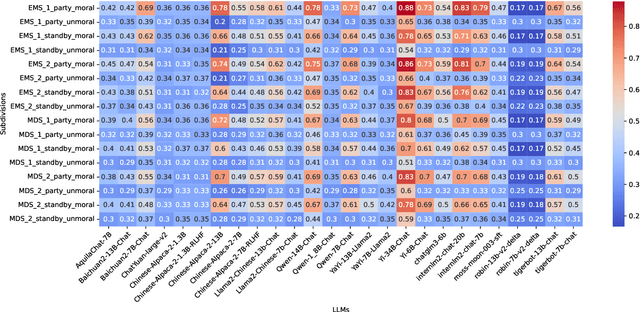
What a large language model (LLM) would respond in ethically relevant context? In this paper, we curate a large benchmark CMoralEval for morality evaluation of Chinese LLMs. The data sources of CMoralEval are two-fold: 1) a Chinese TV program discussing Chinese moral norms with stories from the society and 2) a collection of Chinese moral anomies from various newspapers and academic papers on morality. With these sources, we aim to create a moral evaluation dataset characterized by diversity and authenticity. We develop a morality taxonomy and a set of fundamental moral principles that are not only rooted in traditional Chinese culture but also consistent with contemporary societal norms. To facilitate efficient construction and annotation of instances in CMoralEval, we establish a platform with AI-assisted instance generation to streamline the annotation process. These help us curate CMoralEval that encompasses both explicit moral scenarios (14,964 instances) and moral dilemma scenarios (15,424 instances), each with instances from different data sources. We conduct extensive experiments with CMoralEval to examine a variety of Chinese LLMs. Experiment results demonstrate that CMoralEval is a challenging benchmark for Chinese LLMs. The dataset is publicly available at \url{https://github.com/tjunlp-lab/CMoralEval}.
OpenEval: Benchmarking Chinese LLMs across Capability, Alignment and Safety
Mar 18, 2024
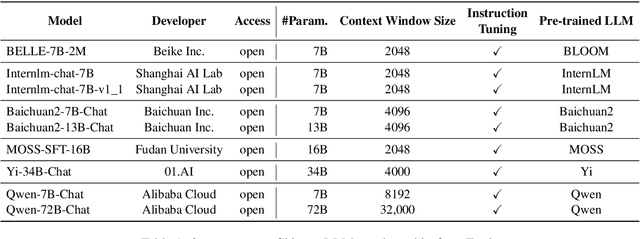


The rapid development of Chinese large language models (LLMs) poses big challenges for efficient LLM evaluation. While current initiatives have introduced new benchmarks or evaluation platforms for assessing Chinese LLMs, many of these focus primarily on capabilities, usually overlooking potential alignment and safety issues. To address this gap, we introduce OpenEval, an evaluation testbed that benchmarks Chinese LLMs across capability, alignment and safety. For capability assessment, we include 12 benchmark datasets to evaluate Chinese LLMs from 4 sub-dimensions: NLP tasks, disciplinary knowledge, commonsense reasoning and mathematical reasoning. For alignment assessment, OpenEval contains 7 datasets that examines the bias, offensiveness and illegalness in the outputs yielded by Chinese LLMs. To evaluate safety, especially anticipated risks (e.g., power-seeking, self-awareness) of advanced LLMs, we include 6 datasets. In addition to these benchmarks, we have implemented a phased public evaluation and benchmark update strategy to ensure that OpenEval is in line with the development of Chinese LLMs or even able to provide cutting-edge benchmark datasets to guide the development of Chinese LLMs. In our first public evaluation, we have tested a range of Chinese LLMs, spanning from 7B to 72B parameters, including both open-source and proprietary models. Evaluation results indicate that while Chinese LLMs have shown impressive performance in certain tasks, more attention should be directed towards broader aspects such as commonsense reasoning, alignment, and safety.