 Add to Chrome
 Add to Firefox
 Add to Edge
Compositional-Degradation UAV Image Restoration: Conditional Decoupled MoE Network and A Benchmark
Apr 10, 2026
UAV images are critical for applications such as large-area mapping, infrastructure inspection, and emergency response. However, in real-world flight environments, a single image is often affected by multiple degradation factors, including rain, haze, and noise, undermining downstream task performance. Current unified restoration approaches typically rely on implicit degradation representations that entangle multiple factors into a single condition, causing mutual interference among heterogeneous corrections. To this end, we propose DAME-Net, a Degradation-Aware Mixture-of-Experts Network that decouples explicit degradation perception from degradation-conditioned reconstruction for compositional UAV image restoration. Specifically, we design a Factor-wise Degradation Perception module(FDPM) to provide explicit per-factor degradation cues for the restoration stage through multi-label prediction with label-similarity-guided soft alignment, replacing implicit entangled conditions with interpretable and generalizable degradation descriptions. Moreover, we develop a Conditioned Decoupled MoE module(CDMM) that leverages these cues for stage-wise conditioning, spatial-frequency hybrid processing, and mask-constrained decoupled expert routing, enabling selective factor-specific correction while suppressing irrelevant interference. In addition, we construct the Multi-Degradation UAV Restoration benchmark (MDUR), the first large-scale UAV benchmark for compositional UAV image restoration, with 43 degradation configurations from single degradations to four-factor composites and standardized seen/unseen splits.Extensive experiments on MDUR demonstrate consistent improvements over representative unified restoration methods, with greater gains on unseen and higher-order composite degradations. Downstream experiments further validate benefits for UAV object detection.

Physics-Constrained Cross-Resolution Enhancement Network for Optics-Guided Thermal UAV Image Super-Resolution
Jan 07, 2026Optics-guided thermal UAV image super-resolution has attracted significant research interest due to its potential in all-weather monitoring applications. However, existing methods typically compress optical features to match thermal feature dimensions for cross-modal alignment and fusion, which not only causes the loss of high-frequency information that is beneficial for thermal super-resolution, but also introduces physically inconsistent artifacts such as texture distortions and edge blurring by overlooking differences in the imaging physics between modalities. To address these challenges, we propose PCNet to achieve cross-resolution mutual enhancement between optical and thermal modalities, while physically constraining the optical guidance process via thermal conduction to enable robust thermal UAV image super-resolution. In particular, we design a Cross-Resolution Mutual Enhancement Module (CRME) to jointly optimize thermal image super-resolution and optical-to-thermal modality conversion, facilitating effective bidirectional feature interaction across resolutions while preserving high-frequency optical priors. Moreover, we propose a Physics-Driven Thermal Conduction Module (PDTM) that incorporates two-dimensional heat conduction into optical guidance, modeling spatially-varying heat conduction properties to prevent inconsistent artifacts. In addition, we introduce a temperature consistency loss that enforces regional distribution consistency and boundary gradient smoothness to ensure generated thermal images align with real-world thermal radiation principles. Extensive experiments on VGTSR2.0 and DroneVehicle datasets demonstrate that PCNet significantly outperforms state-of-the-art methods on both reconstruction quality and downstream tasks including semantic segmentation and object detection.
DehazeMamba: SAR-guided Optical Remote Sensing Image Dehazing with Adaptive State Space Model
Mar 17, 2025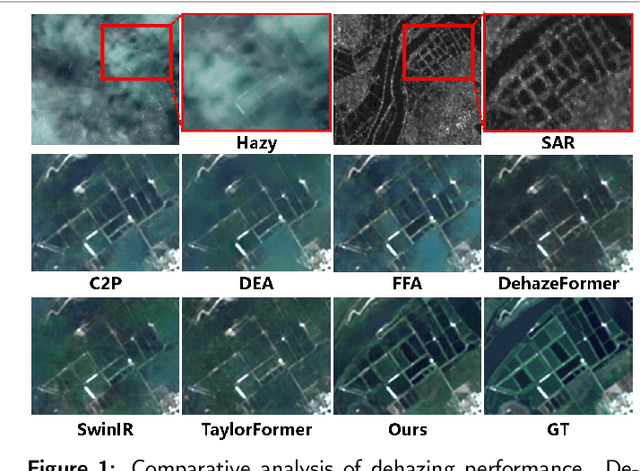
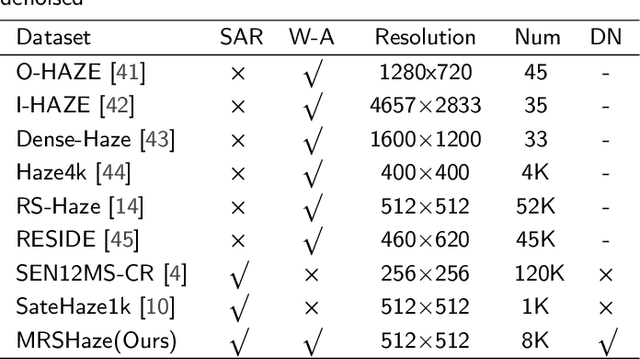
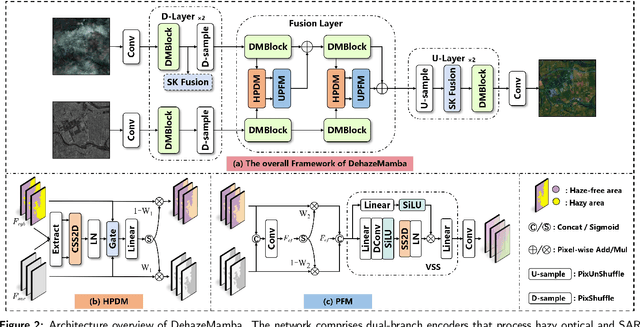
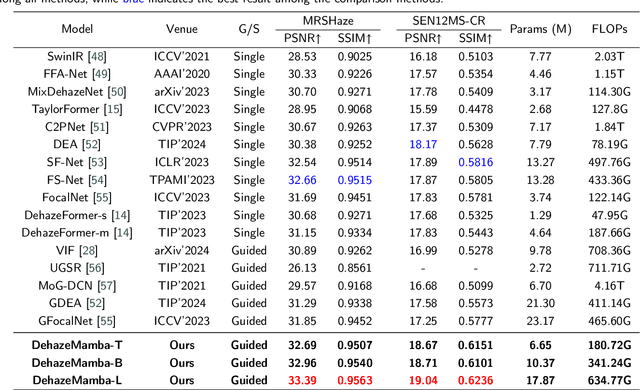
Optical remote sensing image dehazing presents significant challenges due to its extensive spatial scale and highly non-uniform haze distribution, which traditional single-image dehazing methods struggle to address effectively. While Synthetic Aperture Radar (SAR) imagery offers inherently haze-free reference information for large-scale scenes, existing SAR-guided dehazing approaches face two critical limitations: the integration of SAR information often diminishes the quality of haze-free regions, and the instability of feature quality further exacerbates cross-modal domain shift. To overcome these challenges, we introduce DehazeMamba, a novel SAR-guided dehazing network built on a progressive haze decoupling fusion strategy. Our approach incorporates two key innovations: a Haze Perception and Decoupling Module (HPDM) that dynamically identifies haze-affected regions through optical-SAR difference analysis, and a Progressive Fusion Module (PFM) that mitigates domain shift through a two-stage fusion process based on feature quality assessment. To facilitate research in this domain, we present MRSHaze, a large-scale benchmark dataset comprising 8,000 pairs of temporally synchronized, precisely geo-registered SAR-optical images with high resolution and diverse haze conditions. Extensive experiments demonstrate that DehazeMamba significantly outperforms state-of-the-art methods, achieving a 0.73 dB improvement in PSNR and substantial enhancements in downstream tasks such as semantic segmentation. The dataset is available at https://github.com/mmic-lcl/Datasets-and-benchmark-code.