 Add to Chrome
 Add to Firefox
 Add to Edge
SERPO: Self-Evolving Rubric Policy Optimization for Open-Ended Test-Time Reinforcement Learning
Jul 29, 2026
Test-time reinforcement learning (TTRL) enables language models to self-evolve at inference time without labeled feedback. Existing methods rely on answer voting and therefore do not extend naturally to open-ended generation, where valid responses cannot be mapped to a shared canonical answer. Without external reward models or stronger judges, adaptation must instead construct reliable rewards from the model's own outputs. We introduce SERPO (Self-Evolving Rubric Policy Optimization), which replaces answer voting with a closed loop that co-evolves response evidence, query-specific rubrics, and policy parameters. Good-Normal-Bad (G-N-B) response evolution organizes maximally separated rollouts into ordered archives; rubric evolution retains criteria that discriminate these archives; probabilistic criterion scoring converts verdict-token likelihoods into reward signals; and policy evolution optimizes the actor with the resulting signals. New actor rollouts then refresh both the archives and rubrics, closing the three-way evolution loop. Across two model configurations, two in-domain benchmarks, and four OOD benchmarks, SERPO improves HealthBench and ResearchQA by up to 20.63 and 20.31 points over the corresponding base models, raises the six-benchmark macro-average by up to 8.06 points, and supports OOD transfer and continued cross-benchmark evolution.

Detect an Object At Once without Fine-tuning
Nov 04, 2024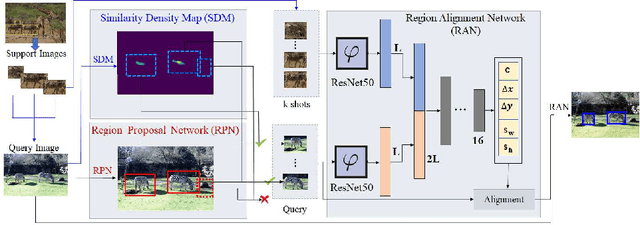

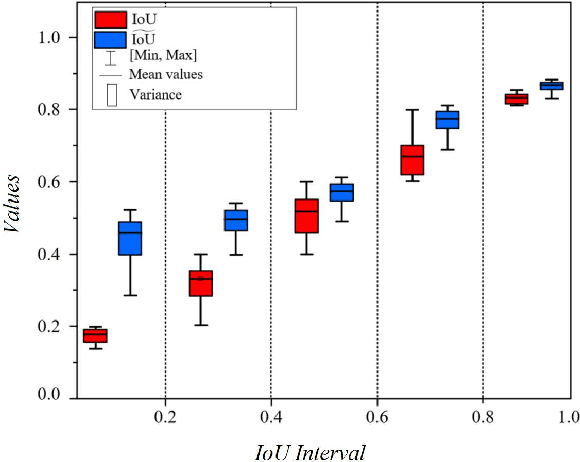
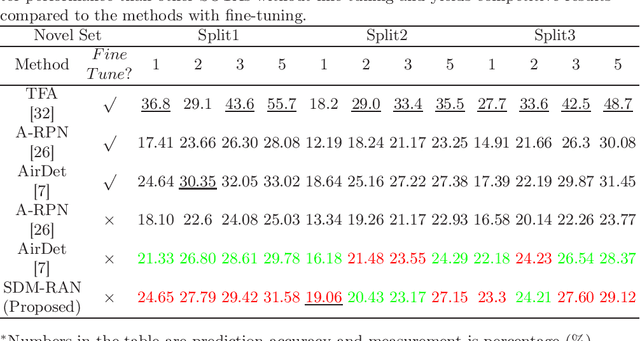
When presented with one or a few photos of a previously unseen object, humans can instantly recognize it in different scenes. Although the human brain mechanism behind this phenomenon is still not fully understood, this work introduces a novel technical realization of this task. It consists of two phases: (1) generating a Similarity Density Map (SDM) by convolving the scene image with the given object image patch(es) so that the highlight areas in the SDM indicate the possible locations; (2) obtaining the object occupied areas in the scene through a Region Alignment Network (RAN). The RAN is constructed on a backbone of Deep Siamese Network (DSN), and different from the traditional DSNs, it aims to obtain the object accurate regions by regressing the location and area differences between the ground truths and the predicted ones indicated by the highlight areas in SDM. By pre-learning from labels annotated in traditional datasets, the SDM-RAN can detect previously unknown objects without fine-tuning. Experiments were conducted on the MS COCO, PASCAL VOC datasets. The results indicate that the proposed method outperforms state-of-the-art methods on the same task.