 Add to Chrome
 Add to Firefox
 Add to Edge
PoseCraft: Tokenized 3D Body Landmark and Camera Conditioning for Photorealistic Human Image Synthesis
Feb 22, 2026
Digitizing humans and synthesizing photorealistic avatars with explicit 3D pose and camera controls are central to VR, telepresence, and entertainment. Existing skinning-based workflows require laborious manual rigging or template-based fittings, while neural volumetric methods rely on canonical templates and re-optimization for each unseen pose. We present PoseCraft, a diffusion framework built around tokenized 3D interface: instead of relying only on rasterized geometry as 2D control images, we encode sparse 3D landmarks and camera extrinsics as discrete conditioning tokens and inject them into diffusion via cross-attention. Our approach preserves 3D semantics by avoiding 2D re-projection ambiguity under large pose and viewpoint changes, and produces photorealistic imagery that faithfully captures identity and appearance. To train and evaluate at scale, we also implement GenHumanRF, a data generation workflow that renders diverse supervision from volumetric reconstructions. Our experiments show that PoseCraft achieves significant perceptual quality improvement over diffusion-centric methods, and attains better or comparable metrics to latest volumetric rendering SOTA while better preserving fabric and hair details.

Gaussian Head & Shoulders: High Fidelity Neural Upper Body Avatars with Anchor Gaussian Guided Texture Warping
May 21, 2024
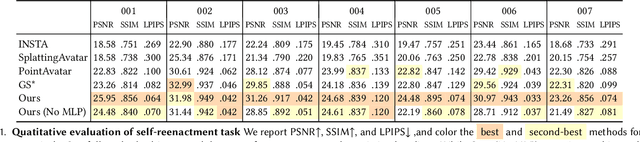
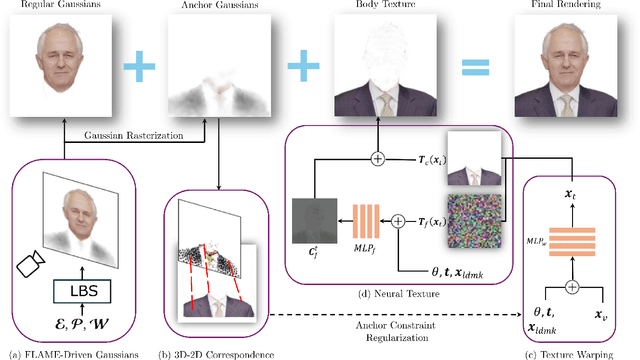
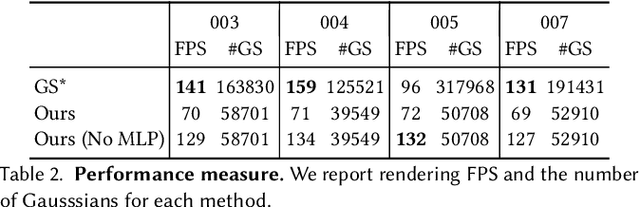
By equipping the most recent 3D Gaussian Splatting representation with head 3D morphable models (3DMM), existing methods manage to create head avatars with high fidelity. However, most existing methods only reconstruct a head without the body, substantially limiting their application scenarios. We found that naively applying Gaussians to model the clothed chest and shoulders tends to result in blurry reconstruction and noisy floaters under novel poses. This is because of the fundamental limitation of Gaussians and point clouds -- each Gaussian or point can only have a single directional radiance without spatial variance, therefore an unnecessarily large number of them is required to represent complicated spatially varying texture, even for simple geometry. In contrast, we propose to model the body part with a neural texture that consists of coarse and pose-dependent fine colors. To properly render the body texture for each view and pose without accurate geometry nor UV mapping, we optimize another sparse set of Gaussians as anchors that constrain the neural warping field that maps image plane coordinates to the texture space. We demonstrate that Gaussian Head & Shoulders can fit the high-frequency details on the clothed upper body with high fidelity and potentially improve the accuracy and fidelity of the head region. We evaluate our method with casual phone-captured and internet videos and show our method archives superior reconstruction quality and robustness in both self and cross reenactment tasks. To fully utilize the efficient rendering speed of Gaussian splatting, we additionally propose an accelerated inference method of our trained model without Multi-Layer Perceptron (MLP) queries and reach a stable rendering speed of around 130 FPS for any subjects.