 Add to Chrome
 Add to Firefox
 Add to Edge
SkipGS: Post-Densification Backward Skipping for Efficient 3DGS Training
Mar 09, 2026
3D Gaussian Splatting (3DGS) achieves real-time novel-view synthesis by optimizing millions of anisotropic Gaussians, yet its training remains expensive, with the backward pass dominating runtime in the post-densification refinement phase. We observe substantial update redundancy in this phase: many sampled views have near-plateaued losses and provide diminishing gradient benefits, but standard training still runs full backpropagation. We propose SkipGS with a novel view-adaptive backward gating mechanism for efficient post-densification training. SkipGS always performs the forward pass to update per-view loss statistics, and selectively skips backward passes when the sampled view's loss is consistent with its recent per-view baseline, while enforcing a minimum backward budget for stable optimization. On Mip-NeRF 360, compared to 3DGS, SkipGS reduces end-to-end training time by 23.1%, driven by a 42.0% reduction in post-densification time, with comparable reconstruction quality. Because it only changes when to backpropagate -- without modifying the renderer, representation, or loss -- SkipGS is plug-and-play and compatible with other complementary efficiency strategies for additive speedups.

Speedy MASt3R
Mar 13, 2025Image matching is a key component of modern 3D vision algorithms, essential for accurate scene reconstruction and localization. MASt3R redefines image matching as a 3D task by leveraging DUSt3R and introducing a fast reciprocal matching scheme that accelerates matching by orders of magnitude while preserving theoretical guarantees. This approach has gained strong traction, with DUSt3R and MASt3R collectively cited over 250 times in a short span, underscoring their impact. However, despite its accuracy, MASt3R's inference speed remains a bottleneck. On an A40 GPU, latency per image pair is 198.16 ms, mainly due to computational overhead from the ViT encoder-decoder and Fast Reciprocal Nearest Neighbor (FastNN) matching. To address this, we introduce Speedy MASt3R, a post-training optimization framework that enhances inference efficiency while maintaining accuracy. It integrates multiple optimization techniques, including FlashMatch-an approach leveraging FlashAttention v2 with tiling strategies for improved efficiency, computation graph optimization via layer and tensor fusion having kernel auto-tuning with TensorRT (GraphFusion), and a streamlined FastNN pipeline that reduces memory access time from quadratic to linear while accelerating block-wise correlation scoring through vectorized computation (FastNN-Lite). Additionally, it employs mixed-precision inference with FP16/FP32 hybrid computations (HybridCast), achieving speedup while preserving numerical precision. Evaluated on Aachen Day-Night, InLoc, 7-Scenes, ScanNet1500, and MegaDepth1500, Speedy MASt3R achieves a 54% reduction in inference time (198 ms to 91 ms per image pair) without sacrificing accuracy. This advancement enables real-time 3D understanding, benefiting applications like mixed reality navigation and large-scale 3D scene reconstruction.
FastSAM3D: An Efficient Segment Anything Model for 3D Volumetric Medical Images
Mar 14, 2024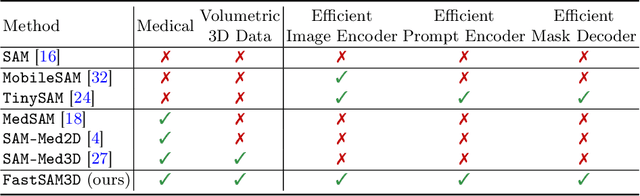
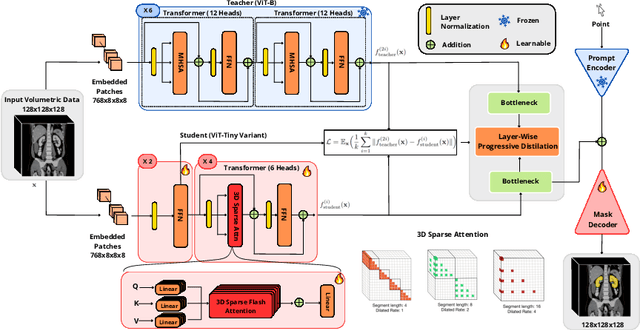
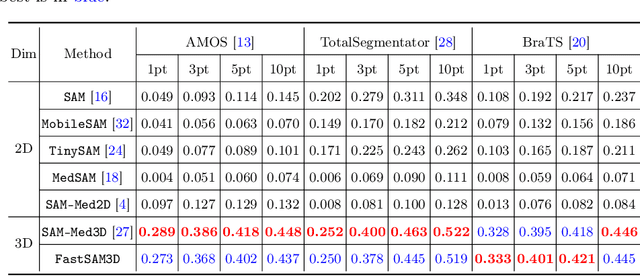
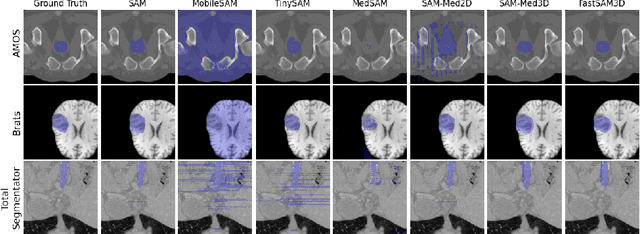
Segment anything models (SAMs) are gaining attention for their zero-shot generalization capability in segmenting objects of unseen classes and in unseen domains when properly prompted. Interactivity is a key strength of SAMs, allowing users to iteratively provide prompts that specify objects of interest to refine outputs. However, to realize the interactive use of SAMs for 3D medical imaging tasks, rapid inference times are necessary. High memory requirements and long processing delays remain constraints that hinder the adoption of SAMs for this purpose. Specifically, while 2D SAMs applied to 3D volumes contend with repetitive computation to process all slices independently, 3D SAMs suffer from an exponential increase in model parameters and FLOPS. To address these challenges, we present FastSAM3D which accelerates SAM inference to 8 milliseconds per 128*128*128 3D volumetric image on an NVIDIA A100 GPU. This speedup is accomplished through 1) a novel layer-wise progressive distillation scheme that enables knowledge transfer from a complex 12-layer ViT-B to a lightweight 6-layer ViT-Tiny variant encoder without training from scratch; and 2) a novel 3D sparse flash attention to replace vanilla attention operators, substantially reducing memory needs and improving parallelization. Experiments on three diverse datasets reveal that FastSAM3D achieves a remarkable speedup of 527.38x compared to 2D SAMs and 8.75x compared to 3D SAMs on the same volumes without significant performance decline. Thus, FastSAM3D opens the door for low-cost truly interactive SAM-based 3D medical imaging segmentation with commonly used GPU hardware. Code is available at https://github.com/arcadelab/FastSAM3D.