 Add to Chrome
 Add to Firefox
 Add to Edge
When would Vision-Proprioception Policies Fail in Robotic Manipulation?
Feb 12, 2026
Proprioceptive information is critical for precise servo control by providing real-time robotic states. Its collaboration with vision is highly expected to enhance performances of the manipulation policy in complex tasks. However, recent studies have reported inconsistent observations on the generalization of vision-proprioception policies. In this work, we investigate this by conducting temporally controlled experiments. We found that during task sub-phases that robot's motion transitions, which require target localization, the vision modality of the vision-proprioception policy plays a limited role. Further analysis reveals that the policy naturally gravitates toward concise proprioceptive signals that offer faster loss reduction when training, thereby dominating the optimization and suppressing the learning of the visual modality during motion-transition phases. To alleviate this, we propose the Gradient Adjustment with Phase-guidance (GAP) algorithm that adaptively modulates the optimization of proprioception, enabling dynamic collaboration within the vision-proprioception policy. Specifically, we leverage proprioception to capture robotic states and estimate the probability of each timestep in the trajectory belonging to motion-transition phases. During policy learning, we apply fine-grained adjustment that reduces the magnitude of proprioception's gradient based on estimated probabilities, leading to robust and generalizable vision-proprioception policies. The comprehensive experiments demonstrate GAP is applicable in both simulated and real-world environments, across one-arm and dual-arm setups, and compatible with both conventional and Vision-Language-Action models. We believe this work can offer valuable insights into the development of vision-proprioception policies in robotic manipulation.

KOI: Accelerating Online Imitation Learning via Hybrid Key-state Guidance
Aug 06, 2024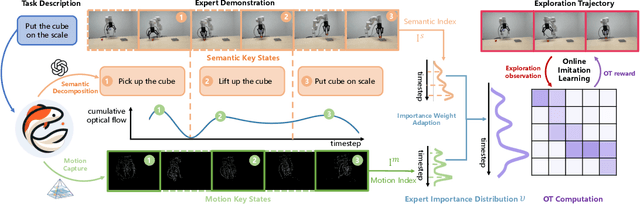
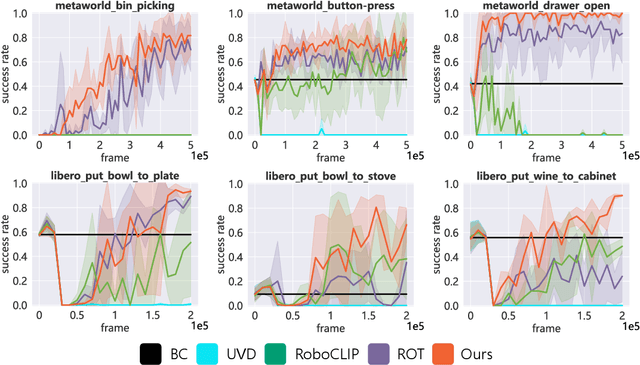
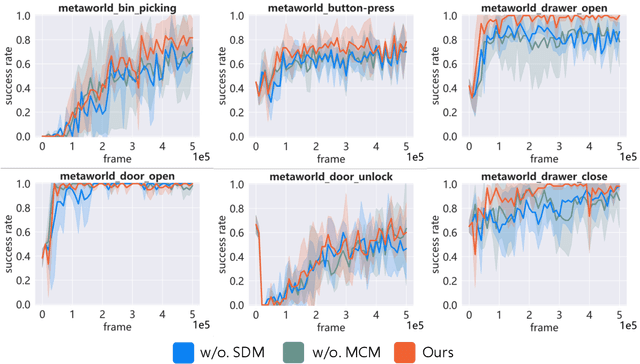
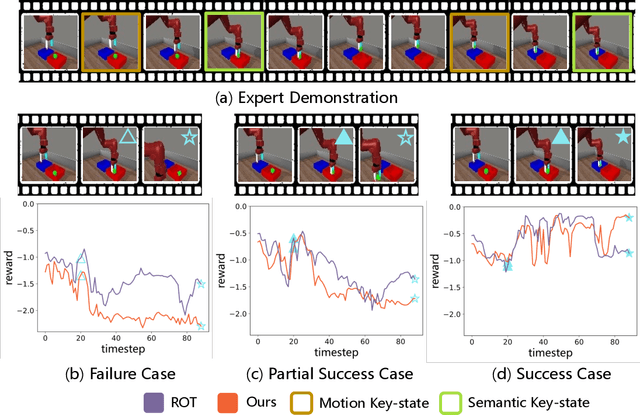
Online Imitation Learning methods struggle with the gap between extensive online exploration space and limited expert trajectories, which hinder efficient exploration due to inaccurate task-aware reward estimation. Inspired by the findings from cognitive neuroscience that task decomposition could facilitate cognitive processing for efficient learning, we hypothesize that an agent could estimate precise task-aware imitation rewards for efficient online exploration by decomposing the target task into the objectives of "what to do" and the mechanisms of "how to do". In this work, we introduce the hybrid Key-state guided Online Imitation (KOI) learning approach, which leverages the integration of semantic and motion key states as guidance for task-aware reward estimation. Initially, we utilize the visual-language models to segment the expert trajectory into semantic key states, indicating the objectives of "what to do". Within the intervals between semantic key states, optical flow is employed to capture motion key states to understand the process of "how to do". By integrating a thorough grasp of both semantic and motion key states, we refine the trajectory-matching reward computation, encouraging task-aware exploration for efficient online imitation learning. Our experiment results prove that our method is more sample efficient in the Meta-World and LIBERO environments. We also conduct real-world robotic manipulation experiments to validate the efficacy of our method, demonstrating the practical applicability of our KOI method.