 Add to Chrome
 Add to Firefox
 Add to Edge
HierSVA: A Data Synthesis Pipeline, Dataset, and Benchmark for LLM-Driven Hierarchical Hardware Formal Verification
Jun 09, 2026
We present HierSVA, an integrated suite that combines a pipeline, dataset, and benchmark for LLM-driven hierarchical hardware formal verification. HierSVA-SP pairs an RTL preprocessing toolchain with an LLM-in-the-loop formal verification flow to produce reference SystemVerilog Assertions (SVA) on hierarchical RTL. Applying it to BaseJump STL yields HierSVA-DS, a dataset of 342 modules, with hierarchy metadata and depths 0--9, accompanied by a deep subset of 28 module-bug pairs with natural-language specifications and bug variants. HierSVA-B decomposes assertion quality into six metric axes: syntax correctness, assertion proof success rate, vacuity, specification faithfulness, mutation coverage, and formal core coverage. Applying HierSVA-B to twelve recent LLMs reveals three findings. First, the module-level compile rate is 67.1\%; among generated assertions in evaluable runs, 82.1\% prove non-vacuously, but the corresponding assertion sets detect only 70.2\% of eligible injected faults and cover 36.2\% of the formal core. Second, on 211 evaluable model--module entries in the deep subset, assertion sets flag buggy RTL with 0.87 recall, but 40\% of predicted-buggy outcomes are false positives on correct RTL, limiting precision to 0.60. Third, agentic mode improves S1-style provability and strength metrics, but gains plateau and oscillate. Codes and artifacts are available at \href{https://github.com/HierSVAAnon/HierSVACodeAndArtifacts}{https://github.com/HierSVAAnon/HierSVACodeAndArtifacts}. Dataset is available at \href{https://huggingface.co/datasets/AnonymousHierSVA/HierSVA}{https://huggingface.co/datasets/AnonymousHierSVA/HierSVA}.

Uni-Render: A Unified Accelerator for Real-Time Rendering Across Diverse Neural Renderers
Mar 31, 2025Recent advancements in neural rendering technologies and their supporting devices have paved the way for immersive 3D experiences, significantly transforming human interaction with intelligent devices across diverse applications. However, achieving the desired real-time rendering speeds for immersive interactions is still hindered by (1) the lack of a universal algorithmic solution for different application scenarios and (2) the dedication of existing devices or accelerators to merely specific rendering pipelines. To overcome this challenge, we have developed a unified neural rendering accelerator that caters to a wide array of typical neural rendering pipelines, enabling real-time and on-device rendering across different applications while maintaining both efficiency and compatibility. Our accelerator design is based on the insight that, although neural rendering pipelines vary and their algorithm designs are continually evolving, they typically share common operators, predominantly executing similar workloads. Building on this insight, we propose a reconfigurable hardware architecture that can dynamically adjust dataflow to align with specific rendering metric requirements for diverse applications, effectively supporting both typical and the latest hybrid rendering pipelines. Benchmarking experiments and ablation studies on both synthetic and real-world scenes demonstrate the effectiveness of the proposed accelerator. The proposed unified accelerator stands out as the first solution capable of achieving real-time neural rendering across varied representative pipelines on edge devices, potentially paving the way for the next generation of neural graphics applications.
Instant-NeRF: Instant On-Device Neural Radiance Field Training via Algorithm-Accelerator Co-Designed Near-Memory Processing
May 09, 2023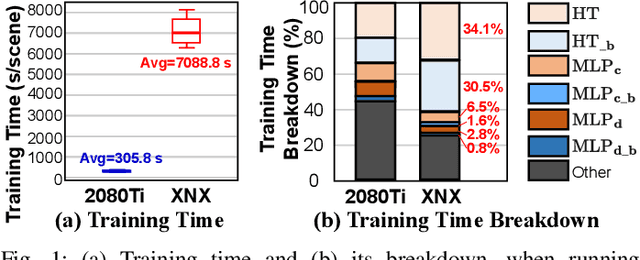
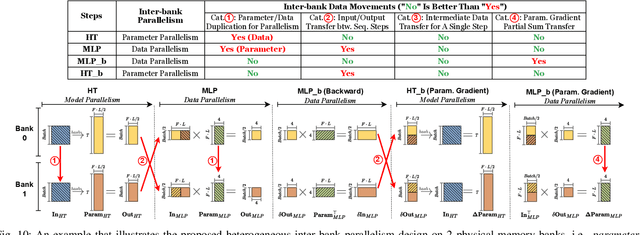
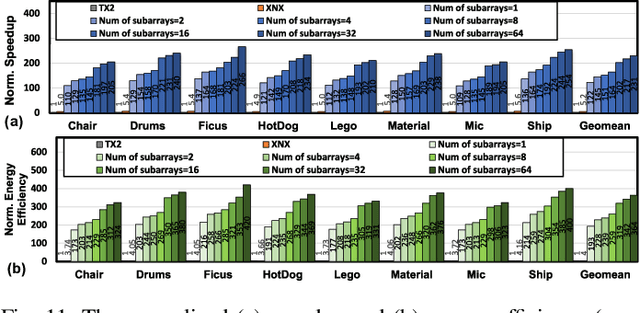
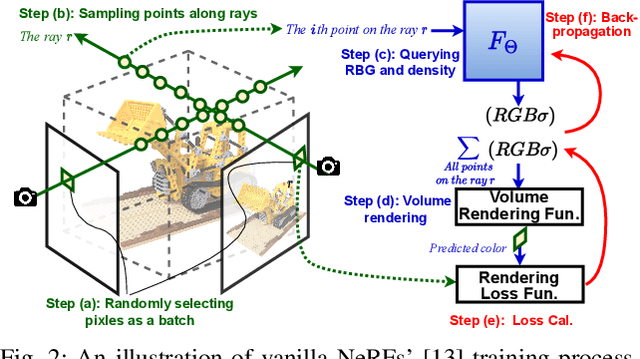
Instant on-device Neural Radiance Fields (NeRFs) are in growing demand for unleashing the promise of immersive AR/VR experiences, but are still limited by their prohibitive training time. Our profiling analysis reveals a memory-bound inefficiency in NeRF training. To tackle this inefficiency, near-memory processing (NMP) promises to be an effective solution, but also faces challenges due to the unique workloads of NeRFs, including the random hash table lookup, random point processing sequence, and heterogeneous bottleneck steps. Therefore, we propose the first NMP framework, Instant-NeRF, dedicated to enabling instant on-device NeRF training. Experiments on eight datasets consistently validate the effectiveness of Instant-NeRF.