 Add to Chrome
 Add to Firefox
 Add to Edge
Quant.npu: Enabling Efficient Mobile NPU Inference for on-device LLMs via Fully Static Quantization
May 19, 2026
Large language models (LLMs) are increasingly deployed on mobile devices, where Neural Processing Units (NPUs) necessitate fully static quantization for optimal inference efficiency. However, existing post-training quantization (PTQ) methods predominantly rely on dynamic activation quantization, rendering them incompatible with NPU hardware constraints. To bridge the gap between high-fidelity PTQ and NPU-constrained inference, we propose Quant.npu, a integer-only fully static quantization framework. It incorporates learnable quantization parameters and rotation matrices, enabling low-bit activation-weight quantization without runtime quantization parameters re-computation. Crucially, we identify that initialization and selective optimization of quantization parameters is pivotal for optimization stability, as improper initialization and naive joint optimization induce gradient instability that disrupts the optimization of rotation matrices. To address this, we propose a rotation-and-bit-width-aware initialization tailored to diverse activation profiles and a distribution-aware selective optimization (two-stage quantization pipeline) tailored to rotated and unrotated tensors. Furthermore, we introduce a sensitivity-guided adaptive mixed-precision scheme to balance accuracy with inference efficiency. Extensive experiments on real-world mobile NPUs demonstrate that Quant.npu achieves comparable accuracy to state-of-the-art methods, while reducing inference latency by up to 15.1%.

Sparse Longitudinal Representations of Electronic Health Record Data for the Early Detection of Chronic Kidney Disease in Diabetic Patients
Nov 09, 2020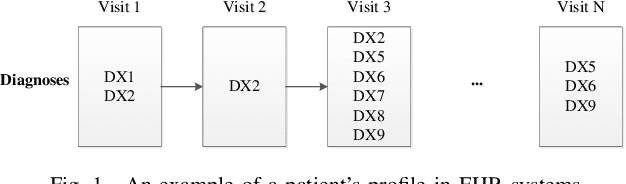
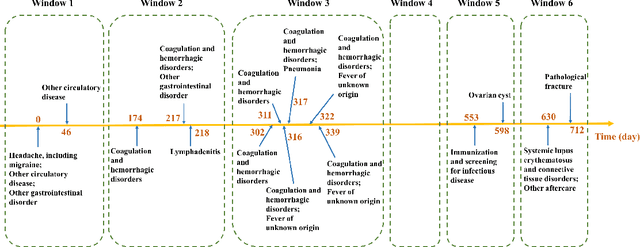
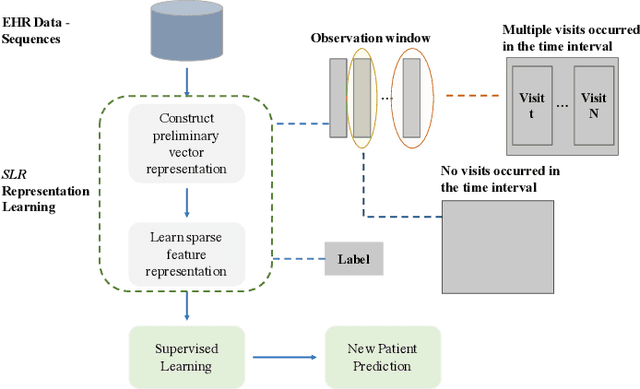
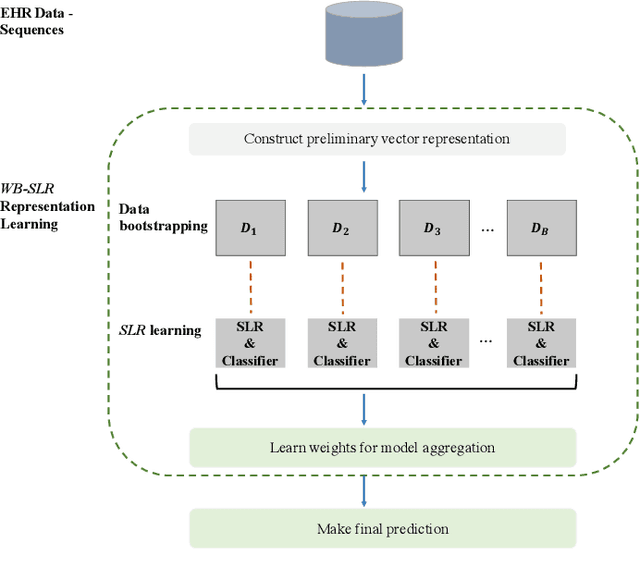
Chronic kidney disease (CKD) is a gradual loss of renal function over time, and it increases the risk of mortality, decreased quality of life, as well as serious complications. The prevalence of CKD has been increasing in the last couple of decades, which is partly due to the increased prevalence of diabetes and hypertension. To accurately detect CKD in diabetic patients, we propose a novel framework to learn sparse longitudinal representations of patients' medical records. The proposed method is also compared with widely used baselines such as Aggregated Frequency Vector and Bag-of-Pattern in Sequences on real EHR data, and the experimental results indicate that the proposed model achieves higher predictive performance. Additionally, the learned representations are interpreted and visualized to bring clinical insights.
Patient2Vec: A Personalized Interpretable Deep Representation of the Longitudinal Electronic Health Record
Oct 25, 2018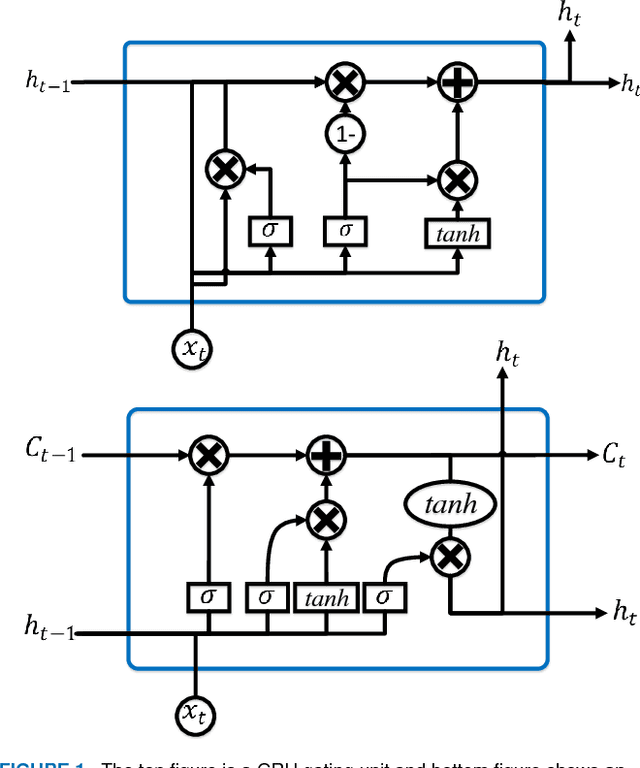

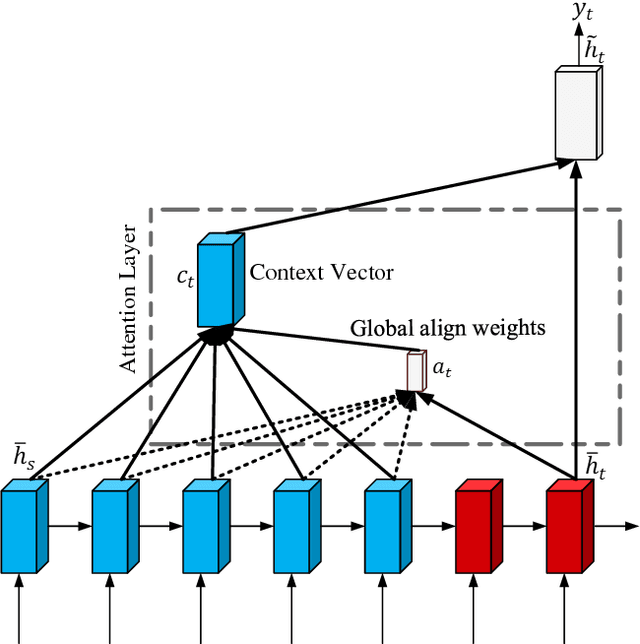

The wide implementation of electronic health record (EHR) systems facilitates the collection of large-scale health data from real clinical settings. Despite the significant increase in adoption of EHR systems, this data remains largely unexplored, but presents a rich data source for knowledge discovery from patient health histories in tasks such as understanding disease correlations and predicting health outcomes. However, the heterogeneity, sparsity, noise, and bias in this data present many complex challenges. This complexity makes it difficult to translate potentially relevant information into machine learning algorithms. In this paper, we propose a computational framework, Patient2Vec, to learn an interpretable deep representation of longitudinal EHR data which is personalized for each patient. To evaluate this approach, we apply it to the prediction of future hospitalizations using real EHR data and compare its predictive performance with baseline methods. Patient2Vec produces a vector space with meaningful structure and it achieves an AUC around 0.799 outperforming baseline methods. In the end, the learned feature importance can be visualized and interpreted at both the individual and population levels to bring clinical insights.