 Add to Chrome
 Add to Firefox
 Add to Edge
Can MLLMs "Read" What is Missing?
Apr 23, 2026
We introduce MMTR-Bench, a benchmark designed to evaluate the intrinsic ability of Multimodal Large Language Models (MLLMs) to reconstruct masked text directly from visual context. Unlike conventional question-answering tasks, MMTR-Bench eliminates explicit prompts, requiring models to recover masked text from single- or multi-page inputs across real-world domains such as documents and webpages. This design isolates the reconstruction task from instruction-following abilities, enabling a direct assessment of a model's layout understanding, visual grounding, and knowledge integration. MMTR-Bench comprises 2,771 test samples spanning multiple languages and varying target lengths. To account for this diversity, we propose a level-aware evaluation protocol. Experiments on representative MLLMs show that the benchmark poses a significant challenge, especially for sentence- and paragraph-level reconstruction. The homepage is available at https://mmtr-bench-dataset.github.io/MMTR-Bench/.

MLLM-Tool: A Multimodal Large Language Model For Tool Agent Learning
Jan 24, 2024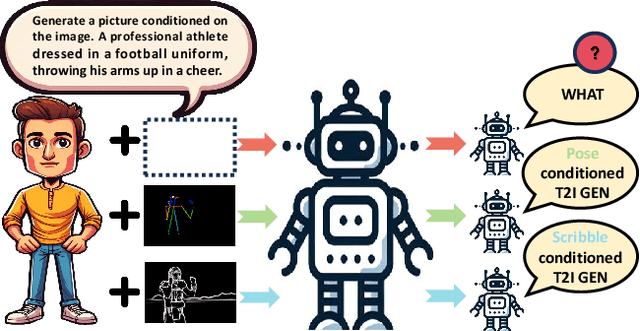
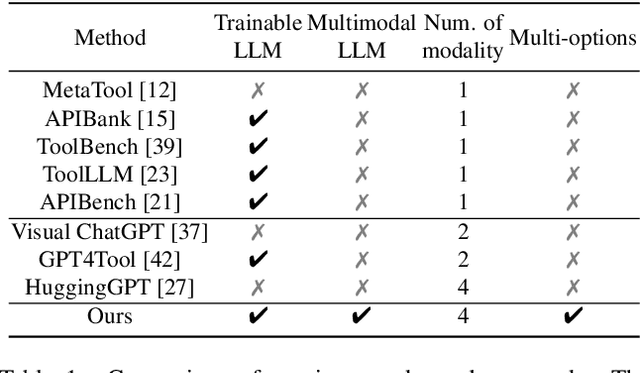
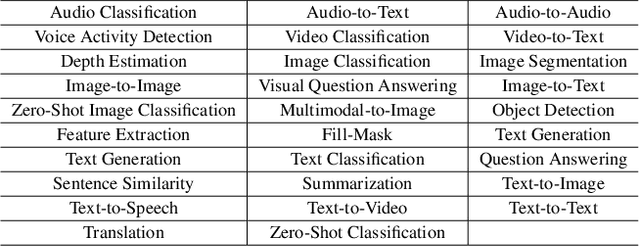
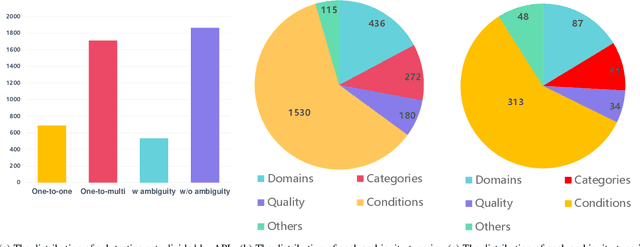
Recently, the astonishing performance of large language models (LLMs) in natural language comprehension and generation tasks triggered lots of exploration of using them as central controllers to build agent systems. Multiple studies focus on bridging the LLMs to external tools to extend the application scenarios. However, the current LLMs' perceiving tool-use ability is limited to a single text query, which may result in ambiguity in understanding the users' real intentions. LLMs are expected to eliminate that by perceiving the visual- or auditory-grounded instructions' information. Therefore, in this paper, we propose MLLM-Tool, a system incorporating open-source LLMs and multi-modal encoders so that the learnt LLMs can be conscious of multi-modal input instruction and then select the function-matched tool correctly. To facilitate the evaluation of the model's capability, we collect a dataset featured by consisting of multi-modal input tools from HuggingFace. Another important feature of our dataset is that our dataset also contains multiple potential choices for the same instruction due to the existence of identical functions and synonymous functions, which provides more potential solutions for the same query. The experiments reveal that our MLLM-Tool is capable of recommending appropriate tools for multi-modal instructions. Codes and data are available at https://github.com/MLLM-Tool/MLLM-Tool.