 Add to Chrome
 Add to Firefox
 Add to Edge
Less is More: Modality-Decoupling for General AIGC Audio-Video Detection
Jul 28, 2026
Generative AI has rapidly expanded audio-visual forgery beyond human-centric deepfakes into general scenes. Existing AIGC detection methods assume audio-visual content correspondence, identifying forgeries by spotting cross-modal inconsistencies. However, we empirically find that this assumption does not consistently hold in general scenarios. We argue that, for general audio-visual AIGC detection, decision-level fusion is a more robust alternative to feature-level fusion. Therefore, we propose DAV-Det, a decoupled audio-visual AIGC detection system that independently models forensic evidence from each modality. The visual detector leverages multi-granularity representations at global, patch, and segment levels to capture spatial forgery cues, while the audio detector exploits both temporal and spectral irregularities via a gated temporal-spectral dual-branch architecture to model acoustic artifacts. Our method ranks 1st in the General AIGC Audio-Video Detection Challenge of the IJCAI-ECAI 2026 DDL 2.0 Workshop, with a final score of 0.8460. Code is available at https://github.com/tuffy-studio/DAV-Det.

Robust Deepfake Detection, NTIRE 2026 Challenge: Report
Apr 27, 2026Robustness is a long-overlooked problem in deepfake detection. However, detection performance is nearly worthless in the real world if it suffers under exposure to even slight image degradation. In addition to weaker degradations that can accidentally occur in the image processing pipeline, there is another risk of malicious deepfakes that specifically introduce degradations, purposefully exploiting the detector's weaknesses in that regard. Here, we present an overview of the NTIRE 2026 Robust Deepfake Detection Challenge, which specifically addresses that problem. Participants were tasked with building a detector that would later be tested on an unknown test-set, which included both common and uncommon degradations of various strengths. With a total number of 337 participants and 57 submissions to the final leaderboard, the first edition of the challenge was well received. To ensure the reliability of the results, participants were given only 24h to complete the test run with no labels provided, limiting the possibility of training on the test data. Furthermore, the top solutions were scored on a private test-set to detect any such overfitting. This report presents the competition setting, dataset preparation, as well as details and performance of methods. Top methods rely on large foundation models, ensembles, and degradation training to combine generality and robustness.
SAGE: Agentic Framework for Interpretable and Clinically Translatable Computational Pathology Biomarker Discovery
Feb 01, 2026Despite significant progress in computational pathology, many AI models remain black-box and difficult to interpret, posing a major barrier to clinical adoption due to limited transparency and explainability. This has motivated continued interest in engineered image-based biomarkers, which offer greater interpretability but are often proposed based on anecdotal evidence or fragmented prior literature rather than systematic biological validation. We introduce SAGE (Structured Agentic system for hypothesis Generation and Evaluation), an agentic AI system designed to identify interpretable, engineered pathology biomarkers by grounding them in biological evidence. SAGE integrates literature-anchored reasoning with multimodal data analysis to correlate image-derived features with molecular biomarkers, such as gene expression, and clinically relevant outcomes. By coordinating specialized agents for biological contextualization and empirical hypothesis validation, SAGE prioritizes transparent, biologically supported biomarkers and advances the clinical translation of computational pathology.
Rethinking Bias in Generative Data Augmentation for Medical AI: a Frequency Recalibration Method
Nov 15, 2025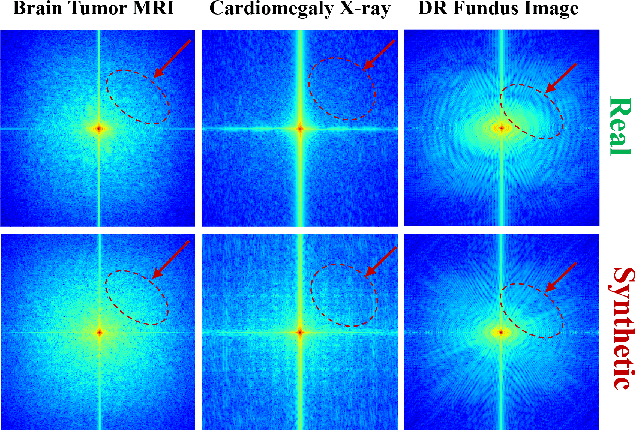

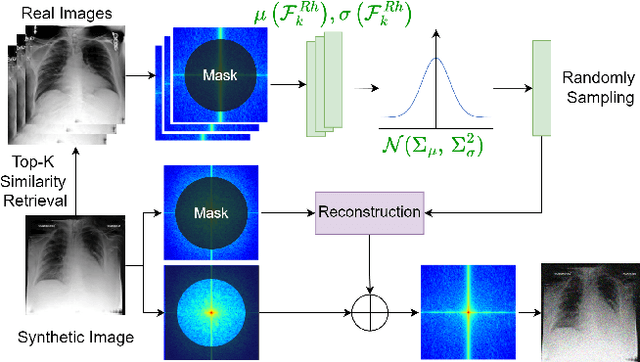
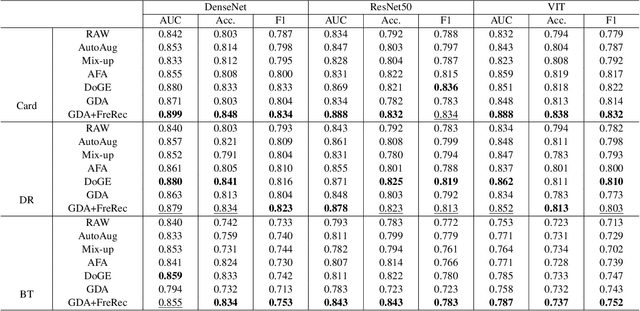
Developing Medical AI relies on large datasets and easily suffers from data scarcity. Generative data augmentation (GDA) using AI generative models offers a solution to synthesize realistic medical images. However, the bias in GDA is often underestimated in medical domains, with concerns about the risk of introducing detrimental features generated by AI and harming downstream tasks. This paper identifies the frequency misalignment between real and synthesized images as one of the key factors underlying unreliable GDA and proposes the Frequency Recalibration (FreRec) method to reduce the frequency distributional discrepancy and thus improve GDA. FreRec involves (1) Statistical High-frequency Replacement (SHR) to roughly align high-frequency components and (2) Reconstructive High-frequency Mapping (RHM) to enhance image quality and reconstruct high-frequency details. Extensive experiments were conducted in various medical datasets, including brain MRIs, chest X-rays, and fundus images. The results show that FreRec significantly improves downstream medical image classification performance compared to uncalibrated AI-synthesized samples. FreRec is a standalone post-processing step that is compatible with any generative model and can integrate seamlessly with common medical GDA pipelines.