 Add to Chrome
 Add to Firefox
 Add to Edge
Right or Wrong, Models Comply: Directional Blindness in LLM Moral Judgment
Jun 12, 2026
As language models take integrated roles across many domains, the response of LLMs to user pushback becomes a critical alignment property. Yet many existing evaluations treat compliance as unidirectional, measuring whether models resist pressure but not whether they resist it selectively. We introduce Compliance Asymmetry (A = BCR/HCR), a bidirectional diagnostic that compares beneficial output change under helpful nudges with harmful change under misleading nudges. Across 9 models and 972,000 nudge-condition responses, we find that this selectivity differs in factual and moral judgments: models follow helpful nudges more than harmful ones on factual questions (A = 1.58), but follow both directions at nearly identical rates on moral questions (A = 1.04). This phenomenon persists across model families, capability levels, and nudging types. Interestingly, we also find that chain-of-thought prompting amplifies helpful and harmful compliance together, while identity-based prompting suppresses both by nearly identical margins. These results identify direction-blind moral compliance as a distinct failure mode in current LLMs and suggest that alignment should target directionally calibrated updating rather than lower compliance alone.

MIRAGE: A Polarity-Flipping Encoding Subspace in LLM Agents
Jun 09, 2026When LLM agents are coerced into covertly encoding sensitive data (Base64, ROT13, acrostic, synonym chains, and beyond), the resulting outputs evade output-side detection but the underlying computation does not. Across nine encoding families and eight models from five architecture families, that computation is supported by a shared low-dimensional encoding subspace in the residual stream. A logistic-regression probe trained on eight encoding families recovers the held-out ninth at AUC 0.975-1.000, reading the computation rather than surface features. The same direction exhibits a second mechanistic signature at the planning token, flipping polarity to activate positively when the model will simulate the encoding inline and negatively when it will outsource it to a tool call, distinguishing two execution strategies before the encoded text exists. We build MIRAGE (Model-Internal Readout of Agentic Generation Exfiltration), a two-channel real-time monitor exploiting both signals. On 126 agentic exfiltration scenarios, it reaches AUC = 0.918, substantially outperforming output-only detection (AUC = 0.518). Monitor performance is fundamentally a property of the host model's geometry: benign-encoding false-positive rate ranges from 0% on Qwen-7B to 100% on Phi-3.5, revealing that the probe faithfully reads whether a model's geometry separates covert from overt encoding. Across all tested adversarial budgets, every attack suppressing the subspace also destroyed encoding fidelity, reported as an empirical regularity on the evaluated budgets, not a structural impossibility claim.
HyperCLOVA X Technical Report
Apr 13, 2024We introduce HyperCLOVA X, a family of large language models (LLMs) tailored to the Korean language and culture, along with competitive capabilities in English, math, and coding. HyperCLOVA X was trained on a balanced mix of Korean, English, and code data, followed by instruction-tuning with high-quality human-annotated datasets while abiding by strict safety guidelines reflecting our commitment to responsible AI. The model is evaluated across various benchmarks, including comprehensive reasoning, knowledge, commonsense, factuality, coding, math, chatting, instruction-following, and harmlessness, in both Korean and English. HyperCLOVA X exhibits strong reasoning capabilities in Korean backed by a deep understanding of the language and cultural nuances. Further analysis of the inherent bilingual nature and its extension to multilingualism highlights the model's cross-lingual proficiency and strong generalization ability to untargeted languages, including machine translation between several language pairs and cross-lingual inference tasks. We believe that HyperCLOVA X can provide helpful guidance for regions or countries in developing their sovereign LLMs.
CrossSplit: Mitigating Label Noise Memorization through Data Splitting
Dec 03, 2022
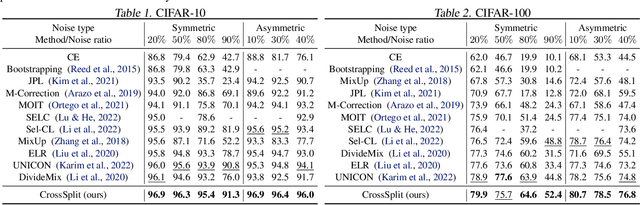
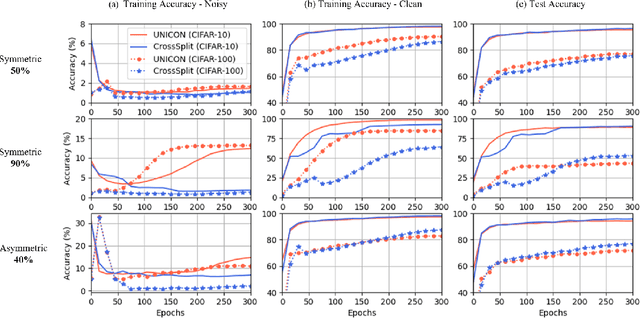

We approach the problem of improving robustness of deep learning algorithms in the presence of label noise. Building upon existing label correction and co-teaching methods, we propose a novel training procedure to mitigate the memorization of noisy labels, called CrossSplit, which uses a pair of neural networks trained on two disjoint parts of the dataset. CrossSplit combines two main ingredients: (i) Cross-split label correction. The idea is that, since the model trained on one part of the data cannot memorize example-label pairs from the other part, the training labels presented to each network can be smoothly adjusted by using the predictions of its peer network; (ii) Cross-split semi-supervised training. A network trained on one part of the data also uses the unlabeled inputs of the other part. Extensive experiments on CIFAR-10, CIFAR-100, Tiny-ImageNet and mini-WebVision datasets demonstrate that our method can outperform the current state-of-the-art up to 90% noise ratio.