 Add to Chrome
 Add to Firefox
 Add to Edge
Graph-Structured Rubrics: Compiling Rubrics into Typed Evaluation Graphs for LLM Judges
Aug 12, 2026
Rubric-based evaluators commonly treat rubrics as prompt context or flat criteria: they specify what to judge but leave criterion composition implicit, even when natural-language rules state it. We introduce Graph-Structured Rubrics (GSR), which compiles a rubric into a response-independent typed evaluation graph before observing responses. Criterion nodes elicit judgments; transformation, reduction, and gating operators compose them through named ports; and a task-specific output mapping, termed Readout, converts the unique sink into a score or preference. Compilation rejects malformed or type-incompatible graphs. Pointwise evaluation judges rubric dimensions separately before graph aggregation; pairwise evaluation reuses the graph with one judgment for each candidate under every criterion. Under GPT-OSS-120B, GSR improves exact score agreement by 0.62--6.75 percentage points over Prometheus-style scoring on four pointwise datasets and achieves the numerically highest end-to-end pairwise accuracy on two preference benchmarks under native tie and abstention policies.

Explore Internal and External Similarity for Single Image Deraining with Graph Neural Networks
Jun 02, 2024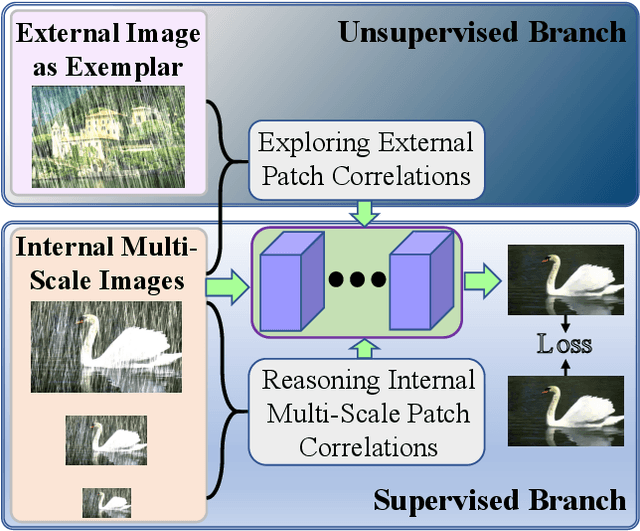

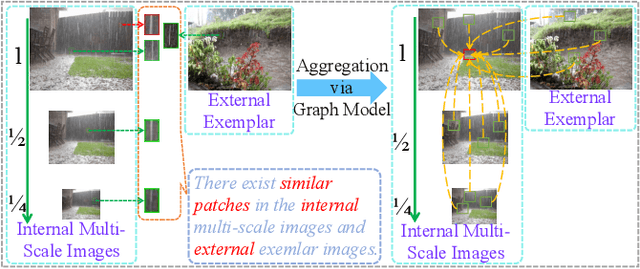
Patch-level non-local self-similarity is an important property of natural images. However, most existing methods do not consider this property into neural networks for image deraining, thus affecting recovery performance. Motivated by this property, we find that there exists significant patch recurrence property of a rainy image, that is, similar patches tend to recur many times in one image and its multi-scale images and external images. To better model this property for image detaining, we develop a multi-scale graph network with exemplars, called MSGNN, that contains two branches: 1) internal data-based supervised branch is used to model the internal relations of similar patches from the rainy image itself and its multi-scale images and 2) external data-participated unsupervised branch is used to model the external relations of the similar patches in the rainy image and exemplar. Specifically, we construct a graph model by searching the k-nearest neighboring patches from both the rainy images in a multi-scale framework and the exemplar. After obtaining the corresponding k neighboring patches from the multi-scale images and exemplar, we build a graph and aggregate them in an attentional manner so that the graph can provide more information from similar patches for image deraining. We embed the proposed graph in a deep neural network and train it in an end-to-end manner. Extensive experiments demonstrate that the proposed algorithm performs favorably against eight state-of-the-art methods on five public synthetic datasets and one real-world dataset. The source codes will be available at https://github.com/supersupercong/MSGNN.