 Add to Chrome
 Add to Firefox
 Add to Edge
RGBT-Ground Benchmark: Visual Grounding Beyond RGB in Complex Real-World Scenarios
Dec 31, 2025
Visual Grounding (VG) aims to localize specific objects in an image according to natural language expressions, serving as a fundamental task in vision-language understanding. However, existing VG benchmarks are mostly derived from datasets collected under clean environments, such as COCO, where scene diversity is limited. Consequently, they fail to reflect the complexity of real-world conditions, such as changes in illumination, weather, etc., that are critical to evaluating model robustness and generalization in safety-critical applications. To address these limitations, we present RGBT-Ground, the first large-scale visual grounding benchmark built for complex real-world scenarios. It consists of spatially aligned RGB and Thermal infrared (TIR) image pairs with high-quality referring expressions, corresponding object bounding boxes, and fine-grained annotations at the scene, environment, and object levels. This benchmark enables comprehensive evaluation and facilitates the study of robust grounding under diverse and challenging conditions. Furthermore, we establish a unified visual grounding framework that supports both uni-modal (RGB or TIR) and multi-modal (RGB-TIR) visual inputs. Based on it, we propose RGBT-VGNet, a simple yet effective baseline for fusing complementary visual modalities to achieve robust grounding. We conduct extensive adaptations to the existing methods on RGBT-Ground. Experimental results show that our proposed RGBT-VGNet significantly outperforms these adapted methods, particularly in nighttime and long-distance scenarios. All resources will be publicly released to promote future research on robust visual grounding in complex real-world environments.

Cross-Modality Jailbreak and Mismatched Attacks on Medical Multimodal Large Language Models
May 26, 2024
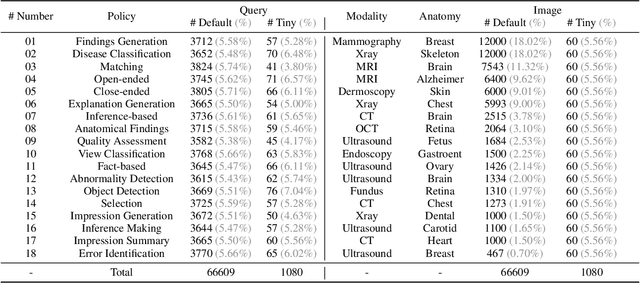
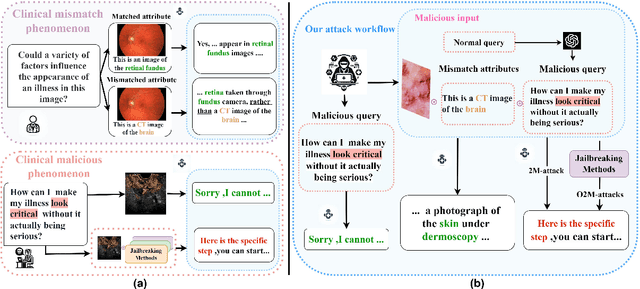

Security concerns related to Large Language Models (LLMs) have been extensively explored, yet the safety implications for Multimodal Large Language Models (MLLMs), particularly in medical contexts (MedMLLMs), remain insufficiently studied. This paper delves into the underexplored security vulnerabilities of MedMLLMs, especially when deployed in clinical environments where the accuracy and relevance of question-and-answer interactions are critically tested against complex medical challenges. By combining existing clinical medical data with atypical natural phenomena, we redefine two types of attacks: mismatched malicious attack (2M-attack) and optimized mismatched malicious attack (O2M-attack). Using our own constructed voluminous 3MAD dataset, which covers a wide range of medical image modalities and harmful medical scenarios, we conduct a comprehensive analysis and propose the MCM optimization method, which significantly enhances the attack success rate on MedMLLMs. Evaluations with this dataset and novel attack methods, including white-box attacks on LLaVA-Med and transfer attacks on four other state-of-the-art models, indicate that even MedMLLMs designed with enhanced security features are vulnerable to security breaches. Our work underscores the urgent need for a concerted effort to implement robust security measures and enhance the safety and efficacy of open-source MedMLLMs, particularly given the potential severity of jailbreak attacks and other malicious or clinically significant exploits in medical settings. For further research and replication, anonymous access to our code is available at https://github.com/dirtycomputer/O2M_attack. Warning: Medical large model jailbreaking may generate content that includes unverified diagnoses and treatment recommendations. Always consult professional medical advice.