 Add to Chrome
 Add to Firefox
 Add to Edge
Solving Inverse Problems of Chaotic Systems with Bidirectional Conditional Flow Matching
Jun 23, 2026
Modeling chaotic systems is crucial yet challenging. Inverse problems in chaotic dynamics, namely inferring initial conditions from final states, remain largely unsolved because of ill-posedness, non-uniqueness, instability, and potentially chaotic time-reverse dynamics. We address this open problem with Bidirectional Conditional Flow Matching (Bi-CFM), which learns bidirectional mappings between distributions of initial and final states to capture the stochasticity of chaotic evolution and mitigate exponential error accumulation over time. Furthermore, for systems with conservation laws, we extend it to Conservation-constrained Bi-CFM (CBi-CFM). Across the classic Lorenz, Circuit, and high-dimensional Lorenz 96 systems, Bi-CFM improves five distribution-level metrics over baselines while achieving a speedup of more than two orders of magnitude. In the three-body planet-planet scattering problem in planetary dynamics, CBi-CFM better respects conservation laws, with conservation errors comparable to those of the ground truth. Finally, on real observations of globular clusters, collisional million-body systems shaped by $\sim 10^{10}$ years (10 Gyr) of evolution, our method represents an advance in accuracy, establishing a scalable route to solving inverse problems of long-timescale real-world chaotic dynamics.

Astroconformer: Inferring Surface Gravity of Stars from Stellar Light Curves with Transformer
Jul 06, 2022
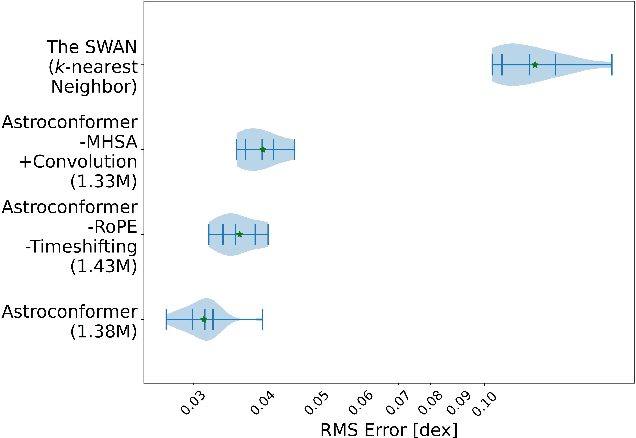
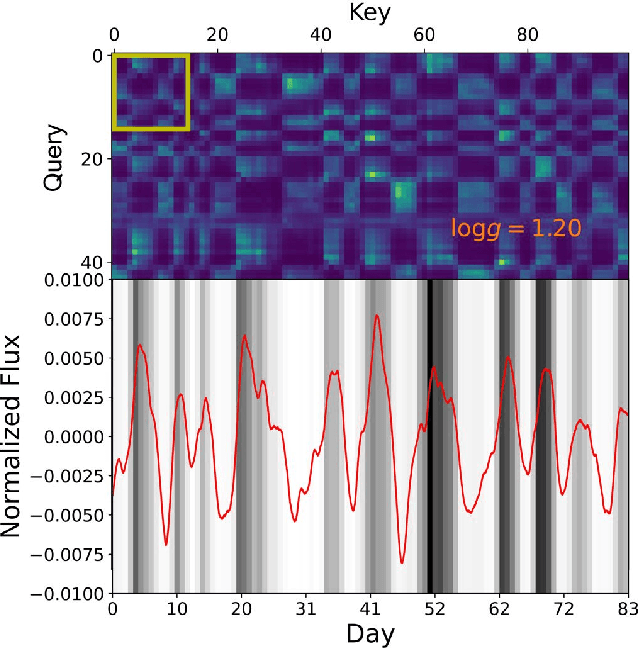
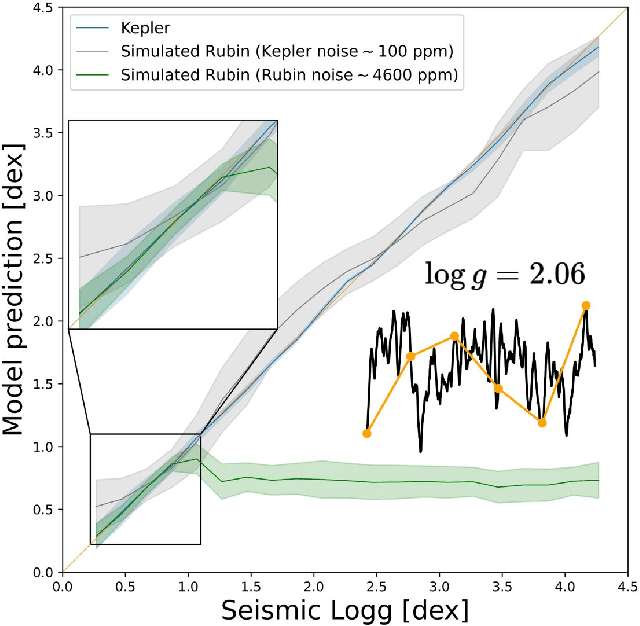
We introduce Astroconformer, a Transformer-based model to analyze stellar light curves from the Kepler mission. We demonstrate that Astrconformer can robustly infer the stellar surface gravity as a supervised task. Importantly, as Transformer captures long-range information in the time series, it outperforms the state-of-the-art data-driven method in the field, and the critical role of self-attention is proved through ablation experiments. Furthermore, the attention map from Astroconformer exemplifies the long-range correlation information learned by the model, leading to a more interpretable deep learning approach for asteroseismology. Besides data from Kepler, we also show that the method can generalize to sparse cadence light curves from the Rubin Observatory, paving the way for the new era of asteroseismology, harnessing information from long-cadence ground-based observations.