 Add to Chrome
 Add to Firefox
 Add to Edge
Where Steering Signals Come From: Activation Source Selection in Activation Steering
Jul 28, 2026
Activation steering controls language models by adding vectors or features to hidden states at inference time, but the upstream source of these steering signals is often treated as a secondary detail. We study this source choice as activation source selection: the combination of source context and activation readout policy used to collect the hidden states from which a steering signal is built. Holding the downstream intervention fixed, we show across three instruction-tuned models and four steering task families that changing only the source activations substantially changes steering success. We further find that effective steering is not explained simply by whether the desired behavior appears in the source text. Instead, strong signals come from execution-boundary states, where the model is about to produce or continue the target behavior. This pre-/post-realization distinction explains why answer-based sources sometimes work: their useful component aligns with execution-boundary directions rather than target appearance alone. Building on this view, we introduce tail subtraction, which removes shared prompt and continuation semantics from boundary states and yields cleaner, more stable steering signals. Overall, our results suggest that steering depends on representations of what the model is about to do, not merely on what has already appeared.

How does Transformer Learn Implicit Reasoning?
May 29, 2025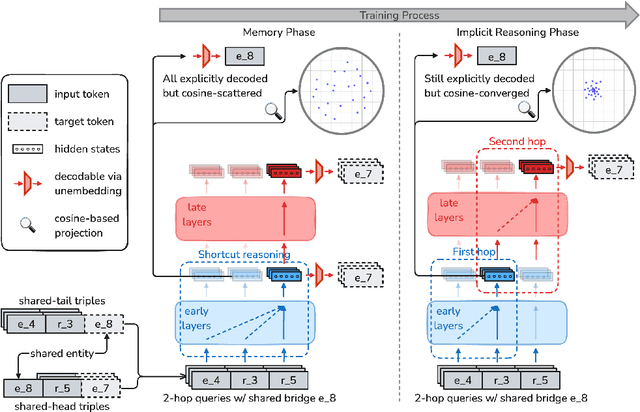

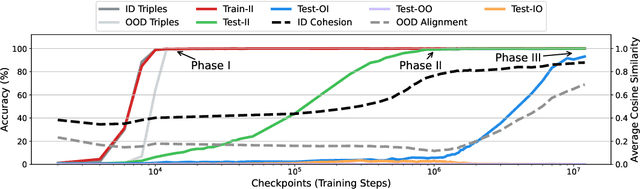
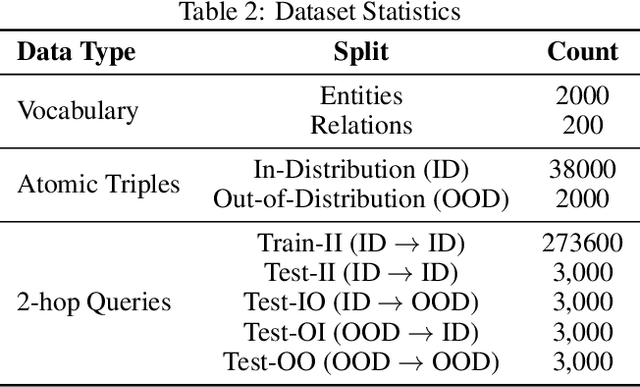
Recent work suggests that large language models (LLMs) can perform multi-hop reasoning implicitly -- producing correct answers without explicitly verbalizing intermediate steps -- but the underlying mechanisms remain poorly understood. In this paper, we study how such implicit reasoning emerges by training transformers from scratch in a controlled symbolic environment. Our analysis reveals a three-stage developmental trajectory: early memorization, followed by in-distribution generalization, and eventually cross-distribution generalization. We find that training with atomic triples is not necessary but accelerates learning, and that second-hop generalization relies on query-level exposure to specific compositional structures. To interpret these behaviors, we introduce two diagnostic tools: cross-query semantic patching, which identifies semantically reusable intermediate representations, and a cosine-based representational lens, which reveals that successful reasoning correlates with the cosine-base clustering in hidden space. This clustering phenomenon in turn provides a coherent explanation for the behavioral dynamics observed across training, linking representational structure to reasoning capability. These findings provide new insights into the interpretability of implicit multi-hop reasoning in LLMs, helping to clarify how complex reasoning processes unfold internally and offering pathways to enhance the transparency of such models.