 Add to Chrome
 Add to Firefox
 Add to Edge
MMUSV-Sim: A Perception-Oriented Simulation and Data-Generation Platform for Multi-USV Cooperative Perception
Aug 14, 2026
Cooperative perception among multiple unmanned surface vehicles (USVs) combines complementary observations to extend maritime target sensing beyond the view range and field of a single platform. Developing such systems at scale calls for a unified workflow for configurable multi-USV scenarios, multimodal acquisition, and shared annotations. We present MMUSV-Sim, a perception-oriented maritime simulation and data-generation platform built on Unreal Engine 5 and Project AirSim. It provides island, open-sea, and port environments; configurable weather, time of day, and wave conditions; a diverse vessel asset library; and spline-based multi-vessel motion. MMUSV-Sim acquires RGB, depth, semantic, LiDAR, and radar observations across multiple USVs and captures a common world state for per-agent annotation export. Experiments verify that the configured wave settings produce the intended changes in vessel heave, roll, and pitch, and evaluate the geometric consistency between projected annotations and semantic renderings. In LiDAR-based cooperative BEV vessel detection experiments on the generated multi-USV dataset, Early Fusion achieves an AP@0.5 of 72.74, compared with 45.54 using a single USV.

SC-Diff: Semantically Calibrated Diffusion for Visible-to-Infrared Image Translation
Aug 09, 2026Visible-to-infrared image translation provides a practical way to expand infrared training data using abundant visible images. Diffusion models are promising for this task because of their strong generative performance. However, existing diffusion-based methods typically use semantic priors only as external conditions, without explicitly regulating token interactions within the denoising network. Consequently, they struggle to preserve object locations, shapes, and semantic layouts required for reliable annotation reuse. We propose SC-Diff, a semantically calibrated latent diffusion framework that uses semantic priors for both conditional guidance and internal self-attention calibration. A pretrained SAM3 model with predefined text prompts first extracts category-specific semantic masks from visible images. These masks are merged into a semantic map and fused with the visible image as the input condition. The same map is converted into token-level semantic labels to calibrate self-attention in the denoising network. Based on these labels, we introduce Semantic-Guided Self-Attention Calibration (SGSC), which adaptively applies positive biases to query-key pairs of the same category. The query-wise calibration strength depends on the dispersion of attention across semantic categories and the attention assigned to the query's own category. The original attention scores further modulate the bias, giving greater calibration to same-category keys with stronger responses. This soft calibration reduces cross-category interference while retaining global contextual interactions, thereby improving semantic consistency in generated infrared images. Extensive experiments show that SC-Diff improves perceptual quality and produces more effective synthetic training data for downstream infrared object detection.
AD-DINOv3: Enhancing DINOv3 for Zero-Shot Anomaly Detection with Anomaly-Aware Calibration
Sep 18, 2025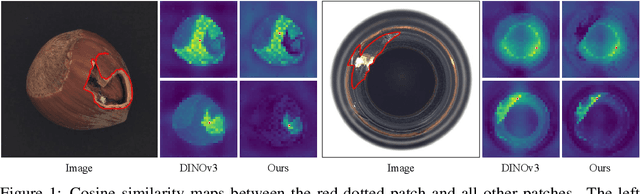
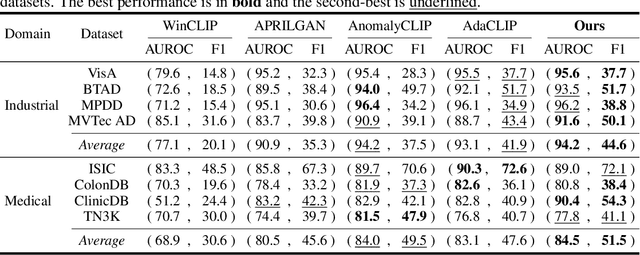
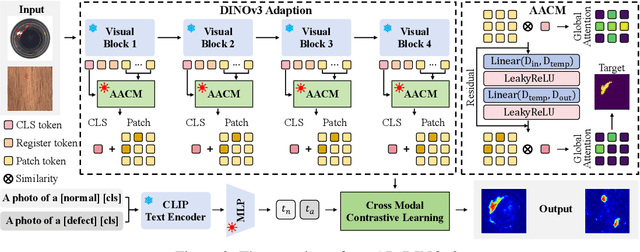
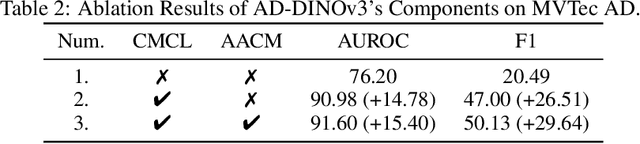
Zero-Shot Anomaly Detection (ZSAD) seeks to identify anomalies from arbitrary novel categories, offering a scalable and annotation-efficient solution. Traditionally, most ZSAD works have been based on the CLIP model, which performs anomaly detection by calculating the similarity between visual and text embeddings. Recently, vision foundation models such as DINOv3 have demonstrated strong transferable representation capabilities. In this work, we are the first to adapt DINOv3 for ZSAD. However, this adaptation presents two key challenges: (i) the domain bias between large-scale pretraining data and anomaly detection tasks leads to feature misalignment; and (ii) the inherent bias toward global semantics in pretrained representations often leads to subtle anomalies being misinterpreted as part of the normal foreground objects, rather than being distinguished as abnormal regions. To overcome these challenges, we introduce AD-DINOv3, a novel vision-language multimodal framework designed for ZSAD. Specifically, we formulate anomaly detection as a multimodal contrastive learning problem, where DINOv3 is employed as the visual backbone to extract patch tokens and a CLS token, and the CLIP text encoder provides embeddings for both normal and abnormal prompts. To bridge the domain gap, lightweight adapters are introduced in both modalities, enabling their representations to be recalibrated for the anomaly detection task. Beyond this baseline alignment, we further design an Anomaly-Aware Calibration Module (AACM), which explicitly guides the CLS token to attend to anomalous regions rather than generic foreground semantics, thereby enhancing discriminability. Extensive experiments on eight industrial and medical benchmarks demonstrate that AD-DINOv3 consistently matches or surpasses state-of-the-art methods.The code will be available at https://github.com/Kaisor-Yuan/AD-DINOv3.