 Add to Chrome
 Add to Firefox
 Add to Edge
Security of OpenClaw Agents: Fundamentals, Attacks, and Countermeasures
May 25, 2026
The rapid evolution of large language model (LLM)-driven autonomous agents has given rise to OpenClaw, a new class of open-source agent frameworks that operate as continuously running, skill-augmented systems with persistent memory, multi-channel interaction, and high degrees of autonomy. Such capabilities enable OpenClaw agents to autonomously execute complex, multi-step tasks and interact seamlessly with external applications, but simultaneously introduce a substantially enlarged attack surface. In particular, the combination of high-privilege operations and persistent memory exposes OpenClaw agents to various emerging threats, including skill poisoning, cognitive manipulation, multi-agent cascading failures, and supply-chain vulnerabilities. In this survey, we present a comprehensive study of the security landscape of OpenClaw agents. We first examine the general architecture and key characteristics that distinguish OpenClaw agents from traditional AI agent systems. We categorize existing security and privacy threats into a layered framework and analyze how vulnerabilities arise during agent reasoning, action execution, and external interaction. Representative defense mechanisms are also reviewed to draw the current defense landscape. Finally, several unresolved issues related to the reliability and trustworthiness of OpenClaw ecosystems are discussed.

Movable Antennas Enabled ISAC Systems: Fundamentals, Opportunities, and Future Directions
Dec 30, 2024The movable antenna (MA)-enabled integrated sensing and communication (ISAC) system attracts widespread attention as an innovative framework. The ISAC system integrates sensing and communication functions, achieving resource sharing across various domains, significantly enhancing communication and sensing performance, and promoting the intelligent interconnection of everything. Meanwhile, MA utilizes the spatial variations of wireless channels by dynamically adjusting the positions of MA elements at the transmitter and receiver to improve the channel and further enhance the performance of the ISAC systems. In this paper, we first outline the fundamental principles of MA and introduce the application scenarios of MA-enabled ISAC systems. Then, we summarize the advantages of MA-enabled ISAC systems in enhancing spectral efficiency, achieving flexible and precise beamforming, and making the signal coverage range adjustable. Besides, a specific case is studied to show the performance gains in terms of transmit power that MA brings to ISAC systems. Finally, we discuss the challenges of MA-enabled ISAC and future research directions, aiming to provide insights for future research on MA-enabled ISAC systems.
Joint Discrete Antenna Positioning and Beamforming Optimization in Movable Antenna Enabled Full-Duplex ISAC Networks
Nov 07, 2024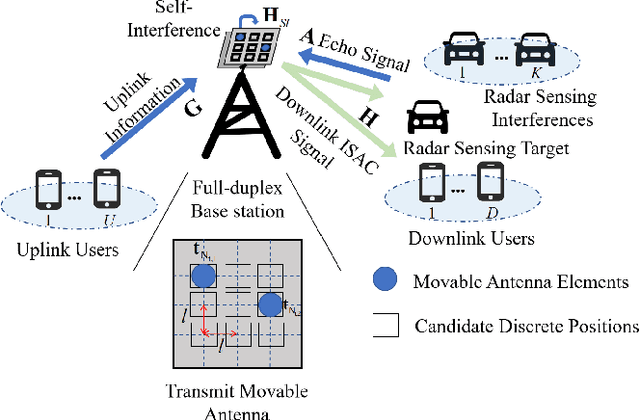
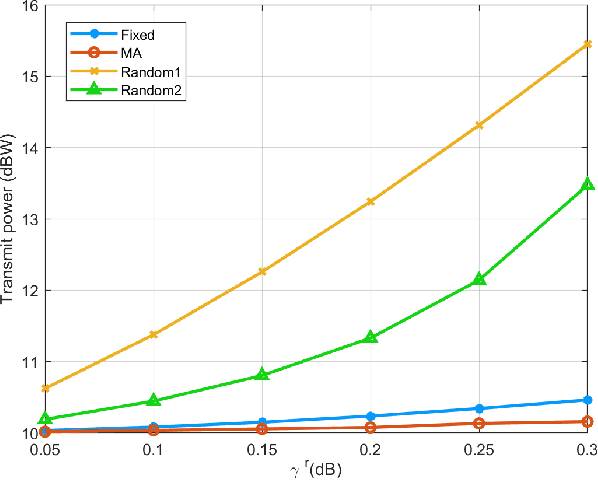
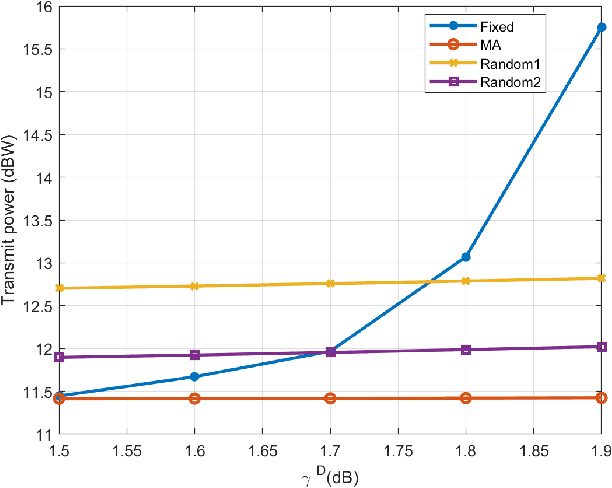
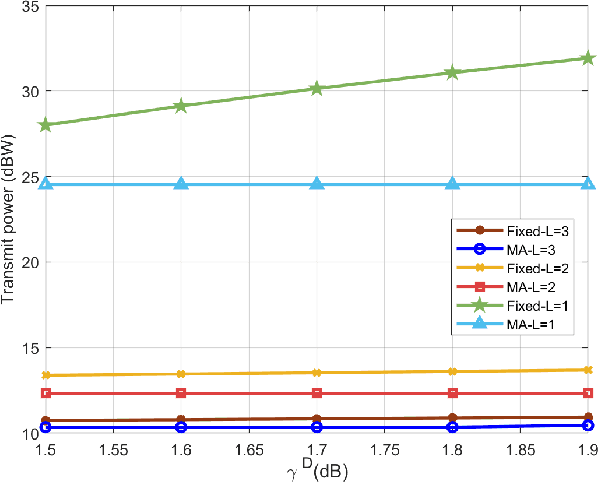
In this paper, we propose a full-duplex integrated sensing and communication (ISAC) system enabled by a movable antenna (MA). By leveraging the characteristic of MA that can increase the spatial diversity gain, the performance of the system can be enhanced. We formulate a problem of minimizing the total transmit power consumption via jointly optimizing the discrete position of MA elements, beamforming vectors, sensing signal covariance matrix and user transmit power. Given the significant coupling of optimization variables, the formulated problem presents a non-convex optimization challenge that poses difficulties for direct resolution. To address this challenging issue, the discrete binary particle swarm optimization (BPSO) algorithm framework is employed to solve the formulated problem. Specifically, the discrete positions of MA elements are first obtained by iteratively solving the fitness function. The difference-of-convex (DC) programming and successive convex approximation (SCA) are used to handle non-convex and rank-1 terms in the fitness function. Once the BPSO iteration is complete, the discrete positions of MA elements can be determined, and we can obtain the solutions for beamforming vectors, sensing signal covariance matrix and user transmit power. Numerical results demonstrate the superiority of the proposed system in reducing the total transmit power consumption compared with fixed antenna arrays.