 Add to Chrome
 Add to Firefox
 Add to Edge
The Devil Is in the Leakage: A Disentangled Dual-Purification Framework for High-Fidelity Hairstyle Transfer
Jul 13, 2026
Hairstyle transfer aims to synthesize a photorealistic portrait by transplanting the hairstyle from a reference image onto a source subject while preserving the source identity. Recent foundation models show strong generative capability, but they struggle with the zero-shot disentanglement required for precise local editing, often entangling the reference hairstyle with its original identity and pose. Existing diffusion-based pipelines typically decompose the task by first generating a "bald" image from the source and then injecting hairstyle features from the reference. However, we show that this paradigm suffers from a fundamental leakage problem. Identity Leakage in Hairstyle occurs when hairstyle features retain reference identity or pose information, while Flaw Leakage in Bald arises when residual artifacts in the bald image are propagated into the final synthesis. To address both issues, we propose the Dual-Purification Framework (DPF), which introduces two complementary training-time regularizers. Adversarial Hairstyle Purification (AHP) purifies hairstyle features by suppressing identity predictability under a mutual-information-inspired adversarial objective. Contrastive Geometric Purification (CGP) regularizes the ControlNet pathway with a contrastive objective, reducing the model's reliance on geometric artifacts in the bald condition. By jointly purifying the hairstyle representation and geometric pathway, DPF achieves high-fidelity, identity-preserving hairstyle transfer and state-of-the-art performance on diverse benchmarks.

Towards Flexible, Natural, Efficient Interaction for Conversational Talking Face Generation
Jun 30, 2026Conversational talking face generation has recently attracted increasing attention, aiming to synthesize interactive talking videos where characters speak, listen, and respond dynamically to each other. This task presents three core challenges: 1) Flexibility: enabling multi-round dialogues with an arbitrary number of participants; 2) Naturalness: maintaining coherent motion and appropriate non-verbal feedback throughout the interaction; and 3) Efficiency: achieving real-time generation and low computation overhead for long-term continuous online conversation. Despite recent advances, existing methods still fall short in balancing all three requirements. To bridge this gap, we introduce InterTalk, a novel and efficient framework designed for highly interactive conversational talking face generation. Built upon a motion-based architecture, InterTalk supports real-time conversation synthesis. Our method achieves strong flexibility by explicitly modeling multi-round conversational dynamics among each participant, eliminating constraints on their numbers. To enhance interactivity, we incorporate motion feedback from multiple participants and introduce an iterative generation strategy for more natural behaviors. Besides, we disentangle motion into several facial components, enabling targeted refinements for natural response such as precise lip sync and realistic eye blinking. Finally, we construct a new multi-person conversational dataset and enrich it with 3D face-based data augmentation. Extensive experiments demonstrate that InterTalk achieves superior interaction quality while maintaining real-time performance at 30 FPS.
* 17 Pages,8 figures
SRM-Hair: Single Image Head Mesh Reconstruction via 3D Morphable Hair
Mar 08, 20253D Morphable Models (3DMMs) have played a pivotal role as a fundamental representation or initialization for 3D avatar animation and reconstruction. However, extending 3DMMs to hair remains challenging due to the difficulty of enforcing vertex-level consistent semantic meaning across hair shapes. This paper introduces a novel method, Semantic-consistent Ray Modeling of Hair (SRM-Hair), for making 3D hair morphable and controlled by coefficients. The key contribution lies in semantic-consistent ray modeling, which extracts ordered hair surface vertices and exhibits notable properties such as additivity for hairstyle fusion, adaptability, flipping, and thickness modification. We collect a dataset of over 250 high-fidelity real hair scans paired with 3D face data to serve as a prior for the 3D morphable hair. Based on this, SRM-Hair can reconstruct a hair mesh combined with a 3D head from a single image. Note that SRM-Hair produces an independent hair mesh, facilitating applications in virtual avatar creation, realistic animation, and high-fidelity hair rendering. Both quantitative and qualitative experiments demonstrate that SRM-Hair achieves state-of-the-art performance in 3D mesh reconstruction. Our project is available at https://github.com/wang-zidu/SRM-Hair
Revisiting Marr in Face: The Building of 2D--2.5D--3D Representations in Deep Neural Networks
Nov 25, 2024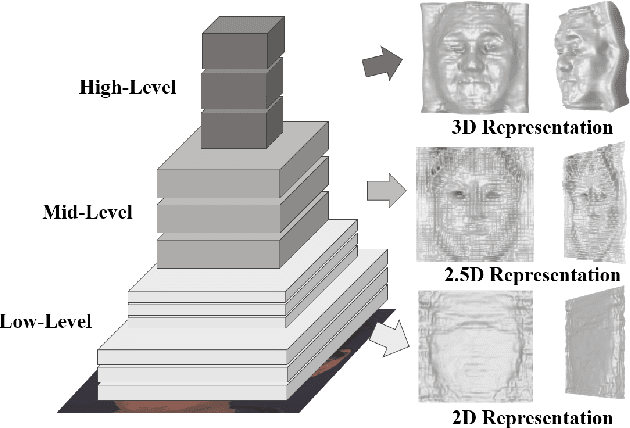
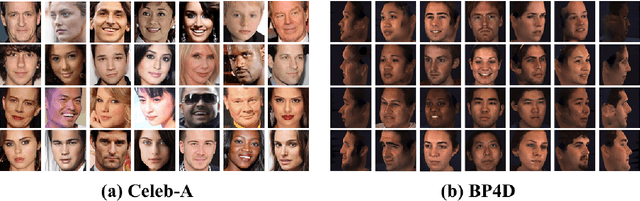
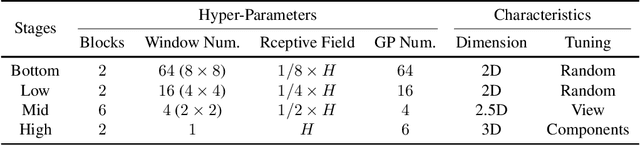
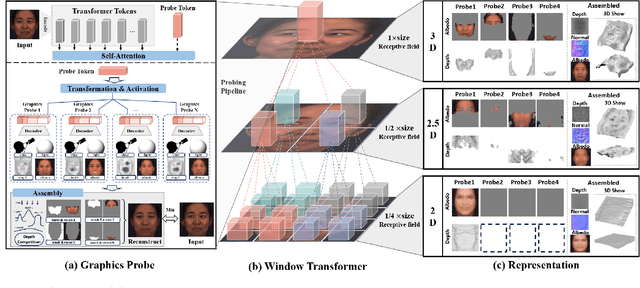
David Marr's seminal theory of vision proposes that the human visual system operates through a sequence of three stages, known as the 2D sketch, the 2.5D sketch, and the 3D model. In recent years, Deep Neural Networks (DNN) have been widely thought to have reached a level comparable to human vision. However, the mechanisms by which DNNs accomplish this and whether they adhere to Marr's 2D--2.5D--3D construction theory remain unexplored. In this paper, we delve into the perception task to explore these questions and find evidence supporting Marr's theory. We introduce a graphics probe, a sub-network crafted to reconstruct the original image from the network's intermediate layers. The key to the graphics probe is its flexible architecture that supports image in both 2D and 3D formats, as well as in a transitional state between them. By injecting graphics probes into neural networks, and analyzing their behavior in reconstructing images, we find that DNNs initially encode images as 2D representations in low-level layers, and finally construct 3D representations in high-level layers. Intriguingly, in mid-level layers, DNNs exhibit a hybrid state, building a geometric representation that s sur normals within a narrow depth range, akin to the appearance of a low-relief sculpture. This stage resembles the 2.5D representations, providing a view of how DNNs evolve from 2D to 3D in the perception process. The graphics probe therefore serves as a tool for peering into the mechanisms of DNN, providing empirical support for Marr's theory.