 Add to Chrome
 Add to Firefox
 Add to Edge
Hear to See: Discerning Stateful Listening for Audio-Visual Instance Segmentation
Aug 04, 2026
Audio-visual instance segmentation (AVIS) requires accurately identifying and tracking individual sounding objects with pixel-level masks. Existing methods struggle to match overlapping acoustic events with visual instances and handle asynchronous audio-visual dynamics. Therefore, two critical questions arise: how can a model establish precise correspondence between overlapping sound sources and visual instances, and how can a model maintain robust tracking when audio and visual signals are temporally misaligned?This paper proposes Hear to See (H2S), addressing these challenges through two mechanisms. The Acoustic-Semantic Projector (ASP) disentangles mixed audio and establishes hierarchical correspondence from semantic to spatial domains. The Asynchronous Dynamics Modulator (ADM) adaptively adjusts state transitions via audio-modulated Mamba, prioritizing current information during dynamic variations and maintaining continuity in stable periods.Experiments on AVISeg show H2S achieves SOTA performance, attaining 48.54 mAP with a COCO pretrained ResNet50 and surpassing the previous by 7.8\%. The code will be open-sourced once the paper is accepted. The source code will be publicly available at https://github.com/leiyeliu/H2S.

CriDiff: Criss-cross Injection Diffusion Framework via Generative Pre-train for Prostate Segmentation
Jun 20, 2024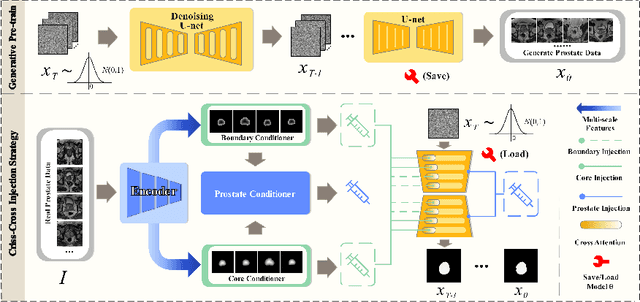
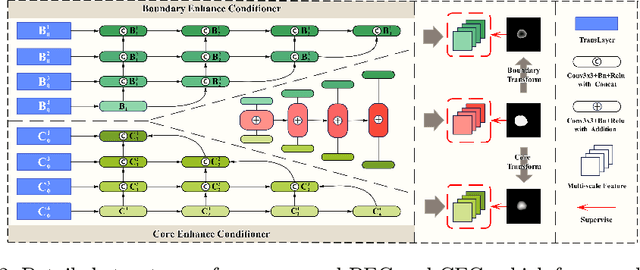
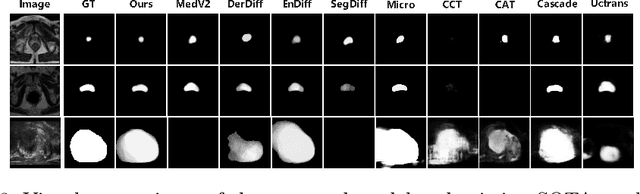
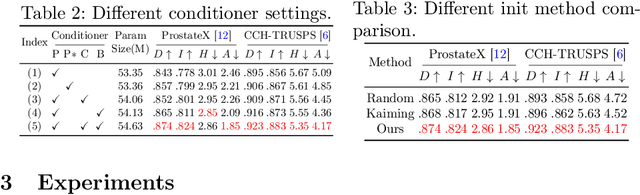
Recently, the Diffusion Probabilistic Model (DPM)-based methods have achieved substantial success in the field of medical image segmentation. However, most of these methods fail to enable the diffusion model to learn edge features and non-edge features effectively and to inject them efficiently into the diffusion backbone. Additionally, the domain gap between the images features and the diffusion model features poses a great challenge to prostate segmentation. In this paper, we proposed CriDiff, a two-stage feature injecting framework with a Crisscross Injection Strategy (CIS) and a Generative Pre-train (GP) approach for prostate segmentation. The CIS maximizes the use of multi-level features by efficiently harnessing the complementarity of high and low-level features. To effectively learn multi-level of edge features and non-edge features, we proposed two parallel conditioners in the CIS: the Boundary Enhance Conditioner (BEC) and the Core Enhance Conditioner (CEC), which discriminatively model the image edge regions and non-edge regions, respectively. Moreover, the GP approach eases the inconsistency between the images features and the diffusion model without adding additional parameters. Extensive experiments on four benchmark datasets demonstrate the effectiveness of the proposed method and achieve state-of-the-art performance on four evaluation metrics.