 Add to Chrome
 Add to Firefox
 Add to Edge
MUSE: Resolving Manifold Misalignment in Visual Tokenization via Topological Orthogonality
May 07, 2026
Unified visual tokenization faces a fundamental trade-off between high-fidelity pixel reconstruction (spatial equivariance) and semantic abstraction (conceptual invariance). We attribute this conflict to Manifold Misalignment: naive joint optimization induces opposing gradients, creating a zero-sum game between reconstruction and perception. To address this, we propose MUSE, a framework based on Topological Orthogonality. By treating Structure as an orthogonal bridge, MUSE decouples optimization within Transformers: structural gradients refine attention topology, while semantic gradients update feature values. This turns destructive interference into Mutual Reinforcement. Experiments show that MUSE breaks the trade-off, achieving state-of-the-art generation quality (gFID 3.08) and surpassing its teacher InternViT-300M in linear probing (85.2\% vs. 82.5\%), demonstrating that structurally aligned reconstruction can enhance semantic perception. Code is available at https://github.com/PanqiYang1/MUSE.

Efficient and Accurate Quantized Image Super-Resolution on Mobile NPUs, Mobile AI & AIM 2022 challenge: Report
Nov 07, 2022

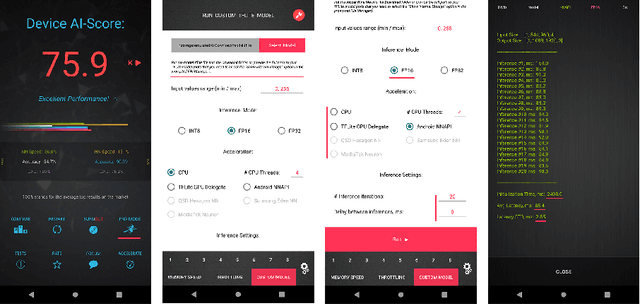
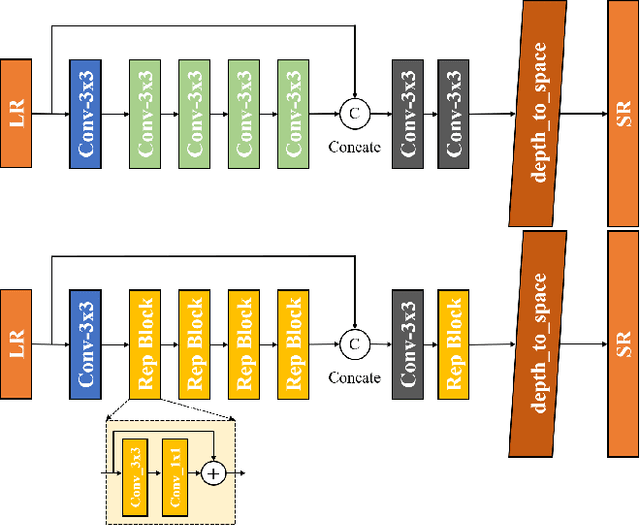
Image super-resolution is a common task on mobile and IoT devices, where one often needs to upscale and enhance low-resolution images and video frames. While numerous solutions have been proposed for this problem in the past, they are usually not compatible with low-power mobile NPUs having many computational and memory constraints. In this Mobile AI challenge, we address this problem and propose the participants to design an efficient quantized image super-resolution solution that can demonstrate a real-time performance on mobile NPUs. The participants were provided with the DIV2K dataset and trained INT8 models to do a high-quality 3X image upscaling. The runtime of all models was evaluated on the Synaptics VS680 Smart Home board with a dedicated edge NPU capable of accelerating quantized neural networks. All proposed solutions are fully compatible with the above NPU, demonstrating an up to 60 FPS rate when reconstructing Full HD resolution images. A detailed description of all models developed in the challenge is provided in this paper.