 Add to Chrome
 Add to Firefox
 Add to Edge
IPSM-Bench: A New Intermediate Phase Segmentation Benchmark in Microstructure Images of Zinc-Based Absorbable Biomaterials
Jun 09, 2026
Zinc-based alloys are indispensable emerging absorbable metallic biomaterials, and their macroscopic performance is governed by microstructural characteristics. Intermediate phases-key microstructural constituents-are pivotal in regulating mechanical and functional properties. However, intermediate phase segmentation in zinc alloy microstructures faces formidable challenges: scarce annotated datasets, low contrast, difficulty detecting small targets, and heterogeneous morphologies. To this end, we construct IPSM-Bench, the largest high-quality dataset for zinc-alloy intermediate phase segmentation. Furthermore, we propose SCoP-SAM, a new Spatial Context Prior-guided SAM method that leverages the gradient structure and grayscale properties of intermediate phases to capture spatial context priors and incorporates them into the entire SAM encoding-decoding process, improving segmentation performance. Based on the proposed IPSM-Bench, we establish a new benchmark for intermediate phase segmentation to systematically evaluate state-of-the-art (SOTA) methods and advance research on zinc alloy microstructure analysis. Extensive experiments on IPSM-Bench and additional public alloy benchmarks demonstrate that our SCoP-SAM not only achieves SOTA performance for zinc-alloy intermediate phase segmentation but also generalizes remarkably well to other alloy scenarios.

Towards Semantic Consistency: Dirichlet Energy Driven Robust Multi-Modal Entity Alignment
Jan 31, 2024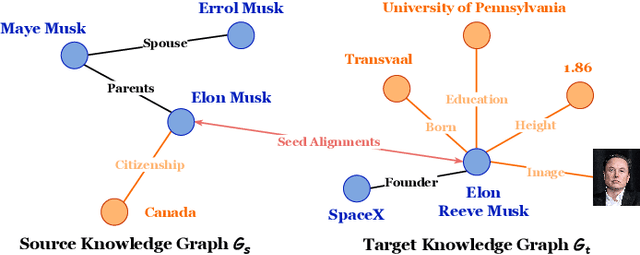
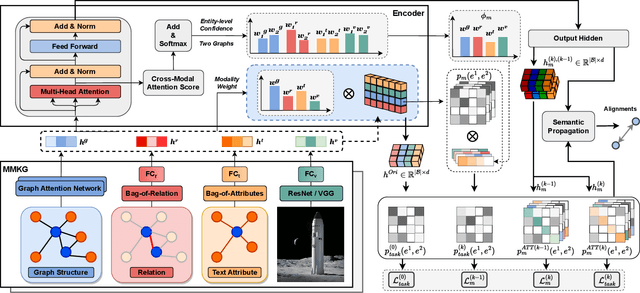
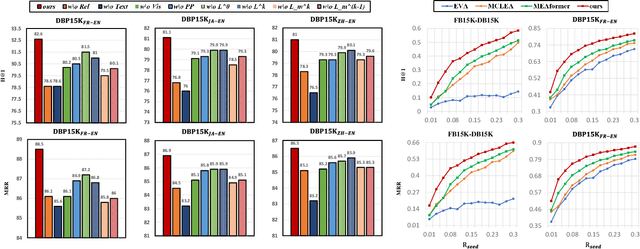
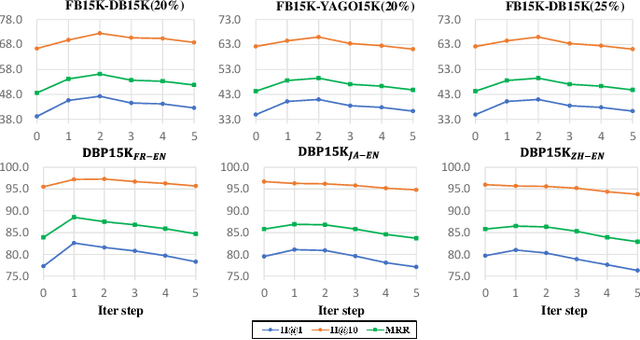
In Multi-Modal Knowledge Graphs (MMKGs), Multi-Modal Entity Alignment (MMEA) is crucial for identifying identical entities across diverse modal attributes. However, semantic inconsistency, mainly due to missing modal attributes, poses a significant challenge. Traditional approaches rely on attribute interpolation, but this often introduces modality noise, distorting the original semantics. Moreover, the lack of a universal theoretical framework limits advancements in achieving semantic consistency. This study introduces a novel approach, DESAlign, which addresses these issues by applying a theoretical framework based on Dirichlet energy to ensure semantic consistency. We discover that semantic inconsistency leads to model overfitting to modality noise, causing performance fluctuations, particularly when modalities are missing. DESAlign innovatively combats over-smoothing and interpolates absent semantics using existing modalities. Our approach includes a multi-modal knowledge graph learning strategy and a propagation technique that employs existing semantic features to compensate for missing ones, providing explicit Euler solutions. Comprehensive evaluations across 18 benchmarks, including monolingual and bilingual scenarios, demonstrate that DESAlign surpasses existing methods, setting a new standard in performance. Further testing on 42 benchmarks with high rates of missing modalities confirms its robustness, offering an effective solution to semantic inconsistency in real-world MMKGs.