 Add to Chrome
 Add to Firefox
 Add to Edge
StreamGVE: Training-Free Video Editing via Few-Step Streaming Video Generation
May 20, 2026
Although existing video editing methods are generally feasible, they often require many costly iterations and still struggle to deliver high-quality yet satisfying editing results. We attribute this limitation to the prevalent data-to-data paradigm, which is less compatible with modern generative models than noise-to-data generation. To address this gap, we revisit video editing from a noise-to-data perspective and propose Streaming-Generation-based Video Editing (StreamGVE), which preserves few-step sampling while seamlessly injecting source-video conditions. Built on pre-trained streaming generation models, StreamGVE introduces dual-branch fast sampling with a self-attention bridge and cross-attention grounding/boosting to satisfy both sampling and conditioning requirements. We further propose source-oriented guidance to improve target-generation quality, and a visual prompting strategy to enhance editing flexibility and practicality. The method is effective, robust, and generalizable across different models. Extensive experiments on diverse video editing tasks show that StreamGVE consistently outperforms existing approaches, even in few-step settings with minimal time cost.

TrajLoom: Dense Future Trajectory Generation from Video
Mar 23, 2026Predicting future motion is crucial in video understanding and controllable video generation. Dense point trajectories are a compact, expressive motion representation, but modeling their future evolution from observed video remains challenging. We propose a framework that predicts future trajectories and visibility from past trajectories and video context. Our method has three components: (1) Grid-Anchor Offset Encoding, which reduces location-dependent bias by representing each point as an offset from its pixel-center anchor; (2) TrajLoom-VAE, which learns a compact spatiotemporal latent space for dense trajectories with masked reconstruction and a spatiotemporal consistency regularizer; and (3) TrajLoom-Flow, which generates future trajectories in latent space via flow matching, with boundary cues and on-policy K-step fine-tuning for stable sampling. We also introduce TrajLoomBench, a unified benchmark spanning real and synthetic videos with a standardized setup aligned with video-generation benchmarks. Compared with state-of-the-art methods, our approach extends the prediction horizon from 24 to 81 frames while improving motion realism and stability across datasets. The predicted trajectories directly support downstream video generation and editing. Code, model checkpoints, and datasets are available at https://trajloom.github.io/.
From Graph Diffusion to Graph Classification
Nov 26, 2024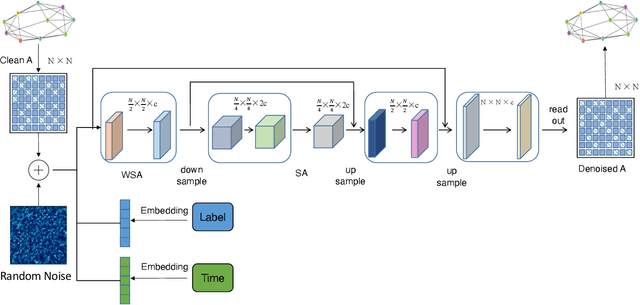
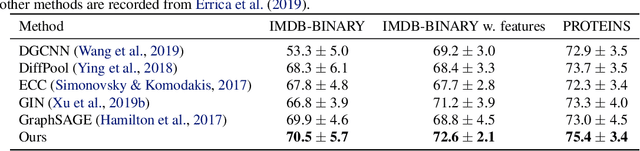
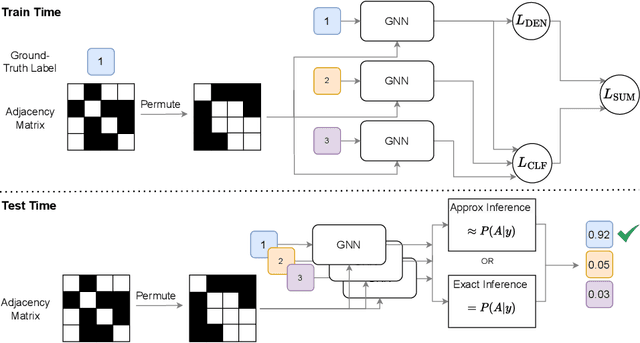
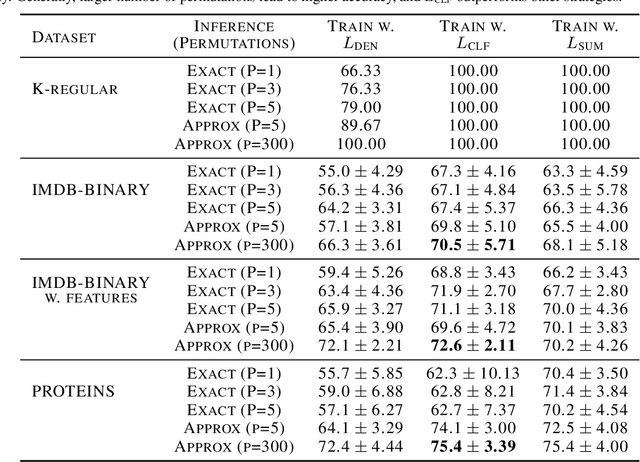
Generative models such as diffusion models have achieved remarkable success in state-of-the-art image and text tasks. Recently, score-based diffusion models have extended their success beyond image generation, showing competitive performance with discriminative methods in image {\em classification} tasks~\cite{zimmermann2021score}. However, their application to classification in the {\em graph} domain, which presents unique challenges such as complex topologies, remains underexplored. We show how graph diffusion models can be applied for graph classification. We find that to achieve competitive classification accuracy, score-based graph diffusion models should be trained with a novel training objective that is tailored to graph classification. In experiments with a sampling-based inference method, our discriminative training objective achieves state-of-the-art graph classification accuracy.