 Add to Chrome
 Add to Firefox
 Add to Edge
Counterfactual Residual Data Augmentation for Regression
Jun 26, 2026
Data-driven modeling in real-world regression tasks often suffers from limited training samples, high collection costs, and noisy observations. Inspired by the impact of data augmentation in vision and language, we propose a novel Counterfactual Residual Data Augmentation (CRDA) technique for tabular regression. Our key insight is that once a regressor has modeled the systematic component of the data, the remaining noise can be viewed as an invariant residual that remains stable under small perturbations of carefully selected features. We exploit this residual invariance to generate new, yet realistic, training samples, effectively expanding the dataset without requiring additional real data. Our method is model-agnostic and readily applicable to various types of regressors. In experiments across datasets from a variety of benchmark repositories, on average, CRDA reduces an MLP Regressor's MSE by 22.9% and an XGBoost Regressor's MSE by 6.4%. When compared to existing state-of-the-art data generators and augmentation techniques, CRDA consistently outperforms in MSE reduction. By adding principled counterfactual variations to the training data, our method offers a simple and efficient remedy for noise-prone, small-sample regression settings.

TacticGen: Grounding Adaptable and Scalable Generation of Football Tactics
Apr 20, 2026Success in association football relies on both individual skill and coordinated tactics. While recent advancements in spatio-temporal data and deep learning have enabled predictive analyses like trajectory forecasting, the development of tactical design remains limited. Bridging this gap is essential, as prediction reveals what is likely to occur, whereas tactic generation determines what should occur to achieve strategic objectives. In this work, we present TacticGen, a generative model for adaptable and scalable tactic generation. TacticGen formulates tactics as sequences of multi-agent movements and interactions conditioned on the game context. It employs a multi-agent diffusion transformer with agent-wise self-attention and context-aware cross-attention to capture cooperative and competitive dynamics among players and the ball. Trained with over 3.3 million events and 100 million tracking frames from top-tier leagues, TacticGen achieves state-of-the-art precision in predicting player trajectories. Building on it, TacticGen enables adaptable tactic generation tailored to diverse inference-time objectives through classifier guidance mechanism, specified via rules, natural language, or neural models. Its modeling performance is also inherently scalable. A case study with football experts confirms that TacticGen generates realistic, strategically valuable tactics, demonstrating its practical utility for tactical planning in professional football. The project page is available at: https://shengxu.net/TacticGen/.
From Graph Diffusion to Graph Classification
Nov 26, 2024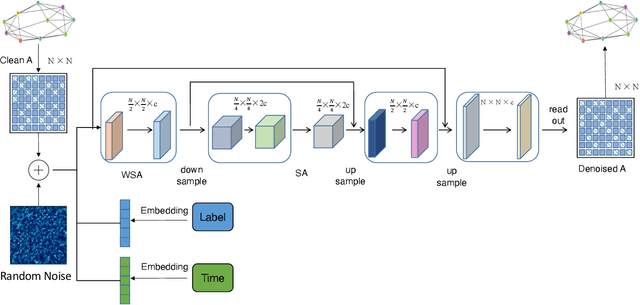
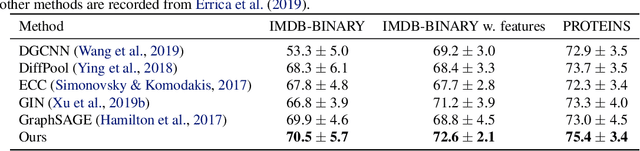
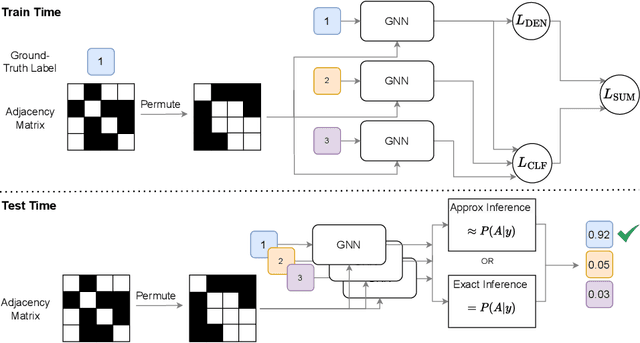
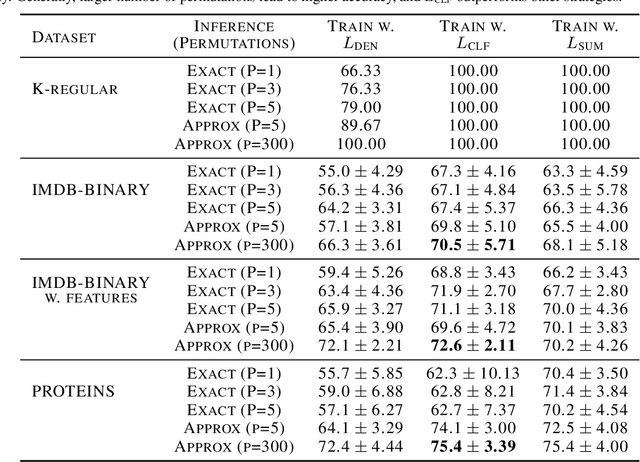
Generative models such as diffusion models have achieved remarkable success in state-of-the-art image and text tasks. Recently, score-based diffusion models have extended their success beyond image generation, showing competitive performance with discriminative methods in image {\em classification} tasks~\cite{zimmermann2021score}. However, their application to classification in the {\em graph} domain, which presents unique challenges such as complex topologies, remains underexplored. We show how graph diffusion models can be applied for graph classification. We find that to achieve competitive classification accuracy, score-based graph diffusion models should be trained with a novel training objective that is tailored to graph classification. In experiments with a sampling-based inference method, our discriminative training objective achieves state-of-the-art graph classification accuracy.
Deep Generative Models for Subgraph Prediction
Aug 07, 2024Graph Neural Networks (GNNs) are important across different domains, such as social network analysis and recommendation systems, due to their ability to model complex relational data. This paper introduces subgraph queries as a new task for deep graph learning. Unlike traditional graph prediction tasks that focus on individual components like link prediction or node classification, subgraph queries jointly predict the components of a target subgraph based on evidence that is represented by an observed subgraph. For instance, a subgraph query can predict a set of target links and/or node labels. To answer subgraph queries, we utilize a probabilistic deep Graph Generative Model. Specifically, we inductively train a Variational Graph Auto-Encoder (VGAE) model, augmented to represent a joint distribution over links, node features and labels. Bayesian optimization is used to tune a weighting for the relative importance of links, node features and labels in a specific domain. We describe a deterministic and a sampling-based inference method for estimating subgraph probabilities from the VGAE generative graph distribution, without retraining, in zero-shot fashion. For evaluation, we apply the inference methods on a range of subgraph queries on six benchmark datasets. We find that inference from a model achieves superior predictive performance, surpassing independent prediction baselines with improvements in AUC scores ranging from 0.06 to 0.2 points, depending on the dataset.
Why Online Reinforcement Learning is Causal
Mar 07, 2024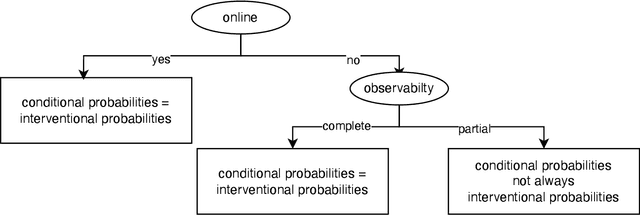
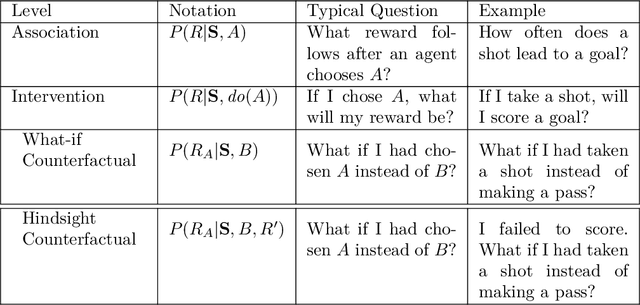
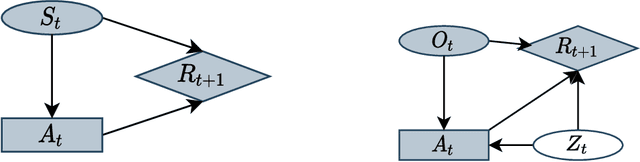
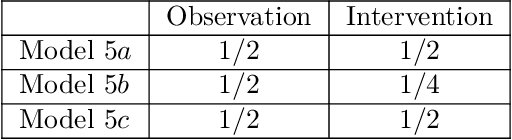
Reinforcement learning (RL) and causal modelling naturally complement each other. The goal of causal modelling is to predict the effects of interventions in an environment, while the goal of reinforcement learning is to select interventions that maximize the rewards the agent receives from the environment. Reinforcement learning includes the two most powerful sources of information for estimating causal relationships: temporal ordering and the ability to act on an environment. This paper examines which reinforcement learning settings we can expect to benefit from causal modelling, and how. In online learning, the agent has the ability to interact directly with their environment, and learn from exploring it. Our main argument is that in online learning, conditional probabilities are causal, and therefore offline RL is the setting where causal learning has the most potential to make a difference. Essentially, the reason is that when an agent learns from their {\em own} experience, there are no unobserved confounders that influence both the agent's own exploratory actions and the rewards they receive. Our paper formalizes this argument. For offline RL, where an agent may and typically does learn from the experience of {\em others}, we describe previous and new methods for leveraging a causal model, including support for counterfactual queries.
Disentanglement in Implicit Causal Models via Switch Variable
Feb 16, 2024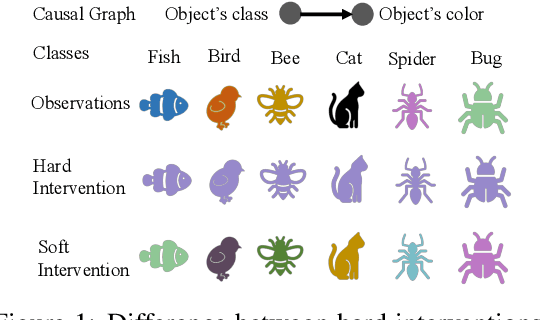

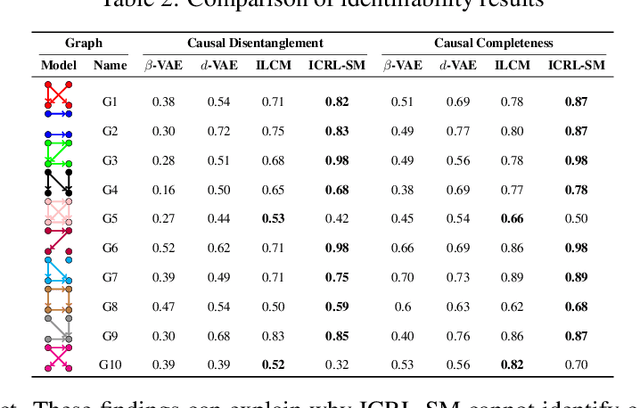
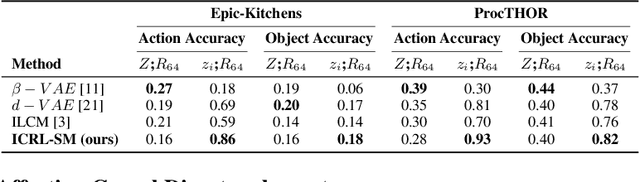
Learning causal representations from observational and interventional data in the absence of known ground-truth graph structures necessitates implicit latent causal representation learning. Implicitly learning causal mechanisms typically involves two categories of interventional data: hard and soft interventions. In real-world scenarios, soft interventions are often more realistic than hard interventions, as the latter require fully controlled environments. Unlike hard interventions, which directly force changes in a causal variable, soft interventions exert influence indirectly by affecting the causal mechanism. In this paper, we tackle implicit latent causal representation learning in a Variational Autoencoder (VAE) framework through soft interventions. Our approach models soft interventions effects by employing a causal mechanism switch variable designed to toggle between different causal mechanisms. In our experiments, we consistently observe improved learning of identifiable, causal representations, compared to baseline approaches.
Computing Expected Motif Counts for Exchangeable Graph Generative Models
May 01, 2023Estimating the expected value of a graph statistic is an important inference task for using and learning graph models. This note presents a scalable estimation procedure for expected motif counts, a widely used type of graph statistic. The procedure applies for generative mixture models of the type used in neural and Bayesian approaches to graph data.
Generative Causal Representation Learning for Out-of-Distribution Motion Forecasting
Feb 17, 2023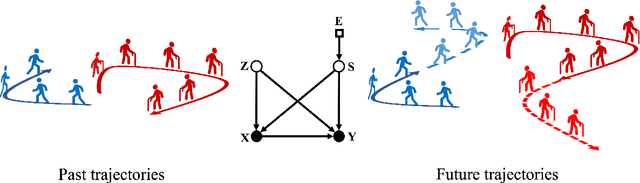
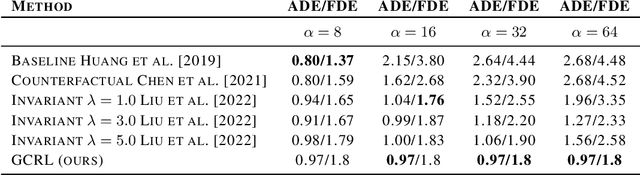
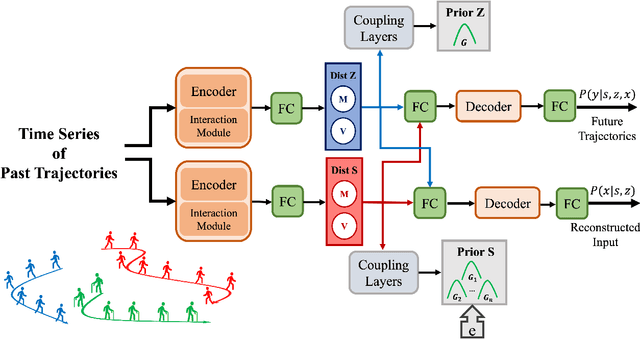

Conventional supervised learning methods typically assume i.i.d samples and are found to be sensitive to out-of-distribution (OOD) data. We propose Generative Causal Representation Learning (GCRL) which leverages causality to facilitate knowledge transfer under distribution shifts. While we evaluate the effectiveness of our proposed method in human trajectory prediction models, GCRL can be applied to other domains as well. First, we propose a novel causal model that explains the generative factors in motion forecasting datasets using features that are common across all environments and with features that are specific to each environment. Selection variables are used to determine which parts of the model can be directly transferred to a new environment without fine-tuning. Second, we propose an end-to-end variational learning paradigm to learn the causal mechanisms that generate observations from features. GCRL is supported by strong theoretical results that imply identifiability of the causal model under certain assumptions. Experimental results on synthetic and real-world motion forecasting datasets show the robustness and effectiveness of our proposed method for knowledge transfer under zero-shot and low-shot settings by substantially outperforming the prior motion forecasting models on out-of-distribution prediction.
From Graph Generation to Graph Classification
Feb 15, 2023This note describes a new approach to classifying graphs that leverages graph generative models (GGM). Assuming a GGM that defines a joint probability distribution over graphs and their class labels, I derive classification formulas for the probability of a class label given a graph. A new conditional ELBO can be used to train a generative graph auto-encoder model for discrimination. While leveraging generative models for classification has been well explored for non-relational i.i.d. data, to our knowledge it is a novel approach to graph classification.
Cause-Effect Inference in Location-Scale Noise Models: Maximum Likelihood vs. Independence Testing
Jan 26, 2023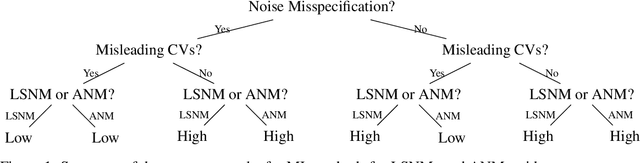
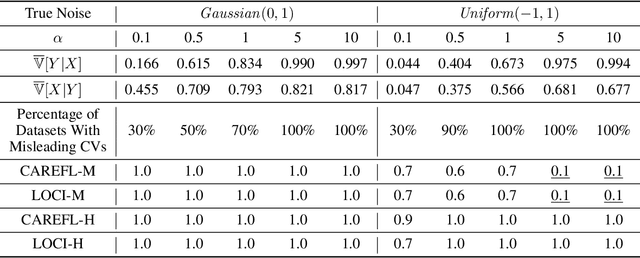
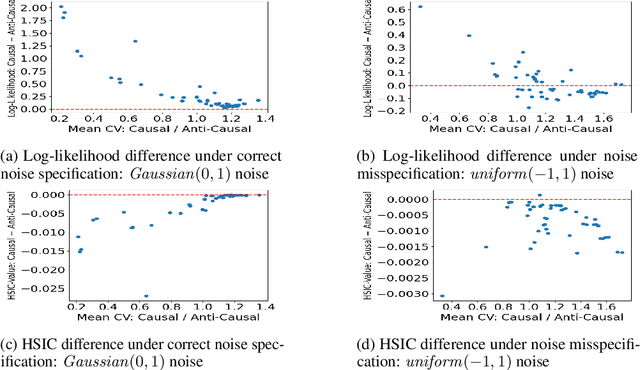

Location-scale noise models (LSNMs) are a class of heteroscedastic structural causal models with wide applicability, closely related to affine flow models. Recent likelihood-based methods designed for LSNMs that infer cause-effect relationships achieve state-of-the-art accuracy, when their assumptions are satisfied concerning the noise distributions. However, under misspecification their accuracy deteriorates sharply, especially when the conditional variance in the anti-causal direction is smaller than that in the causal direction. In this paper, we demonstrate the misspecification problem and analyze why and when it occurs. We show that residual independence testing is much more robust to misspecification than likelihood-based cause-effect inference. Our empirical evaluation includes 580 synthetic and 99 real-world datasets.