 Add to Chrome
 Add to Firefox
 Add to Edge
Evaluation of AI Ethics Tools in Language Models: A Developers' Perspective Case Stud
Dec 16, 2025
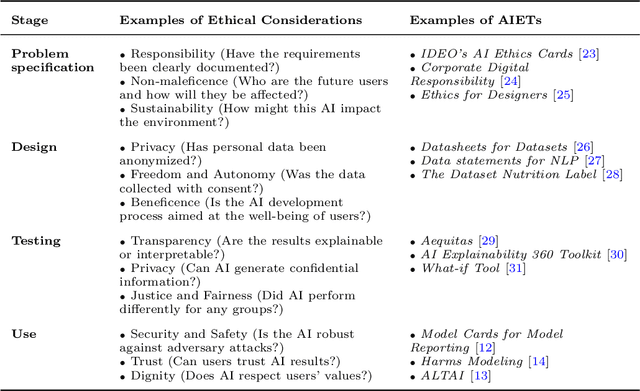
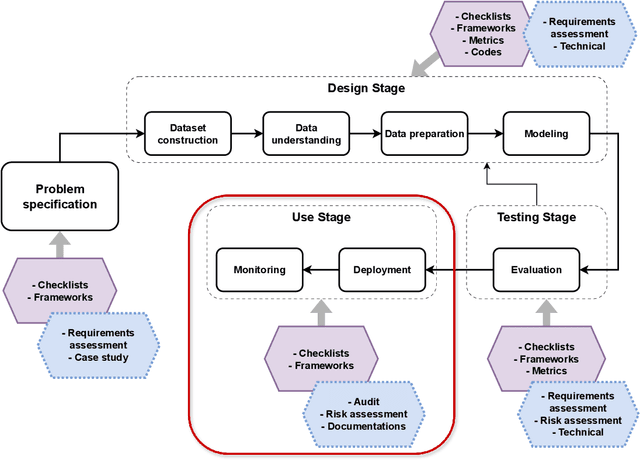
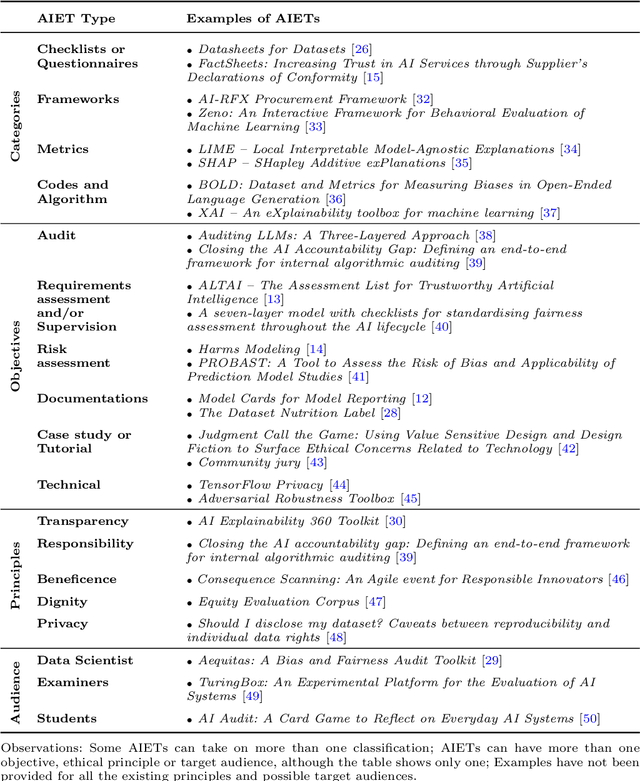
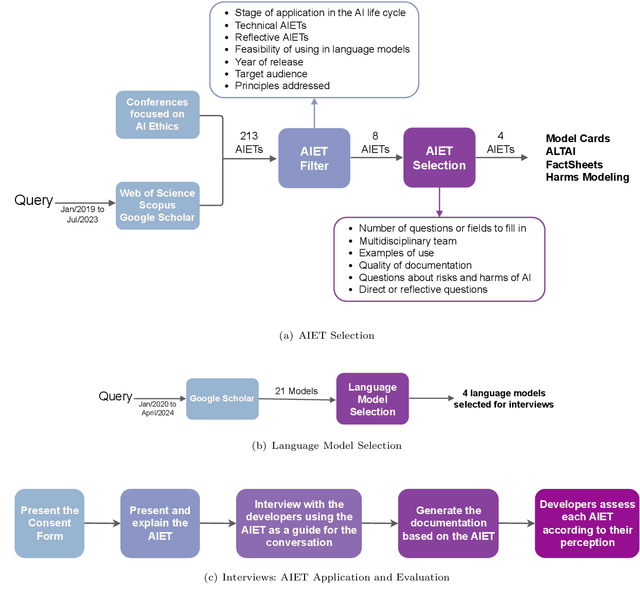
In Artificial Intelligence (AI), language models have gained significant importance due to the widespread adoption of systems capable of simulating realistic conversations with humans through text generation. Because of their impact on society, developing and deploying these language models must be done responsibly, with attention to their negative impacts and possible harms. In this scenario, the number of AI Ethics Tools (AIETs) publications has recently increased. These AIETs are designed to help developers, companies, governments, and other stakeholders establish trust, transparency, and responsibility with their technologies by bringing accepted values to guide AI's design, development, and use stages. However, many AIETs lack good documentation, examples of use, and proof of their effectiveness in practice. This paper presents a methodology for evaluating AIETs in language models. Our approach involved an extensive literature survey on 213 AIETs, and after applying inclusion and exclusion criteria, we selected four AIETs: Model Cards, ALTAI, FactSheets, and Harms Modeling. For evaluation, we applied AIETs to language models developed for the Portuguese language, conducting 35 hours of interviews with their developers. The evaluation considered the developers' perspective on the AIETs' use and quality in helping to identify ethical considerations about their model. The results suggest that the applied AIETs serve as a guide for formulating general ethical considerations about language models. However, we note that they do not address unique aspects of these models, such as idiomatic expressions. Additionally, these AIETs did not help to identify potential negative impacts of models for the Portuguese language.

Yet another algorithmic bias: A Discursive Analysis of Large Language Models Reinforcing Dominant Discourses on Gender and Race
Aug 14, 2025With the advance of Artificial Intelligence (AI), Large Language Models (LLMs) have gained prominence and been applied in diverse contexts. As they evolve into more sophisticated versions, it is essential to assess whether they reproduce biases, such as discrimination and racialization, while maintaining hegemonic discourses. Current bias detection approaches rely mostly on quantitative, automated methods, which often overlook the nuanced ways in which biases emerge in natural language. This study proposes a qualitative, discursive framework to complement such methods. Through manual analysis of LLM-generated short stories featuring Black and white women, we investigate gender and racial biases. We contend that qualitative methods such as the one proposed here are fundamental to help both developers and users identify the precise ways in which biases manifest in LLM outputs, thus enabling better conditions to mitigate them. Results show that Black women are portrayed as tied to ancestry and resistance, while white women appear in self-discovery processes. These patterns reflect how language models replicate crystalized discursive representations, reinforcing essentialization and a sense of social immobility. When prompted to correct biases, models offered superficial revisions that maintained problematic meanings, revealing limitations in fostering inclusive narratives. Our results demonstrate the ideological functioning of algorithms and have significant implications for the ethical use and development of AI. The study reinforces the need for critical, interdisciplinary approaches to AI design and deployment, addressing how LLM-generated discourses reflect and perpetuate inequalities.
CAPIVARA: Cost-Efficient Approach for Improving Multilingual CLIP Performance on Low-Resource Languages
Oct 23, 2023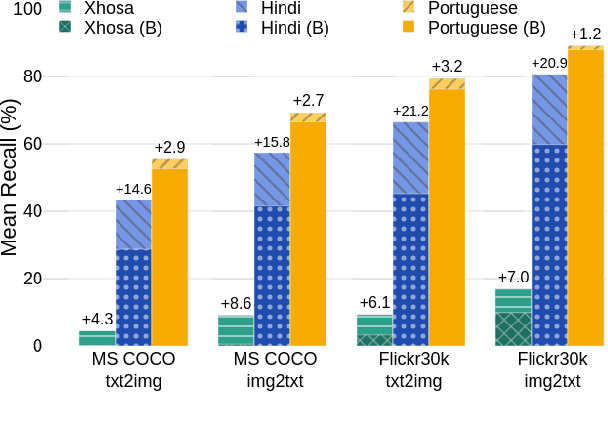

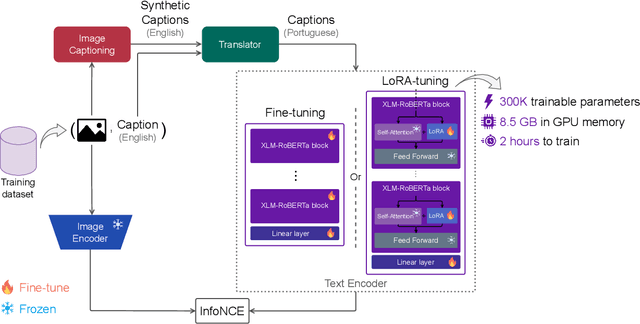
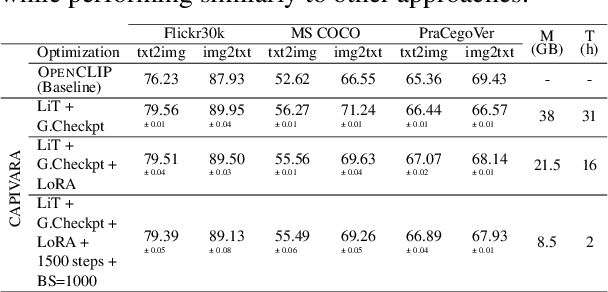
This work introduces CAPIVARA, a cost-efficient framework designed to enhance the performance of multilingual CLIP models in low-resource languages. While CLIP has excelled in zero-shot vision-language tasks, the resource-intensive nature of model training remains challenging. Many datasets lack linguistic diversity, featuring solely English descriptions for images. CAPIVARA addresses this by augmenting text data using image captioning and machine translation to generate multiple synthetic captions in low-resource languages. We optimize the training pipeline with LiT, LoRA, and gradient checkpointing to alleviate the computational cost. Through extensive experiments, CAPIVARA emerges as state of the art in zero-shot tasks involving images and Portuguese texts. We show the potential for significant improvements in other low-resource languages, achieved by fine-tuning the pre-trained multilingual CLIP using CAPIVARA on a single GPU for 2 hours. Our model and code is available at https://github.com/hiaac-nlp/CAPIVARA.