 Add to Chrome
 Add to Firefox
 Add to Edge
Evaluation of AI Ethics Tools in Language Models: A Developers' Perspective Case Stud
Dec 16, 2025
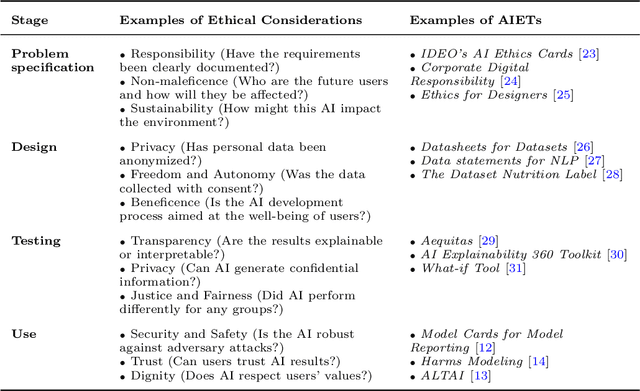
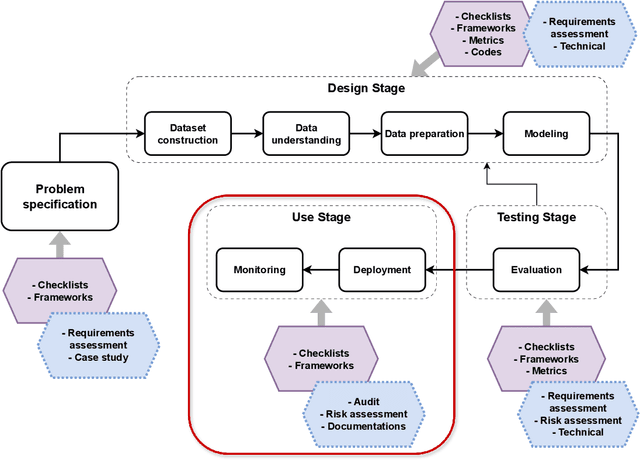
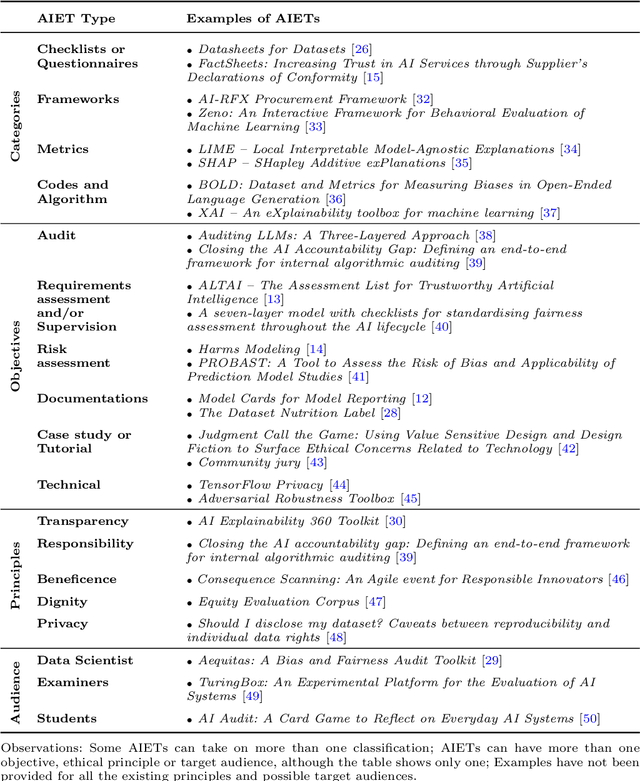
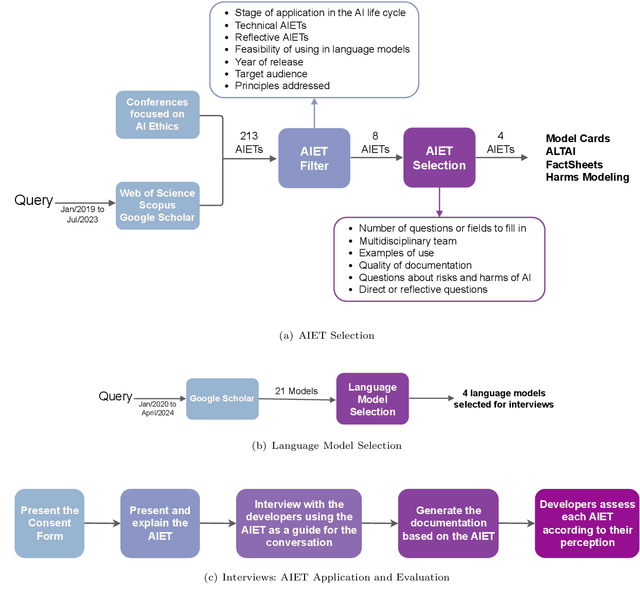
In Artificial Intelligence (AI), language models have gained significant importance due to the widespread adoption of systems capable of simulating realistic conversations with humans through text generation. Because of their impact on society, developing and deploying these language models must be done responsibly, with attention to their negative impacts and possible harms. In this scenario, the number of AI Ethics Tools (AIETs) publications has recently increased. These AIETs are designed to help developers, companies, governments, and other stakeholders establish trust, transparency, and responsibility with their technologies by bringing accepted values to guide AI's design, development, and use stages. However, many AIETs lack good documentation, examples of use, and proof of their effectiveness in practice. This paper presents a methodology for evaluating AIETs in language models. Our approach involved an extensive literature survey on 213 AIETs, and after applying inclusion and exclusion criteria, we selected four AIETs: Model Cards, ALTAI, FactSheets, and Harms Modeling. For evaluation, we applied AIETs to language models developed for the Portuguese language, conducting 35 hours of interviews with their developers. The evaluation considered the developers' perspective on the AIETs' use and quality in helping to identify ethical considerations about their model. The results suggest that the applied AIETs serve as a guide for formulating general ethical considerations about language models. However, we note that they do not address unique aspects of these models, such as idiomatic expressions. Additionally, these AIETs did not help to identify potential negative impacts of models for the Portuguese language.

Neglected Risks: The Disturbing Reality of Children's Images in Datasets and the Urgent Call for Accountability
Apr 20, 2025Including children's images in datasets has raised ethical concerns, particularly regarding privacy, consent, data protection, and accountability. These datasets, often built by scraping publicly available images from the Internet, can expose children to risks such as exploitation, profiling, and tracking. Despite the growing recognition of these issues, approaches for addressing them remain limited. We explore the ethical implications of using children's images in AI datasets and propose a pipeline to detect and remove such images. As a use case, we built the pipeline on a Vision-Language Model under the Visual Question Answering task and tested it on the #PraCegoVer dataset. We also evaluate the pipeline on a subset of 100,000 images from the Open Images V7 dataset to assess its effectiveness in detecting and removing images of children. The pipeline serves as a baseline for future research, providing a starting point for more comprehensive tools and methodologies. While we leverage existing models trained on potentially problematic data, our goal is to expose and address this issue. We do not advocate for training or deploying such models, but instead call for urgent community reflection and action to protect children's rights. Ultimately, we aim to encourage the research community to exercise - more than an additional - care in creating new datasets and to inspire the development of tools to protect the fundamental rights of vulnerable groups, particularly children.