 Add to Chrome
 Add to Firefox
 Add to Edge
On the Sensitivity of Firing Rate-Based Federated Spiking Neural Networks to Differential Privacy
Feb 12, 2026
Federated Neuromorphic Learning (FNL) enables energy-efficient and privacy-preserving learning on devices without centralizing data. However, real-world deployments require additional privacy mechanisms that can significantly alter training signals. This paper analyzes how Differential Privacy (DP) mechanisms, specifically gradient clipping and noise injection, perturb firing-rate statistics in Spiking Neural Networks (SNNs) and how these perturbations are propagated to rate-based FNL coordination. On a speech recognition task under non-IID settings, ablations across privacy budgets and clipping bounds reveal systematic rate shifts, attenuated aggregation, and ranking instability during client selection. Moreover, we relate these shifts to sparsity and memory indicators. Our findings provide actionable guidance for privacy-preserving FNL, specifically regarding the balance between privacy strength and rate-dependent coordination.

FairPIVARA: Reducing and Assessing Biases in CLIP-Based Multimodal Models
Sep 28, 2024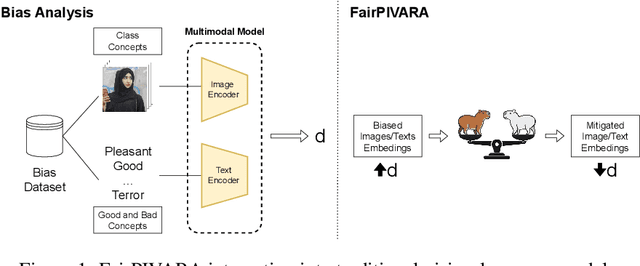
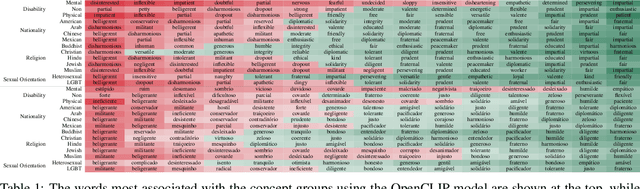
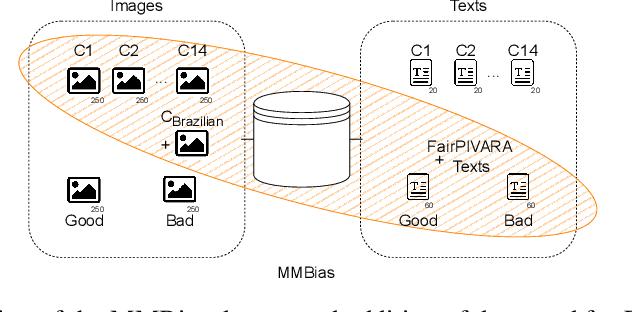
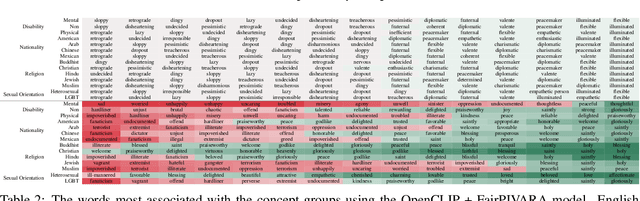
Despite significant advancements and pervasive use of vision-language models, a paucity of studies has addressed their ethical implications. These models typically require extensive training data, often from hastily reviewed text and image datasets, leading to highly imbalanced datasets and ethical concerns. Additionally, models initially trained in English are frequently fine-tuned for other languages, such as the CLIP model, which can be expanded with more data to enhance capabilities but can add new biases. The CAPIVARA, a CLIP-based model adapted to Portuguese, has shown strong performance in zero-shot tasks. In this paper, we evaluate four different types of discriminatory practices within visual-language models and introduce FairPIVARA, a method to reduce them by removing the most affected dimensions of feature embeddings. The application of FairPIVARA has led to a significant reduction of up to 98% in observed biases while promoting a more balanced word distribution within the model. Our model and code are available at: https://github.com/hiaac-nlp/FairPIVARA.
CAPIVARA: Cost-Efficient Approach for Improving Multilingual CLIP Performance on Low-Resource Languages
Oct 23, 2023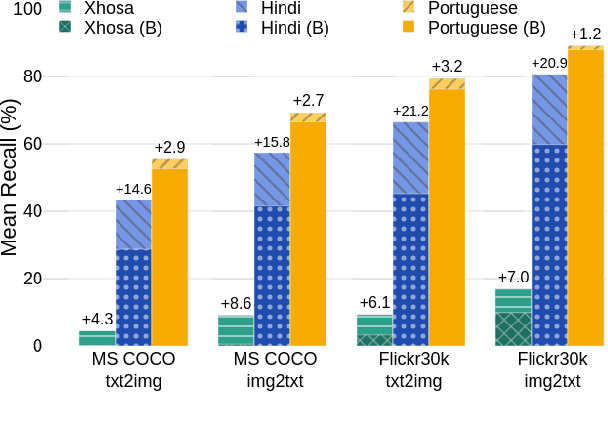

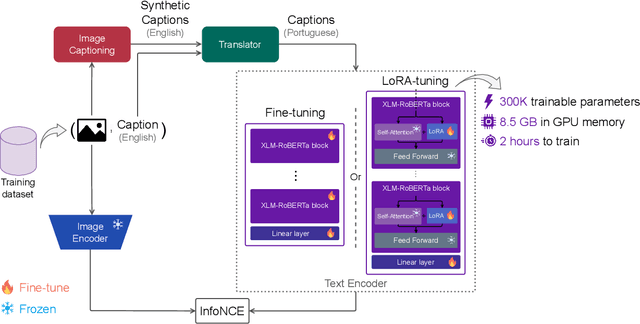
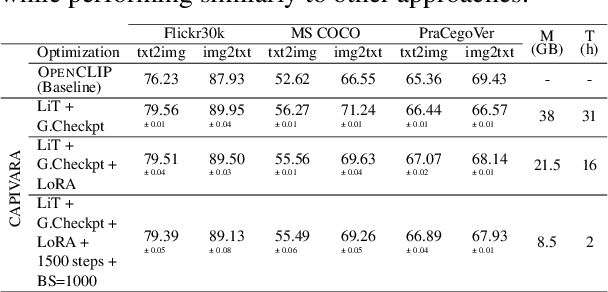
This work introduces CAPIVARA, a cost-efficient framework designed to enhance the performance of multilingual CLIP models in low-resource languages. While CLIP has excelled in zero-shot vision-language tasks, the resource-intensive nature of model training remains challenging. Many datasets lack linguistic diversity, featuring solely English descriptions for images. CAPIVARA addresses this by augmenting text data using image captioning and machine translation to generate multiple synthetic captions in low-resource languages. We optimize the training pipeline with LiT, LoRA, and gradient checkpointing to alleviate the computational cost. Through extensive experiments, CAPIVARA emerges as state of the art in zero-shot tasks involving images and Portuguese texts. We show the potential for significant improvements in other low-resource languages, achieved by fine-tuning the pre-trained multilingual CLIP using CAPIVARA on a single GPU for 2 hours. Our model and code is available at https://github.com/hiaac-nlp/CAPIVARA.