 Add to Chrome
 Add to Firefox
 Add to Edge
SkillRater: Untangling Capabilities in Multimodal Data
Feb 12, 2026
Data curation methods typically assign samples a single quality score. We argue this scalar framing is fundamentally limited: when training requires multiple distinct capabilities, a monolithic scorer cannot maximize useful signals for all of them simultaneously. Quality is better understood as multidimensional, with each dimension corresponding to a capability the model must acquire. We introduce SkillRater, a framework that decomposes data filtering into specialized raters - one per capability, each trained via meta-learning on a disjoint validation objective - and composes their scores through a progressive selection rule: at each training stage, a sample is retained if any rater ranks it above a threshold that tightens over time, preserving diversity early while concentrating on high-value samples late. We validate this approach on vision language models, decomposing quality into three capability dimensions: visual understanding, OCR, and STEM reasoning. At 2B parameters, SkillRater improves over unfiltered baselines by 5.63% on visual understanding, 2.00% on OCR, and 3.53% on STEM on held out benchmarks. The learned rater signals are near orthogonal, confirming that the decomposition captures genuinely independent quality dimensions and explaining why it outperforms both unfiltered training and monolithic learned filtering.

Cruciform: Solving Crosswords with Natural Language Processing
Nov 23, 2016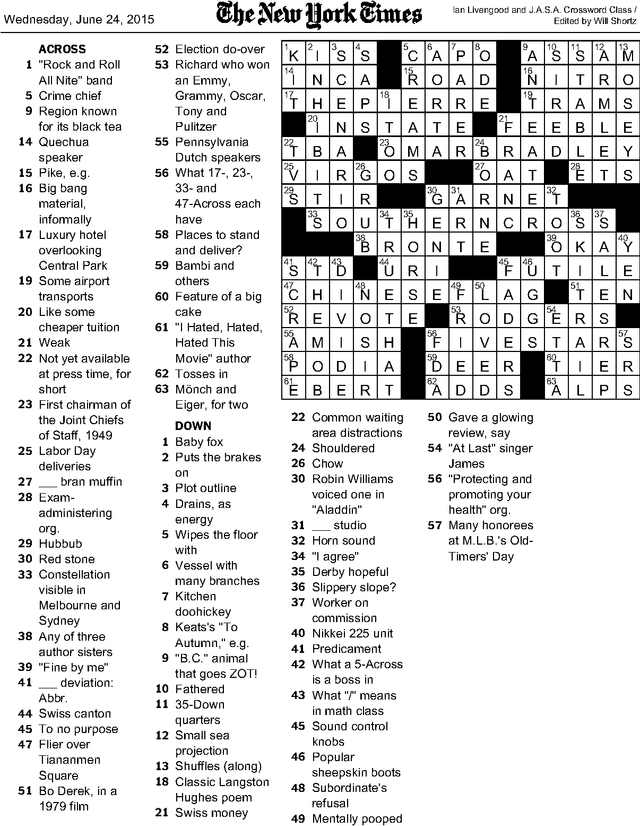
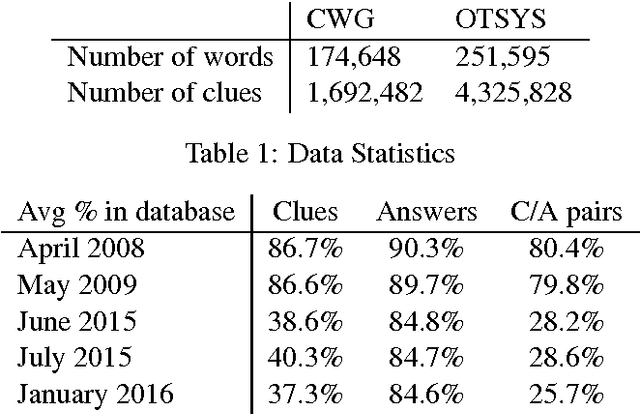
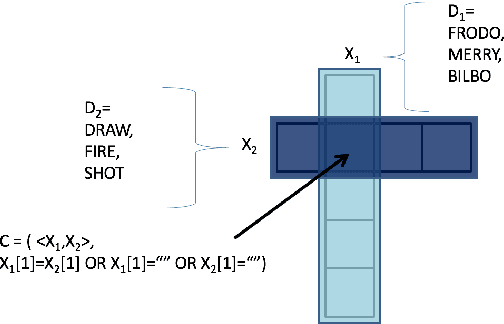
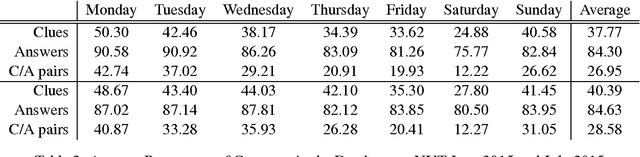
Crossword puzzles are popular word games that require not only a large vocabulary, but also a broad knowledge of topics. Answering each clue is a natural language task on its own as many clues contain nuances, puns, or counter-intuitive word definitions. Additionally, it can be extremely difficult to ascertain definitive answers without the constraints of the crossword grid itself. This task is challenging for both humans and computers. We describe here a new crossword solving system, Cruciform. We employ a group of natural language components, each of which returns a list of candidate words with scores when given a clue. These lists are used in conjunction with the fill intersections in the puzzle grid to formulate a constraint satisfaction problem, in a manner similar to the one used in the Dr. Fill system. We describe the results of several of our experiments with the system.