 Add to Chrome
 Add to Firefox
 Add to Edge
Incident-Data Robustness Analysis of the OWASP Top 10 for LLM Applications (2026): How a Community-Expert Ranking Holds Up Against a Large-Scale LLM Incident Corpus
Aug 18, 2026
The OWASP Top 10 for LLM Applications ranks the risks that a community of security practitioners judges most important. We ask a narrower question: checked against the record of real incidents, does that expert ranking agree with the data? We assembled a large-scale corpus of LLM-security incidents (7,714 snapshotted and 6,639 labeled against the 20-entry taxonomy) drawn from CVE, GHSA, OSV, and AIAAIC, and derived an incident-based ranking with a Bayesian measurement-error model that corrects each category's count for classifier precision and recall. The 2026 candidate list blends the two signals at fixed weights, 0.75 on the expert vote and 0.25 on the data, so the corpus corrects the consensus without overturning it. The agreement between the two rankings is weak: Cohen's $κ\approx 0.20$, with a 90% interval that crosses zero. The expert ranking is nonetheless robust. A pre-registered bake-off of four frontier classifiers returns no winner. None beats the incidence floor's balanced accuracy of 0.863. A ground-truth check leaves the floor's ordering (Spearman $ρ= 0.918$ against held-out truth) in place. This is an exploratory analysis by two working-group members, not the official OWASP release, and it does not supersede the official list or process.

Cruciform: Solving Crosswords with Natural Language Processing
Nov 23, 2016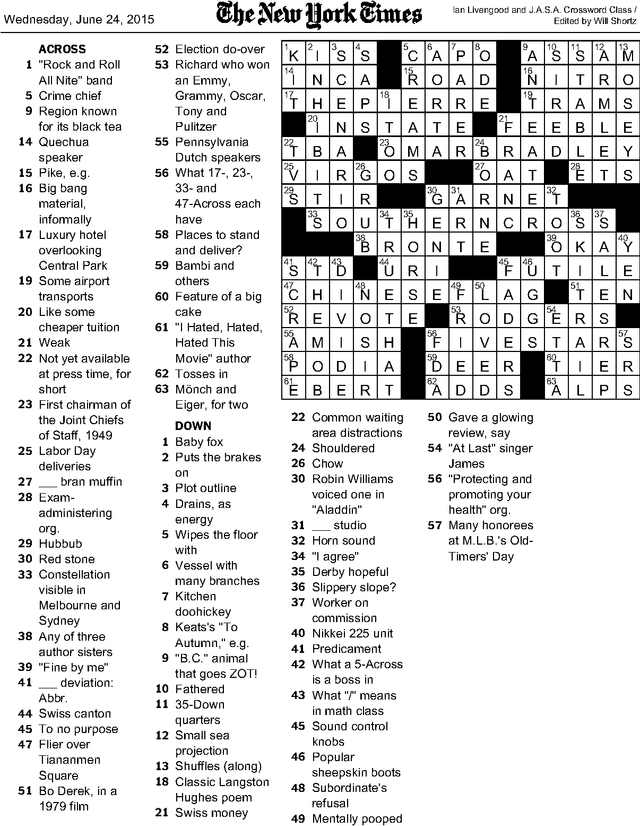
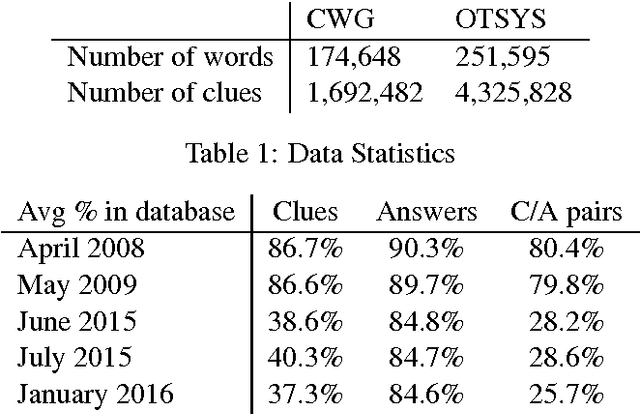
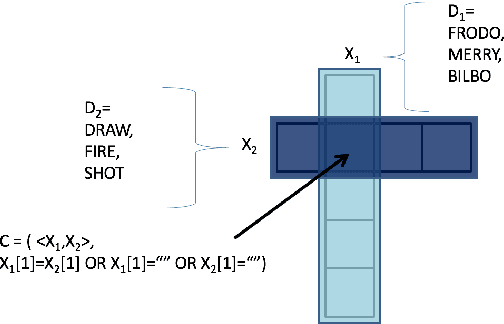
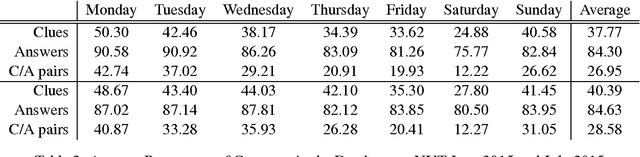
Crossword puzzles are popular word games that require not only a large vocabulary, but also a broad knowledge of topics. Answering each clue is a natural language task on its own as many clues contain nuances, puns, or counter-intuitive word definitions. Additionally, it can be extremely difficult to ascertain definitive answers without the constraints of the crossword grid itself. This task is challenging for both humans and computers. We describe here a new crossword solving system, Cruciform. We employ a group of natural language components, each of which returns a list of candidate words with scores when given a clue. These lists are used in conjunction with the fill intersections in the puzzle grid to formulate a constraint satisfaction problem, in a manner similar to the one used in the Dr. Fill system. We describe the results of several of our experiments with the system.