 Add to Chrome
 Add to Firefox
 Add to Edge
LPH-VTON: Resolving the Structure-Texture Dilemma of Virtual Try-On via Latent Process Handover
May 14, 2026
Virtual Try-On (VTON) aims to synthesize photorealistic images of garments precisely aligned with a person's body and pose. Current diffusion-based methods, however, face a fundamental trade-off between structural integrity and textural fidelity. In this paper, we formalize this challenge as a consequence of complementary inductive biases inherent in prevailing architectures: models heavily reliant on spatial constraints naturally favor geometric alignment but often suppress textures, whereas models dominated by unconstrained generative priors excel at vibrant detail rendering but are prone to structural drift. Based on this diagnosis, we propose LPH-VTON, a new synergistic framework that resolves this tension within a single, continuous denoising process. LPH-VTON strategically decomposes the generation, leveraging a structure-biased model to establish a geometrically consistent latent scaffold in the early stages, before handing over control to a texture-biased model for high-fidelity detail rendering. Extensive experiments validate our approach. Our model achieves a superior Pareto-optimal balance, establishing new benchmarks in perceptual faithfulness while maintaining highly competitive structural alignment across the standard dataset VITON-HD, proving the efficacy of temporal architectural decoupling.

Enhancing Self-Driving Segmentation in Adverse Weather Conditions: A Dual Uncertainty-Aware Training Approach to SAM Optimization
Sep 05, 2025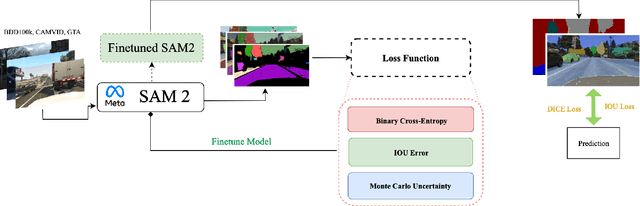
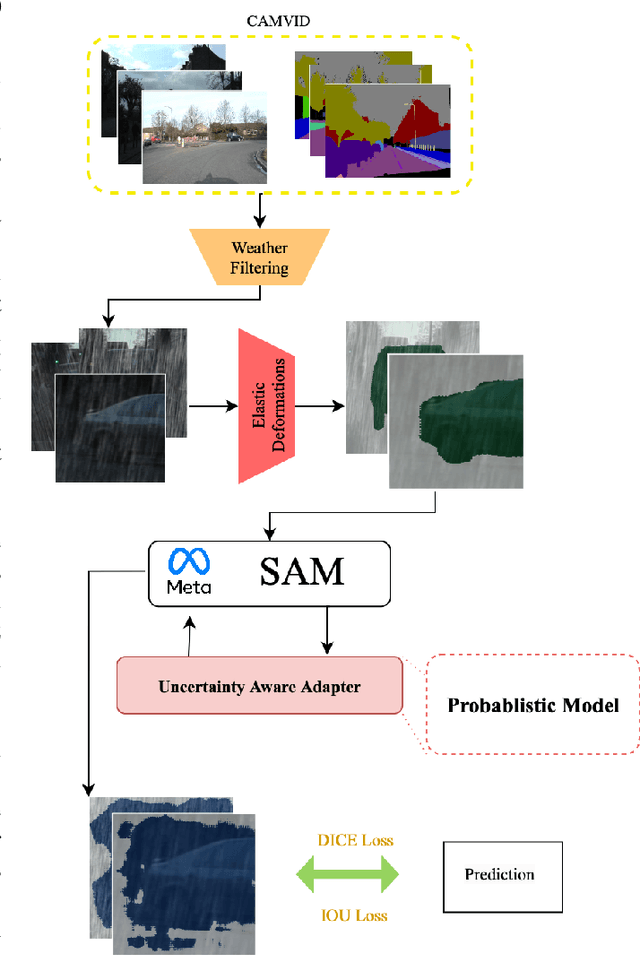
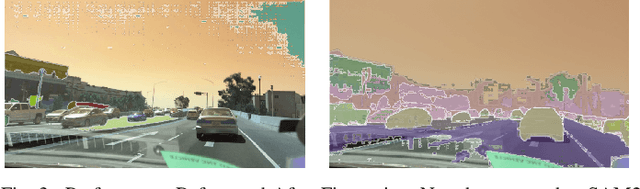
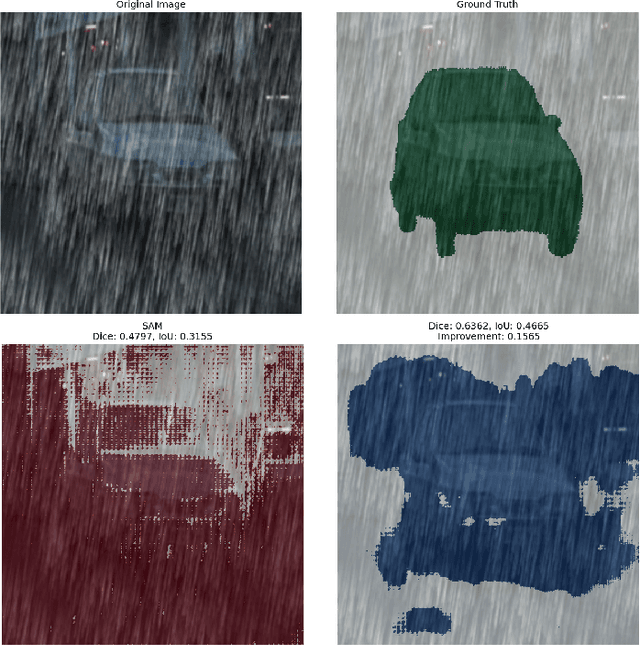
Recent advances in vision foundation models, such as the Segment Anything Model (SAM) and its successor SAM2, have achieved state-of-the-art performance on general image segmentation benchmarks. However, these models struggle in adverse weather conditions where visual ambiguity is high, largely due to their lack of uncertainty quantification. Inspired by progress in medical imaging, where uncertainty-aware training has improved reliability in ambiguous cases, we investigate two approaches to enhance segmentation robustness for autonomous driving. First, we introduce a multi-step finetuning procedure for SAM2 that incorporates uncertainty metrics directly into the loss function, improving overall scene recognition. Second, we adapt the Uncertainty-Aware Adapter (UAT), originally designed for medical image segmentation, to driving contexts. We evaluate both methods on CamVid, BDD100K, and GTA driving datasets. Experiments show that UAT-SAM outperforms standard SAM in extreme weather, while SAM2 with uncertainty-aware loss achieves improved performance across diverse driving scenes. These findings underscore the value of explicit uncertainty modeling for safety-critical autonomous driving in challenging environments.