 Add to Chrome
 Add to Firefox
 Add to Edge
Neural Scaling Universality: If Exponents Are Fixed, Time to Understand Coefficients
Jun 23, 2026
Neural scaling laws describe how pre-training loss decays as power laws with training time, model size, and compute. This position paper argues that the exponents of these power laws are fixed by generic mechanisms: a one-third time scaling due to the strong nonlinearity of Softmax, an inverse width scaling due to representational superposition, and an inverse depth scaling due to ensemble averaging of Transformer layers. These mechanisms are robust to a wide range of data structures and architectural details, placing current large language models in a universality class with fixed exponents. The coefficients, however, are expected to be sensitive to data and architecture details, and directly determine practical quantities such as the optimal model shape and the compute-optimal frontier. We therefore argue that understanding the coefficients is the key to near-term performance improvements, and that a closer examination of the current universality class may reveal pathways to better universality classes.

Everything at Every Scale: Scale-Invariant Diffusion with Continuous Super-Resolution
May 25, 2026Creating images from noise is image generation; reconstructing fine details from coarse inputs is super-resolution. Despite their practical differences, both can be understood as reversing information loss across scales. We introduce $\textbf{SKILD}$, a $\textbf{S}$cale-invariant $\textbf{K}$-Space $\textbf{I}$mage $\textbf{L}$earning $\textbf{D}$iffusion model that unifies generation and continuous super-resolution within a single unconditional framework. Both natural images and critical physical systems exhibit scale invariance, and we leverage it to design a forward process that attenuates image content from fine to coarse scales while injecting spectrum-matched Gaussian noise, making scale an explicit coordinate of the diffusion dynamics. The same trained reverse process performs generation and continuous super-resolution by varying only the starting timestep: $\textit{no task-specific architecture, no conditioning branch, no classifier-free guidance, no retraining per scale factor}$. Empirically, SKILD reaches FID $2.65$ and Inception Score $9.63$ on unconditional CIFAR-10, performs $2\times$--$8\times$ super-resolution on ImageNet from a single unconditional checkpoint while outperforming conditional models across perceptual metrics, and reconstructs critical Ising models whose connected four-point correlations closely track the ground truth.
Inverse Depth Scaling From Most Layers Being Similar
Feb 05, 2026Neural scaling laws relate loss to model size in large language models (LLMs), yet depth and width may contribute to performance differently, requiring more detailed studies. Here, we quantify how depth affects loss via analysis of LLMs and toy residual networks. We find loss scales inversely proportional to depth in LLMs, probably due to functionally similar layers reducing error through ensemble averaging rather than compositional learning or discretizing smooth dynamics. This regime is inefficient yet robust and may arise from the architectural bias of residual networks and target functions incompatible with smooth dynamics. The findings suggest that improving LLM efficiency may require architectural innovations to encourage compositional use of depth.
Universal One-third Time Scaling in Learning Peaked Distributions
Feb 03, 2026Training large language models (LLMs) is computationally expensive, partly because the loss exhibits slow power-law convergence whose origin remains debatable. Through systematic analysis of toy models and empirical evaluation of LLMs, we show that this behavior can arise intrinsically from the use of softmax and cross-entropy. When learning peaked probability distributions, e.g., next-token distributions, these components yield power-law vanishing losses and gradients, creating a fundamental optimization bottleneck. This ultimately leads to power-law time scaling of the loss with a universal exponent of $1/3$. Our results provide a mechanistic explanation for observed neural scaling and suggest new directions for improving LLM training efficiency.
Superposition unifies power-law training dynamics
Feb 01, 2026We investigate the role of feature superposition in the emergence of power-law training dynamics using a teacher-student framework. We first derive an analytic theory for training without superposition, establishing that the power-law training exponent depends on both the input data statistics and channel importance. Remarkably, we discover that a superposition bottleneck induces a transition to a universal power-law exponent of $\sim 1$, independent of data and channel statistics. This one over time training with superposition represents an up to tenfold acceleration compared to the purely sequential learning that takes place in the absence of superposition. Our finding that superposition leads to rapid training with a data-independent power law exponent may have important implications for a wide range of neural networks that employ superposition, including production-scale large language models.
The Blessing of Dimensionality in LLM Fine-tuning: A Variance-Curvature Perspective
Jan 30, 2026Weight-perturbation evolution strategies (ES) can fine-tune billion-parameter language models with surprisingly small populations (e.g., $N\!\approx\!30$), contradicting classical zeroth-order curse-of-dimensionality intuition. We also observe a second seemingly separate phenomenon: under fixed hyperparameters, the stochastic fine-tuning reward often rises, peaks, and then degrades in both ES and GRPO. We argue that both effects reflect a shared geometric property of fine-tuning landscapes: they are low-dimensional in curvature. A small set of high-curvature dimensions dominates improvement, producing (i) heterogeneous time scales that yield rise-then-decay under fixed stochasticity, as captured by a minimal quadratic stochastic-ascent model, and (ii) degenerate improving updates, where many random perturbations share similar components along these directions. Using ES as a geometric probe on fine-tuning reward landscapes of GSM8K, ARC-C, and WinoGrande across Qwen2.5-Instruct models (0.5B--7B), we show that reward-improving perturbations remain empirically accessible with small populations across scales. Together, these results reconcile ES scalability with non-monotonic training dynamics and suggest that high-dimensional fine-tuning may admit a broader class of viable optimization methods than worst-case theory implies.
Estimating the Empowerment of Language Model Agents
Sep 26, 2025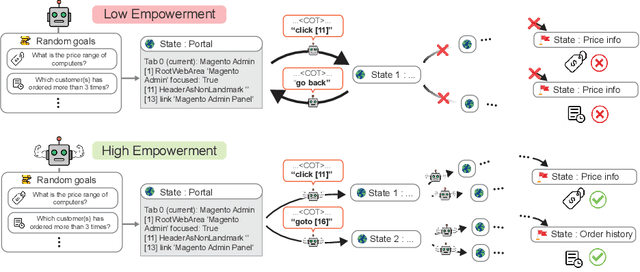
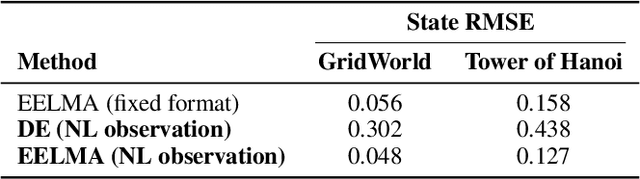
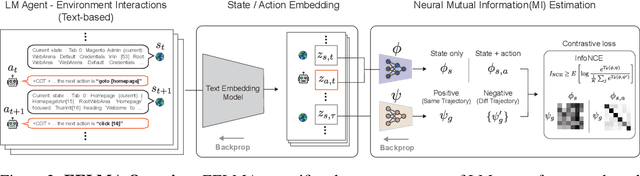
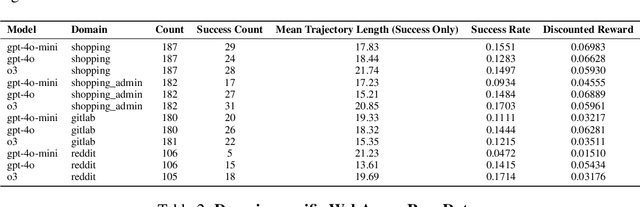
As language model (LM) agents become more capable and gain broader access to real-world tools, there is a growing need for scalable evaluation frameworks of agentic capability. However, conventional benchmark-centric evaluations are costly to design and require human designers to come up with valid tasks that translate into insights about general model capabilities. In this work, we propose information-theoretic evaluation based on empowerment, the mutual information between an agent's actions and future states, as an open-ended method for evaluating LM agents. We introduce EELMA (Estimating Empowerment of Language Model Agents), an algorithm for approximating effective empowerment from multi-turn text interactions. We validate EELMA on both language games and scaled-up realistic web-browsing scenarios. We find that empowerment strongly correlates with average task performance, characterize the impact of environmental complexity and agentic factors such as chain-of-thought, model scale, and memory length on estimated empowerment, and that high empowerment states and actions are often pivotal moments for general capabilities. Together, these results demonstrate empowerment as an appealing general-purpose metric for evaluating and monitoring LM agents in complex, open-ended settings.
Superposition Yields Robust Neural Scaling
May 15, 2025The success of today's large language models (LLMs) depends on the observation that larger models perform better. However, the origin of this neural scaling law -- the finding that loss decreases as a power law with model size -- remains unclear. Starting from two empirical principles -- that LLMs represent more things than the model dimensions (widths) they have (i.e., representations are superposed), and that words or concepts in language occur with varying frequencies -- we constructed a toy model to study the loss scaling with model size. We found that when superposition is weak, meaning only the most frequent features are represented without interference, the scaling of loss with model size depends on the underlying feature frequency; if feature frequencies follow a power law, so does the loss. In contrast, under strong superposition, where all features are represented but overlap with each other, the loss becomes inversely proportional to the model dimension across a wide range of feature frequency distributions. This robust scaling behavior is explained geometrically: when many more vectors are packed into a lower dimensional space, the interference (squared overlaps) between vectors scales inversely with that dimension. We then analyzed four families of open-sourced LLMs and found that they exhibit strong superposition and quantitatively match the predictions of our toy model. The Chinchilla scaling law turned out to also agree with our results. We conclude that representation superposition is an important mechanism underlying the observed neural scaling laws. We anticipate that these insights will inspire new training strategies and model architectures to achieve better performance with less computation and fewer parameters.
Neural Thermodynamic Laws for Large Language Model Training
May 15, 2025Beyond neural scaling laws, little is known about the laws underlying large language models (LLMs). We introduce Neural Thermodynamic Laws (NTL) -- a new framework that offers fresh insights into LLM training dynamics. On the theoretical side, we demonstrate that key thermodynamic quantities (e.g., temperature, entropy, heat capacity, thermal conduction) and classical thermodynamic principles (e.g., the three laws of thermodynamics and the equipartition theorem) naturally emerge under river-valley loss landscape assumptions. On the practical side, this scientific perspective yields intuitive guidelines for designing learning rate schedules.
Physics of Skill Learning
Jan 21, 2025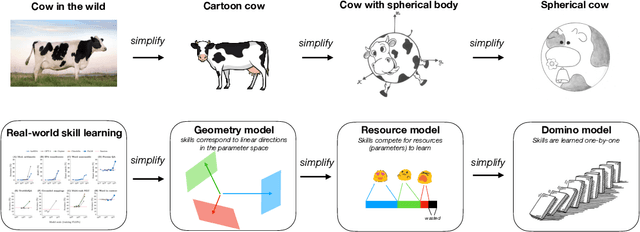
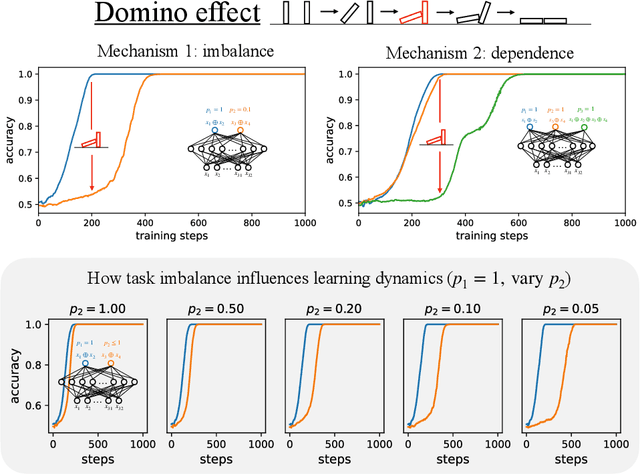
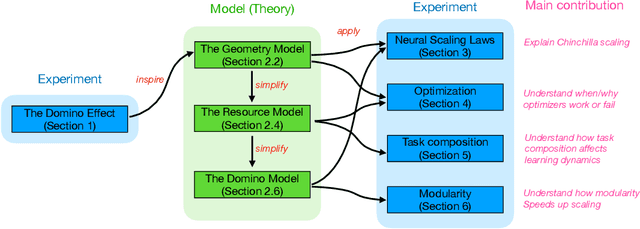
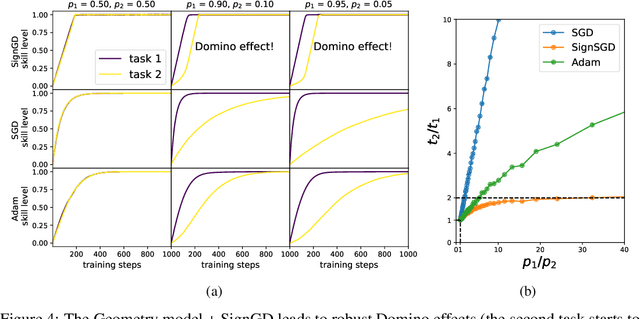
We aim to understand physics of skill learning, i.e., how skills are learned in neural networks during training. We start by observing the Domino effect, i.e., skills are learned sequentially, and notably, some skills kick off learning right after others complete learning, similar to the sequential fall of domino cards. To understand the Domino effect and relevant behaviors of skill learning, we take physicists' approach of abstraction and simplification. We propose three models with varying complexities -- the Geometry model, the Resource model, and the Domino model, trading between reality and simplicity. The Domino effect can be reproduced in the Geometry model, whose resource interpretation inspires the Resource model, which can be further simplified to the Domino model. These models present different levels of abstraction and simplification; each is useful to study some aspects of skill learning. The Geometry model provides interesting insights into neural scaling laws and optimizers; the Resource model sheds light on the learning dynamics of compositional tasks; the Domino model reveals the benefits of modularity. These models are not only conceptually interesting -- e.g., we show how Chinchilla scaling laws can emerge from the Geometry model, but also are useful in practice by inspiring algorithmic development -- e.g., we show how simple algorithmic changes, motivated by these toy models, can speed up the training of deep learning models.