 Add to Chrome
 Add to Firefox
 Add to Edge
SABER-Math: Automated Benchmark for Information Retrieval Evaluation in Mathematics
Jun 29, 2026
As agentic AI systems tackle more complex mathematical tasks, they increasingly rely on information retrieval (IR) to search problem databases, theorem libraries, and educational resources. However, choosing the right retriever remains difficult, as it is infeasible to directly isolate its effect on downstream performance. On the other hand, existing retrieval-specific benchmarks often fail to capture fine-grained mathematical relevance, penalizing relevant documents. We address this gap by introducing SABER-Math, the first fully automated benchmark for evaluating mathematical IR without expert annotation. Starting from 283K high-school-level math problems with solutions, SABER-Math builds challenging reranking tasks in three steps: (i) first, LLMs extract concise solution summaries and mathematical topics for each problem; (ii) then, per-query relevant documents are discovered using ontology topic-based and lexical solutions-summary-based similarities, and (iii) finally, a Swiss-style LLM preference tournament produces fine-grained relevance ratings for the documents. We evaluate lexical retrievers, specialized mathematical retrieval systems, and recent embedding models. We find that while modern embedding models substantially outperform classical and math-specific baselines, even the strongest systems struggle in symbol-heavy domains like Algebra and Calculus. Importantly, we show that general-purpose IR benchmarks such as MTEB do not reliably predict mathematical performance, especially for recent embedding models, highlighting the need for math-specific retrieval benchmarks.

Proof or Bluff? Evaluating LLMs on 2025 USA Math Olympiad
Mar 27, 2025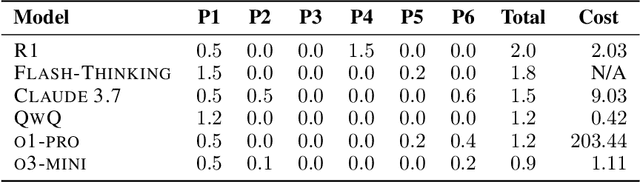
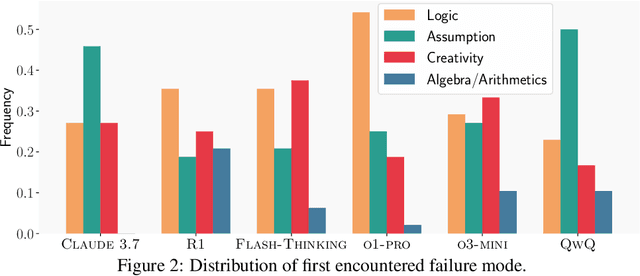
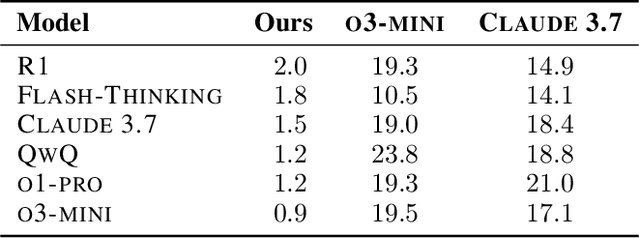
Recent math benchmarks for large language models (LLMs) such as MathArena indicate that state-of-the-art reasoning models achieve impressive performance on mathematical competitions like AIME, with the leading model, o3-mini, achieving scores comparable to top human competitors. However, these benchmarks evaluate models solely based on final numerical answers, neglecting rigorous reasoning and proof generation which are essential for real-world mathematical tasks. To address this, we introduce the first comprehensive evaluation of full-solution reasoning for challenging mathematical problems. Using expert human annotators, we evaluated several state-of-the-art reasoning models on the six problems from the 2025 USAMO within hours of their release. Our results reveal that all tested models struggled significantly, achieving less than 5% on average. Through detailed analysis of reasoning traces, we identify the most common failure modes and find several unwanted artifacts arising from the optimization strategies employed during model training. Overall, our results suggest that current LLMs are inadequate for rigorous mathematical reasoning tasks, highlighting the need for substantial improvements in reasoning and proof generation capabilities.
GRAIN: Exact Graph Reconstruction from Gradients
Mar 03, 2025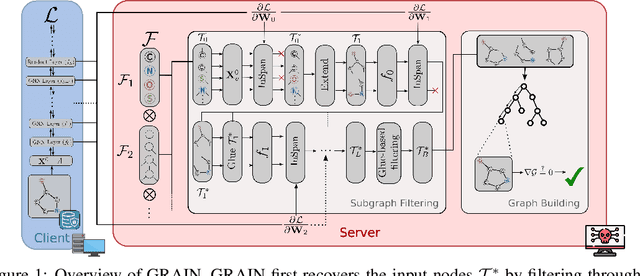
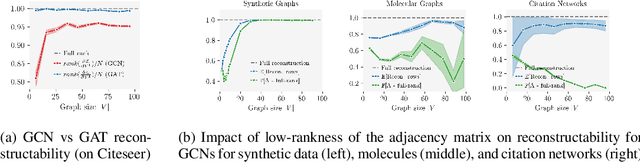
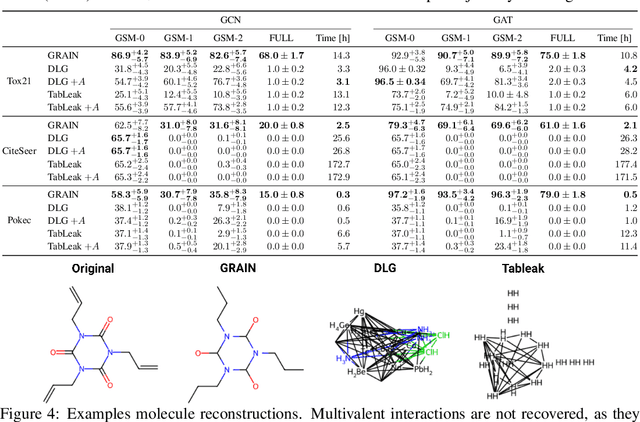
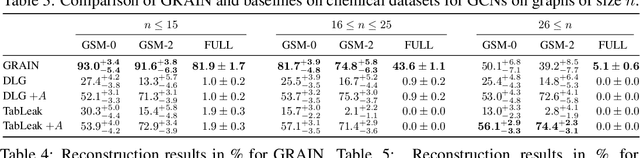
Federated learning claims to enable collaborative model training among multiple clients with data privacy by transmitting gradient updates instead of the actual client data. However, recent studies have shown the client privacy is still at risk due to the, so called, gradient inversion attacks which can precisely reconstruct clients' text and image data from the shared gradient updates. While these attacks demonstrate severe privacy risks for certain domains and architectures, the vulnerability of other commonly-used data types, such as graph-structured data, remain under-explored. To bridge this gap, we present GRAIN, the first exact gradient inversion attack on graph data in the honest-but-curious setting that recovers both the structure of the graph and the associated node features. Concretely, we focus on Graph Convolutional Networks (GCN) and Graph Attention Networks (GAT) -- two of the most widely used frameworks for learning on graphs. Our method first utilizes the low-rank structure of GNN gradients to efficiently reconstruct and filter the client subgraphs which are then joined to complete the input graph. We evaluate our approach on molecular, citation, and social network datasets using our novel metric. We show that GRAIN reconstructs up to 80% of all graphs exactly, significantly outperforming the baseline, which achieves up to 20% correctly positioned nodes.