 Add to Chrome
 Add to Firefox
 Add to Edge
Jiao: Bridging Isolation and Customization in Mixed Criticality Robotics
May 05, 2026
Consumer robotics demands consolidation of safety-critical control, perception pipelines, and user applications on shared multicore platforms. While static partitioning hypervisors provide hardware-enforced isolation, directly transplanting automotive architectures encounters an expertise asymmetry problem in which end-users modifying robot behavior lack the systems knowledge that platform developers possess. We present an architecture addressing this challenge through three integrated components. A Safe IO Cell provides hardware-level override capability. A Parameter Synchronization Service encapsulates cross-domain complexity. A Safety Communication Layer implements IEC~61508-aligned verification. Our empirical evaluation on an ARM Cortex-A55 platform demonstrates that partition isolation reduces cycle-period jitter by 84.5\% and cuts tail timing error by nearly an order of magnitude (p99 $|$jitter$|$ from 69.0\,$μ$s to 7.8\,$μ$s), eliminating all $>$50\,$μ$s~excursions.

Phantom: Constraining Generative Artificial Intelligence Models for Practical Domain Specific Peripherals Trace Synthesizing
Nov 10, 2024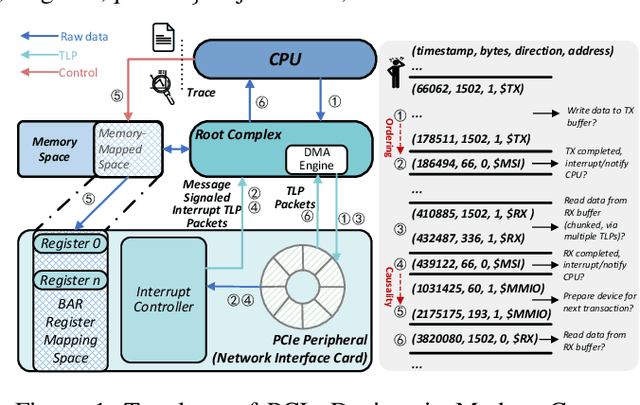
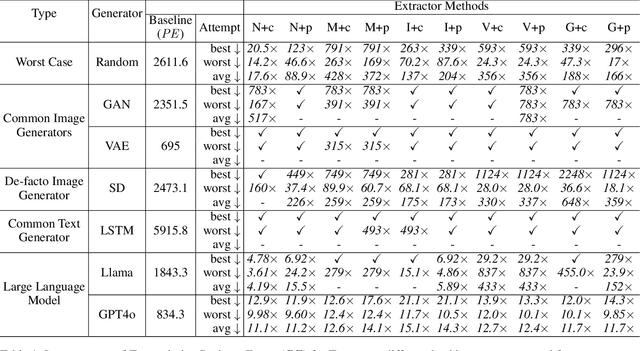

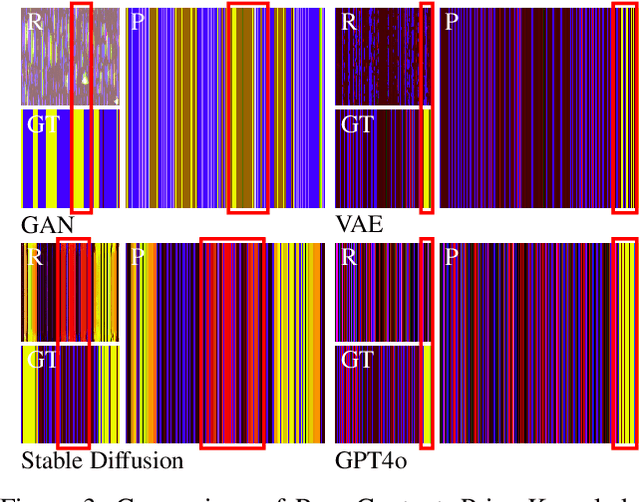
Peripheral Component Interconnect Express (PCIe) is the de facto interconnect standard for high-speed peripherals and CPUs. Prototyping and optimizing PCIe devices for emerging scenarios is an ongoing challenge. Since Transaction Layer Packets (TLPs) capture device-CPU interactions, it is crucial to analyze and generate realistic TLP traces for effective device design and optimization. Generative AI offers a promising approach for creating intricate, custom TLP traces necessary for PCIe hardware and software development. However, existing models often generate impractical traces due to the absence of PCIe-specific constraints, such as TLP ordering and causality. This paper presents Phantom, the first framework that treats TLP trace generation as a generative AI problem while incorporating PCIe-specific constraints. We validate Phantom's effectiveness by generating TLP traces for an actual PCIe network interface card. Experimental results show that Phantom produces practical, large-scale TLP traces, significantly outperforming existing models, with improvements of up to 1000$\times$ in task-specific metrics and up to 2.19$\times$ in Frechet Inception Distance (FID) compared to backbone-only methods.