 Add to Chrome
 Add to Firefox
 Add to Edge
Learning Normal Representations for Blood Biomarkers
May 18, 2026
Blood-based biomarkers underpin clinical diagnosis and management, yet their interpretation relies largely on fixed population reference intervals that ignore stable, intra-patient variability. As such, population-based interpretation can mask meaningful deviation from an individual's baseline, risking delayed disease detection. To remedy this, there have been increasing efforts to personalize blood biomarker interpretation using individual testing histories. However, these methods may overfit to sparse data, inflating false-positive rates and unnecessary follow-up, and can also unwittingly include unrecognized or subclinical disease. Here, we leverage nearly 2 billion longitudinal laboratory measurements from over 1.6 million individuals across North America, the Middle East, and East Asia, to show that while laboratory values are highly individual, purely personalized intervals routinely overfit, classifying up to 68% of measurements as abnormal, without corresponding associations with adverse clinical outcomes. We then introduce NORMA, a conditional transformer-based framework that generates reference intervals by conditioning on both a patient's history and population-level data about "normal" variation. NORMA-derived intervals achieve higher precision for predicting outcomes, including mortality, acute kidney injury, and chronic disease. These findings caution against over-personalization in laboratory medicine and demonstrate that anchoring individual trajectories to population-level priors outperforms either approach alone. To promote transparency, we publicly release the model, code, and an interactive user interface for accessible, individualized laboratory interpretation.

Accuracy of a Vision-Language Model on Challenging Medical Cases
Nov 09, 2023Background: General-purpose large language models that utilize both text and images have not been evaluated on a diverse array of challenging medical cases. Methods: Using 934 cases from the NEJM Image Challenge published between 2005 and 2023, we evaluated the accuracy of the recently released Generative Pre-trained Transformer 4 with Vision model (GPT-4V) compared to human respondents overall and stratified by question difficulty, image type, and skin tone. We further conducted a physician evaluation of GPT-4V on 69 NEJM clinicopathological conferences (CPCs). Analyses were conducted for models utilizing text alone, images alone, and both text and images. Results: GPT-4V achieved an overall accuracy of 61% (95% CI, 58 to 64%) compared to 49% (95% CI, 49 to 50%) for humans. GPT-4V outperformed humans at all levels of difficulty and disagreement, skin tones, and image types; the exception was radiographic images, where performance was equivalent between GPT-4V and human respondents. Longer, more informative captions were associated with improved performance for GPT-4V but similar performance for human respondents. GPT-4V included the correct diagnosis in its differential for 80% (95% CI, 68 to 88%) of CPCs when using text alone, compared to 58% (95% CI, 45 to 70%) of CPCs when using both images and text. Conclusions: GPT-4V outperformed human respondents on challenging medical cases and was able to synthesize information from both images and text, but performance deteriorated when images were added to highly informative text. Overall, our results suggest that multimodal AI models may be useful in medical diagnostic reasoning but that their accuracy may depend heavily on context.
Augmenting medical image classifiers with synthetic data from latent diffusion models
Aug 23, 2023


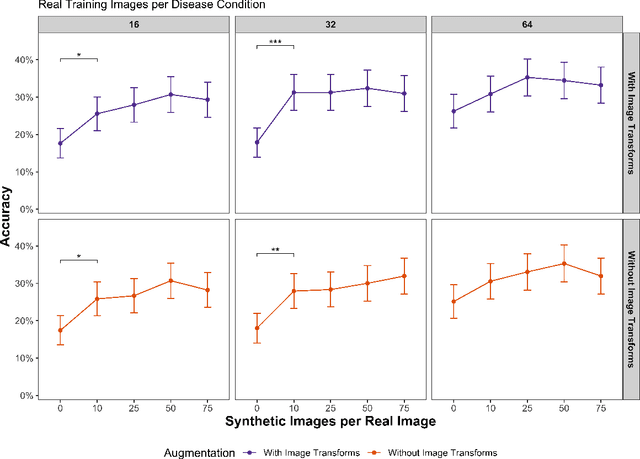
While hundreds of artificial intelligence (AI) algorithms are now approved or cleared by the US Food and Drugs Administration (FDA), many studies have shown inconsistent generalization or latent bias, particularly for underrepresented populations. Some have proposed that generative AI could reduce the need for real data, but its utility in model development remains unclear. Skin disease serves as a useful case study in synthetic image generation due to the diversity of disease appearance, particularly across the protected attribute of skin tone. Here we show that latent diffusion models can scalably generate images of skin disease and that augmenting model training with these data improves performance in data-limited settings. These performance gains saturate at synthetic-to-real image ratios above 10:1 and are substantially smaller than the gains obtained from adding real images. As part of our analysis, we generate and analyze a new dataset of 458,920 synthetic images produced using several generation strategies. Our results suggest that synthetic data could serve as a force-multiplier for model development, but the collection of diverse real-world data remains the most important step to improve medical AI algorithms.
Improving dermatology classifiers across populations using images generated by large diffusion models
Nov 23, 2022Dermatological classification algorithms developed without sufficiently diverse training data may generalize poorly across populations. While intentional data collection and annotation offer the best means for improving representation, new computational approaches for generating training data may also aid in mitigating the effects of sampling bias. In this paper, we show that DALL$\cdot$E 2, a large-scale text-to-image diffusion model, can produce photorealistic images of skin disease across skin types. Using the Fitzpatrick 17k dataset as a benchmark, we demonstrate that augmenting training data with DALL$\cdot$E 2-generated synthetic images improves classification of skin disease overall and especially for underrepresented groups.